Imagination

Photo by Rakicevic Nenadman

Remember when you were a kid and you could run around all day with nothing but some friends and the great outdoors and the possibilities seemed limitless? What ever happened to that time? In my youth the internet did not yet exist, we watched very little television and the radio seemed to embody all the mysteries of the universe. I did not grow up with wealth and many common child distractions were out of reach until my teens, when I started to earn some money of my own. Yet I don’t feel like I missed out on much. I may have never seen Disneyland as a child or had a large collection of Star Wars toys, but I had the wilderness and freedom and my imagination.

I sometimes wonder if my own son has the same ability to make a magical world out of nothing except his mind and his environment. He often seems dependent on video games, television and direct parental interaction. He does not generally like to play outdoors and seems to only enjoy his friends in small doses. Though he is often absorbed by the desire for video entertainment and physical toys, I still see his ability to create something from nothing. It seems hard to compare my background to his since my son always has some kind of stimulation available to him. This is where I see that to him, a lack of stimulation just means not having something new. Sometimes this is what he wants, and he will retreat to his room and arrange his stuffed animals, build a blanket fort, or just lay in his bed cuddle his dog and listen to music. Other times he gets this creative drive and hunts down a toy or game he hasn’t played in months and tries something new with it. Another sign of this innate creativity is when he breaks out the Legos, or Minecraft or a sketch pad and just creates new buildings, cities or drawings for hours straight. I think that having the time to just dump hours into random creative expression is one of the key elements of sustaining creativity that we adults tend to miss out on.

It seems that, as we age, the weight of responsibility and the stress of day to day life suppresses our once active imaginations. Perhaps our adult brains see the skill as less practical and so as we stop flexing this muscle, it atrophies in favor of more pragmatic thought processes. Is there anything we can do to slow this process down or reverse it? Do we want to? What would be the cost? I feel that the ability to think outside of the box is useful in almost every scenario. If we want to be more successful, wealthy and healthy, imagination is a skill set we should definitely spend some time cultivating. As a manager, one’s problem solving ability is related to their experience and ability to creatively apply it to new situations. As a real estate investor, one may be denied financing by dozens of banks or go through several realtors who believe that a second or third property cannot be purchased with non-standard  or creative financing. Sometimes professionals are so blinded by the standard way of doing things, they are blind to the other less common options. As an athlete who wants to lose weight or eat healthy, one must often come up with creative ways to remain on track and stay disciplined when others are not supportive or temptation is around every corner.

Please do not confuse imagination and creativity with discipline and motivation. Imagination can solve problems by envisioning a solution or be the spark of inspiration for a lucrative idea. Discipline is how you follow through with these ideas and stay with them until completion. Even if you are an artist, maybe inspiration helped you make a painting, but discipline makes a career with income. If you are a writer then you know that creativity is an outline that will never be a book without discipline.

For the purpose of this post lets define imagination as your ability to solve unique problems and generate new ideas. Your brain has gone stagnant from years of the nine to five grind, cooking dinner, doing dishes, laundry, and changing diapers. Now you want some of that child-like desire for something different, something new, something that is uniquely yours. Maybe you want something more interesting for dinner, maybe you want to be more in tune with your kids, or maybe you want to creatively outsource all those household chores. Whatever your goals, I hope you find some value in the following suggestions for improving your imagination.

Reading books, especially fiction, exposes you to new worlds, ideas, and perspectives. It can stimulate your imagination by allowing you to visualize scenarios, characters, and places. I prefer fantasy and science fiction to get my fix. If I get transported somewhere for original ideas I certainly don’t want it to be in the real world. Also as a wanna-be fantasy author I feel that that genre fits my goals the best. I also find value in video games and tabletop role playing games like Dungeons and Dragons for priming that spark. Playing video games with my son is especially enlightening as he still has that random creative perspective I’m looking for that can’t really be re-created any other way. 

Carry a journal or use a digital app to jot down your thoughts, observations, and ideas throughout the day. This practice can help you notice interesting details in the world around you and induce creative thinking. This is especially handy for a prospective author or when you are the Dungeon Master for a Dungeons and Dragons group. I once saw a pair of small birds harassing a crow and jotted down this idea for incorporeal fey spirits that would possess animals so they could attack humans encroaching on their land. It’s amazing which images and ideas can trigger random thoughts. I also used to keep a journal by my bed so that I could write down my dreams and draw upon ideas from my subconscious. I seldom remember my dreams anymore and that’s just sad. It’s a sure sign of stress and a rigid lifestyle and a great reason for me to follow my own advice in this post.

Practicing Mindfulness and Meditation can help clear your mind of clutter and stress, making room for more creative thoughts. Mindfulness encourages you to notice details in your environment that you might otherwise overlook. Meditation can quiet the background noise in your mind and open you to a higher state that encourages inspired answers. Eckhart Tolle compared the perfect meditation to being in touch with an infinite intelligence that some believe is a direct connection to the divine. Check out my happiness posts for more information or better yet check out Tolle’s books like the Power of Now. Keep an open mind. I’m not even close to being a religious person, but I can attest to the practical value of effectively managing your inner voices. 

Engage with various forms of art, such as painting, music, theater, and dance. Participating in or even just appreciating different forms of artistic expression can inspire new ideas and ways of thinking. Some personal examples for me include the Black Magic Crafts YouTube channel. I was inspired by the creation of tabletop props using styrofoam and cardboard. I never did anything lucrative with it but I had fun building some environments for D&D miniatures and especially loved building some little play areas for Hot Wheels with my kiddo. Music is something I have always enjoyed listening to. Some of my favorite bands for inspirational listening include Led Zeppelin, Metallica and R.E.M. Another surprisingly inspirational activity for me as a fantasy writer was Salsa dancing. I remember when I finally became good enough to improvise moves on the fly and create my own combination instead of just a single choreographed routine. It was like this bell went off in my head and I thought ‘oh this is how sword fighting is sometimes described when two opponents are using variable forms, chaining combinations and countering each other’. I also gained a keen appreciation of footwork and balance while dancing that I never quite obtained with martial arts.

Puzzles, strategy games, and brain teasers can challenge your problem-solving skills and encourage you to think in innovative ways. In addition to a variety of video games, we also play board and card games like Risk, Settlers of Catan, Magic the Gathering and Dominion to name a few.  You never really think about how much strategy is involved in something that seems like a roll of the dice until you lose six times in a row to your wife while playing Risk. Other games help one to understand the difficulties of resource management and competition when settling a new area. I got the idea for a ‘mana-flow’ game mechanic for one of my half built role playing games from playing MTG. 

Experiencing new places, cultures, and people can broaden your perspective and inspire new ideas. If you can’t travel far, try exploring new areas in your local community. Hiking is my favorite mode of exploration. It helps to clear my mind and I can’t help but imagine myself in a fantasy setting, especially when surrounded by the towering trees and majestic vistas of Sequoia and Yosemite national parks. Exploring Japan opened my eyes to a new world of hidden temples and amazing sculpted gardens woven into the middle of towering skyscrapers in such a way that you feel transported to a new world. The multi-floored train stations with grocery stores underneath and department stores on top give one a unique appreciation for the economy of space. 

Sharing ideas and working on projects with people who have different skills and perspectives can spark creativity. Collaboration can lead to the combination of ideas in ways you might not have thought of on your own. No matter how experienced or diligent you are, other people will always be able to surprise you. Everybody brings their own experience to the table and innovation can arrive even amidst the strain of conflict. I remember leading a work group on a couple different occasions where other members brought up ideas that I thought were so stupid and wasteful it blew my mind. I had to stop and check myself, however, because these people were respected professionals, and their brains worked in such a way that to them, these were legitimate issues. I had to assess my own values in those situations. I can’t say that my overall opinions about wasting resources changed, but we compromised, and learning occurred on all fronts.

Improving your imagination is a process that involves curiosity, openness to new experiences, and the willingness to explore and experiment. By incorporating these practices into your life, you can develop a richer, more creative imagination. So travel to new places, meet new people and try different food. Experience what life has to offer and soak it up. Put yourself in the shoes of others and envision their wants and needs and how you can help them achieve their goals. Above all seek out that inner child, and learn from them.

Blender and Unreal Engine

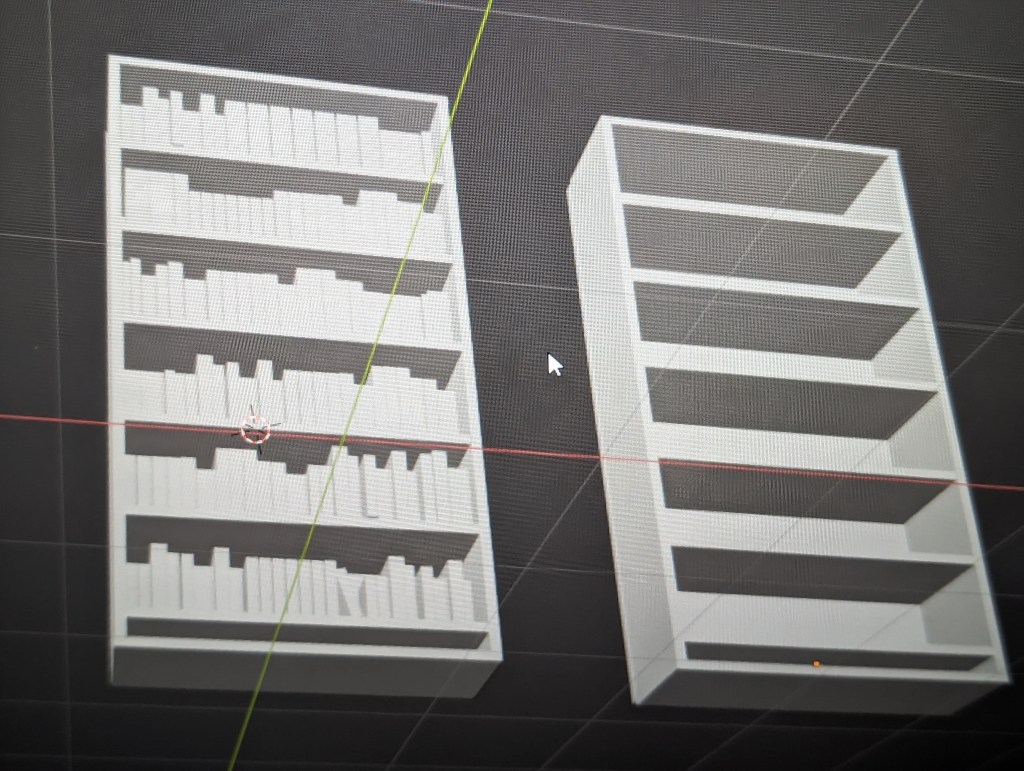
Bookcases made in Blender by me


     A friend of mine was showing me some cool stuff he was doing with Blender and Unreal Engine and it got me motivated  to get into the Blender class I bought on Udemy a while back. I made a bookcase and showed it to some friends. Someone mentioned that I could probably make a bookcase more easily using Unreal Engine. Then I thought to myself, hey, I have made a bookcase on Unreal Engine before and the comment got me wondering if it was really true that Unreal was easier than Blender, at least with respect to bookcases..

     So why am I making bookcases? This is mainly because I am a nerd who loves to collect books. I should say that I used to collect books but unfortunately, I have found it financially prudent to sell them off a couple times in my life. The first time was when Ebay first came out and I was fascinated with the auction process. I sold a bunch of books and all my old Transformer toys from the 80s. Then I bought a car, not a great car but a functional one. Why? Because I really wanted a car, and I was 22 and didn’t have one yet. The books and toys had just been sitting around at my parents house for years anyway. The second time I sold all my books involved downsizing after a career change and in preparation for a move. I was able to replace most of my old yard sale furniture with new stuff. The third time was just after moving into a new house. I had a lot of books at this point, the moving team was quite surprised at the extra workout. The new house needed about 60k in renovations, so I sold all my books except for a few special ones that were signed specifically for me by the authors. Did the books pay for all the renovations? Well no, but they covered most of it.

      So I really love books, however, it became apparent after having a kid and lots of expected and unexpected house guests over the years that rebuilding the book collection in this particular home would not be practical. For this reason one of the early projects I’d like to work on in Unreal Engine is creating a virtual man-cave where I can have all the cool gee-whiz stuff that I can’t afford and don’t have space for in real life. This shall of course include a virtual library.

     The bookcases I have built so far in Blender and Unreal Engine are not anything exciting or fancy. I am at the beginning stages of both and I am basically just joining rectangles together. I had an easier time in Unreal because I did not fill the bookcase with books and it is very easy to drag and drop a wood material onto the bookcase to color it. I still haven’t figured out how to color stuff on Blender, mostly because my class hasn’t gone there yet. However, I didn’t see an easy drag and drop option like UE.

     During the process I learned that materials on Unreal Engine do not always drop on at the right size for some reason. With a little research I found out that I could open the material blueprint and add a texture coordinate node and attach it to the uv part of the material texture sample. Then you can adjust the  u tiling and v tiling to change the relative size of the texture. This technique may be handy for another project I’m thinking about.

     The Blender bookcase was a result of me practicing some of the stuff I had learned in the Udemy class. There was a demo where the instructor used a lot of basic shapes combined with scaling and rotation to create a little scene including a house, some trees and even some blocky cars. I followed along for a little while, but I really wanted to try a bookcase and some books. The bookcase was a simple affair of five rectangles for the main structure and a bunch of duplicated rectangles for the shelves. The books were four rectangles which included the spine, front and back cover and the pages joined together. I used scaling along the various axes to make books of different sizes, joined them and filled the shelves. This took a lot longer than expected as getting the books to all line up correctly and then aligning them on the shelves was tougher than I thought. There is probably an easier way to do it, but I didn’t know how to move the camera so I actually moved the bookshelf around a lot so I could see what I was doing. I also couldn’t figure out how to get the books to just snap to the shelves. What I did get, was a lot of practice with the hotkeys for grabbing and moving along the x,y, and z axis and switching the isometric views with the number pad. I am looking forward to making more bookcases with higher level skills.

My goal is to really leverage what I understand about this software in the next few months. It seems like Blender and UE really are like the peanut butter and jelly of game design. Blender is the cool free software that lets you sculpt, model and animate whatever you want. Then you can take these toys to Unreal Engine’s playground and create game rules and interactions around them.

World building part 2

Photo by Miquel Rosselló Calafell

In this second post on the topic of world building we’ll continue by building upon some of the ideas from the previous post and delving more into the mechanics of the game itself. As I write this, I’m debating if I want to add my own campaign world to this blog. Looking back through my notes and writing I realize that it is pretty disorganized and unbalanced. Maybe I can use my own advice and refine this world into something others might enjoy. I also have a story that is in its initial stages which relates to my campaign world and some of the prominent characters. Looking through the writing it’s obvious that some serious practice is required on my part to get back into the groove. This might be a good opportunity to get into some of that as well and maybe post some of these stories as a web serial. After reading the Wandering Inn I can’t help but be fascinated by the idea of doing nothing but writing a web novel full time in my retirement. For now, let’s jump back into the basics of world building.

Developing factions and organizations is a key strategy for enriching your world with complexity and tension. These entities, each with their own objectives, ideologies, and skills, can significantly enhance the political landscape of any setting. Identify the purpose each faction serves in your world, such as political entities, spiritual bodies, or different guilds—ranging from merchants and thieves to warriors and sorcerers. Consider their ambitions and core essence. Will they assist the players, or will they pose obstacles?

Delve into the backstory for each of your factions. Work their history into the world’s history. Highlight events that shaped the formation of your organization and describe how the repercussions of their past actions affect the players today. Include the past conflicts and political struggles and how it led to their current situation. Who are the notable members of this group? Are they a master crafter, a skilled tactician, or blessed with a silver tongue? Define the hierarchy of the group. How do they gain power or rank? What are the traditions and customs associated with the faction? Can the players become members? If so, how?

A strong faction will usually have influence over a geographical area or at least have a stronghold. Group ties will usually revolve around some sort of resource and compensation. How powerful is your group? How does the resource or area they control affect the economy and the local government? How does their combat power stack up against the local military or police force? There should be powerful stable actions to counter and balance forces that are prone to conquest and chaos. Detail the allies and enemies of the various parties and how they complement or undermine each other. Integrate quests involving the factions into game play and create drama. Players can spend half a game session discussing the ethical ramifications of helping one faction over another. It’s a great bonding experience.

If you are ambitious, have a reputation system that keeps track of the player’s standing in the various organizations. I’ve never really done this with a table top game, but I’ve seen it in a few video games. This reputation can help them gain access to new quest lines, new areas, unique items or even special abilities. If you have an artistic flare, design flags, colors, clothing and architecture that reflects the organization. Create distinction between groups by defining behavior, language differences, codes of honor, and customs.

Now that you are juggling all these factions you need to allow the players to influence them over the course of the story and be ready to accept the inevitable changes that should result. Again remember to keep good documentation for consistency and maintaining balance.

Once you have the basics of your factions outlined, enhance them with a diverse variety of characters. One of the most memorable parts of a gaming session are the interactions between the players and colorful NPCs. The game master should have a solid understanding of the backgrounds, and motivations of the supporting cast. The relationships you build between the supporting characters and players will bring more engagement with the narrative. I like to base my NPCs on people I have met before or an actor on tv, so that I have a picture in my head of what they look like, their mannerisms, clothing, ethnicity and voice. Naturally, I amplify the character, elevating them to a grander scale than what I’m familiar with, to ensure they stand out and entertain. Incorporating numerous details is beneficial, particularly with a vast array of characters, allowing for some similarities while maintaining distinct and unforgettable personas. Assign your NPCs weaknesses and drives, avoiding an excess of clichés. Detail their familial origins, socioeconomic standing, and political beliefs to add depth.

Next, we’ll delve into the mechanics of the game. This section might not resonate with those utilizing pre-existing systems, but for anyone aiming to craft something distinctively their own, there are several considerations to bear in mind. Our desire to infuse our unique touch into the world stems from our creative nature and the joy of gaming collectively. There’s a certain thrill in unleashing our imaginative chaos onto a mundane reality. However, when improvising, it’s important to be wary of potential pitfalls like disrupting the game’s balance or making commitments that are hard to fulfill.

We’ve all been there, in the middle of a cool battle when one of your players comes up with a cool idea with ambiguous rules. You don’t want to slow the flow of the game so you’re like “sure I’ll allow that.” The next thing you know it becomes an exploit that you “allowed before” and the players just bring the ceiling down on the dragon’s head instead of fighting the poor thing. The fact is, we can’t make a rule for everything, but I find that when I am directly involved in creating the mechanics, the numbers and intentions of the rules make more sense and are easier to apply in unique situations.

Developing a set of rules for a tabletop or video game can be a pain, and requires a lot of planning, work and testing. You need a framework to start with that defines what you will allow the players to do. I suggest starting with the basic Hero Quest actions like moving, attacking, and casting spells, then build out from there. Start with an objective for each action and define what the players are trying to achieve. For tabletop games, determine the sequence of actions and what players can accomplish in their turn. For MMOs you need to understand how the real time actions will be structured.

Develop a stat system for attributes that will affect gameplay, for example strength and intelligence. Create a skill system that allows balanced progression and improvement. Define the key resources such as health and mana and how they are used and replenished. Design a combat system with damage calculation, special abilities and defense resolution. Figure out how alternatives to straight combat are resolved when other skills are involved like diplomacy, stealth, and fear. There has to be dice! Decide how the deities of chance affect the gameplay.

The level progression system is the bread and butter of your mechanics. Players need to progress and get stronger in order to defeat tougher foes. Experience can be gained by defeating enemies, completing quests, or overcoming specialized challenges like disarming traps. I have been working on a class-less system for a while and it is rough. Perhaps in the future I will post some of what I have to the blog and ask for some feedback from some more mathematically inclined individuals.

Develop a (virtual) material reward system for overcoming objectives. Yes, I’m talking about that sweet loot. I have many fond memories as a high school nerd flipping to the back of the Dungeon Master’s Guide and rolling on those treasure tables. Gold and magic items, much like experience, should be balanced and earned. Your random number generation mechanism should make it very unlikely to find a plus five vorpal dancing longsword of godly might lying around in a room full of kobolds.

This marks the end of my guide to world-building, at least for the moment. My expertise predominantly resides in crafting stories and plots for tabletop games, with my experience in video game development being somewhat limited. I believe that starting with a well-developed, written world can simplify the process of creating the data structures needed in video game development. As I expand my knowledge, I’ll share more insights. I welcome your comments or suggestions, particularly from those who have experience or know someone who has successfully transitioned their tabletop game into a video game.

Happiness part 3

Photo by M. GodShepherdly

It is no secret that physical fitness and nutrition can improve overall wellness, yet so many people let it slide to the background. Maybe we just need an occasional reminder of the benefits a healthy lifestyle can provide. Not everyone is constantly aware of the need for exercise and quality food. One way to combat this is repetitive reminders. Take the time to read a few blogs every week that discuss the subject of health. Try replacing one out of five audiobooks with a fitness podcast or book. Personally, I know I need to replenish my motivation daily. A busy lifestyle and being around video gamers and people who eat mountains of junk food contribute to my loss of discipline. What are your challenges? 

There are so many positive aspects to a healthy lifestyle it’s hard to focus on just one. For today we will continue a 3 part blog on happiness and discuss how fitness and nutrition can specifically contribute directly to your well being and overall joy. Do you often feel anxious or lack confidence? Do you normally feel tired and sluggish or depressed? Do you think you need to be medicated? You can surely find a medical professional to agree with you. I’m not a fan of medication and I would like to recommend another option. Take a good look at your habits, do some reading and research and try helping yourself out with a little self discipline.

Regular physical activity increases the production of endorphins, which are often referred to as the body’s “feel-good” chemicals. Endorphins naturally improve your mood and alleviate a lot of aches and pains that can come about from just not moving around enough. I was a long distance runner for many years and even now I still like to go out for a 2 or 3 mile run when I have a chance. I can attest that the positive effects of a good run extend beyond the immediate euphoria. Running and other physical activity also release neurotransmitters which are known to reduce stress. 

As someone who has worked predominantly stressful jobs throughout his career, I can say running has been my most reliable stress relief method. As a Marine we were required to perform physical activity on a daily basis. Why are so many Marines self confident to the point of cockiness after boot camp? A big part of it is because they are in the best shape of their lives and they look good. For many people self confidence equals happiness in many applications, yet another good reason to stay in shape. As a 9-1-1 dispatcher I stopped running for a while because my sleep was all messed up from the extreme shift work. I became moody and angry, and gained 30 pounds in the first year. I started running again and wouldn’t you know things got better. My sleep became better and I lost 30 pounds in less than 2 months with the help of running and the good old Tim Ferris “slow carb” lifestyle. 

My air traffic control career has had its ups and downs corresponding with the various trials of life. Running was almost a necessity in my younger career but I guess I’ve been doing this long enough where I don’t get as stressed out at work anymore, that combined with the wife and child have helped me put on some “happy pounds”. More on this in a future blog post about the dangers of maintaining the status quo. I am after all writing this blog to motivate myself as much as you. So maybe I’m not as fit as I once was but I can still run 3 miles pretty easily and I will say that after a bad day a little run is far quicker and less expensive than a trip to the bar.

Another positive aspect of the physical activity that I experience with running is a certain increase in mental resilience. In my current job I’m required to maintain a high level of focus making a lot of quick and successive time based decisions, kind of like your favorite 6v6 high stakes pvp video game match or being a raid leader with a bunch of noobs. Actually my job is more like playing 3 dimensional tetris where all the pieces move at different speeds and there is at least a 5 percent chance that a piece will do something completely random and unexpected.  It is more stressful than a video game, however, because there are real people and real danger involved and everything I do is highly scrutinized. So I am very aware of when my mental reflexes start to fall off even slightly. I notice it with every passing year. I notice it if I eat too many carbs, don’t get enough sleep or drink poor quality coffee. Poor quality coffee for those who don’t know is coffee or espresso that has been defiled by sugar and dairy. I am very aware of the increased mental acuity after a workout. I am also aware of the increased mental endurance of someone who has practiced consistent physical endurance. 

Eating a healthy diet follows as a catalyst to a happy lifestyle. A good diet gives you the energy to workout. Getting enough omega-3, vitamin d, and antioxidants have been associated with reducing depression. It is hard to go out and run when you are depressed. Your brain needs nutrients to combat poor moods. The terrible cycle your body goes through with a bombardment of processed carbs is bound to have a negative effect on your mind.So how do you fix this? How do you get out of your funk and become a happier, more productive human being? Start with baby steps.

I’m sure you’ve heard the advice that says “go to your cabinet and throw out all the processed carbs”, prompting you to go out and buy a cart full of vegetables which will rot in the fridge while you sit on the couch and order a pizza. I know some people can pull this off, but it might also be a sure way to get a divorce from your significant other who is not quite so motivated. It might also make your kids cry, a lot. Also food costs a lot of money. My advice is start small. Make or buy a salad and incorporate it into every meal for a week. When you run out of ranch, buy some vinaigrette. When you run out of chips, buy some cheese and healthy crackers, celery and peanut butter or carrots and hummus. You get the idea. I think that normal people who try to go all hard core from the get go just end up discouraged and quit early and take longer before they try again.

Your exercise program should have a similarly slow start depending on your age and how long you’ve been out of the game. If you’ve been a couch potato for five years and you go out and run 10 miles there is a good chance your runner’s high will cause you to hurt yourself. Now you are injured and discouraged and will probably be a couch potato for another year. Try running a mile instead. Can’t do it? Try running around the block. If that is too hard try walking around the block. If that is too hard you may have a condition that needs to be addressed by a professional outside the scope of this blog. If you live in rural America and your “Block” is 12 miles around, just estimate a quarter to a half a mile to start. You can even pace back and forth in your home for 400 to 800 paces to start. Alternatively you can dance to 3 catchy pop songs. See? You have tons of options! 

Do push-ups, start with your knees on the floor if you have to. Do sit-ups or crunches if sit-ups are too hard. Increase on a weekly basis and pay attention to your body. If you are older with back and joint pain I recommend looking into yoga and tai chi. I would normally recommend starting with no more than 3 days a week in whatever you decide to do, and increasing intensity, distance and/or duration no more than 10% per week. Write down your goals and your progress. Keep track and stay accountable somehow with the diet and the exercise. I am not a trained fitness instructor but I’ve had a lot of experience instructing physical fitness. Figure that one out, the Marines know. In the Marine Corps if you are faster or more fit than everyone else that apparently automatically qualifies you to instruct 40 other people every day on how to stay fit.

All of this advice is just that, advice. If you are feeling more, go for it. If you run a mile and don’t even feel sore the next day, feel free to run 3 miles. If you walk around the block and can’t get out of bed the next morning, see a doctor. Just kidding, no seriously see a doctor. For the rest of you, with some consistency and time you will feel like a whole new person. Your mood should get better. You will look better, have more energy, more confidence and most importantly, feel happier. You will get out what you put into this. Remember there is a momentum to everything in life, and your physical and mental states are symbiotically related. Physical laziness begets mental laziness and vice versa. To combat this be aware that physical discipline begets mental discipline and the reverse is also true to the effect you can say that discipline encourages more discipline. For those of you who like to be fit, healthy, productive and wealthy: discipline begets happiness.

World Building Part 1

Photo by Konstantin Fichtner

One of the aspects of game development I have had some experience with through years of tabletop gaming is world-building. As any good dungeon master can tell you, coming up with engaging content is a lot of work, but it’s also very rewarding. It may be easier to take a module or scenario that someone else has written and adapt it to your campaign but it can feel clunky and leave you scrambling to answer the inevitable context related questions your players will come up with. I believe world-building is a crucial skill that is used in creating immersive environments in both tabletop games and video games. One of my goals is to someday take the experience I have from running hundreds of Dungeons and Dragons sessions and building my own world, and apply it while developing an MMO. Let me share with you some of the basics acquired from around the web and my own experiences and introduce the realm of world-building.

The first thing I like to start with is a map. There needs to be a physical world with some geography including mountains, forests, rivers, oceans and cities. The climate and ecosystems for each area should be considered. If it doesn’t make sense from a basic scientific perspective, for example rivers should run downhill from mountains to larger rivers and eventually to lakes and oceans, you will have to know why. If the basics like gravity and common sense are ignored, this can be ok, just be ready to explain the fantasy aspects in detail. Once you have the basics on a piece of paper or some mapping software, like Campaign Cartographer, you can pick a spot to start your adventures.

Before getting into your story, think about the theme and genre.Is this going to be a horror, sci-fi, fantasy or all of the above type of world? Consider the technology level. Are they only a bow and arrow society? Crossbows? Guns? As you write more of the story of your world consider the history and lore and the various societies and factions that affect the scenario. Historical myths and legends that directly affect the cultural evolution of the people of your realm create more engagement from your players. Remember that the players are paying attention to see if any of this is pertinent to how they complete their quests and get their loot, so include details that are interesting and relevant, but not too long winded. Create places of interest like dungeons, castles and ruins. Have unique back stories, cunning creatures and interesting characters (NPCs) related to each one.

Think about the different societies and factions that will affect your story and the relevant gameplay. What are their beliefs, motivations, customs and political structure? In my opinion it is easier to start in a small town and work your way out. You can work to flesh out each faction week to week as the characters are introduced to them instead of doing all the work up front. You may even decide to create certain specific groups and ideals based on the needs of your players or to incite more drama between players and NPCs. Ask yourself the questions a player might ask upon entering your world. Think about the economy of your starting area and the resources that are available. What do people do for a living and what do they eat? What kind of travel is available and who do they trade with? How do the people pay for stuff, standard copper silver and gold, or something more interesting like glowing mana-infused gems? 

Taking your story to a video game requires all of your aspects to be much more fleshed out. Your map will be more detailed, thought needs to go into how characters will navigate through different biomes. You will need to have actual building designs representing particular cultural architecture. All of the narratives and subplots must be complete and ready to go in quest format, pre-written NPC conversations and lorebooks that can be found within the game world. Having a well organized setting from years of tabletop gaming can help you avoid a lot of the pitfalls of an incoherent story and have the added benefit of ready-made quests and player engagement.

Let’s dive more into creating a culture for your world. Start with creating the prominent races and setting up their interactions. Each one should have at least a basic cultural description and history. The culture should organically develop from the setting and backstory and include languages, customs, social norms, religions and political system. Figure out who is in charge, how they got there and who opposes them. Is this a Kingdom with nobility? Maybe the government is controlled by merchants or guilds or there is a council that decides everything with competition for seats. What motivates the populace? How do they earn their income? What is the education level like? Is there a class system where the rich few have the power and peasants toil away for a few coppers a day? Culture also includes things like celebrations, holidays and traditional games or sports. Finally bring out the drama. Who are the political rivals? What neighboring countries are thinking about invading? What monsters lurk in the dark fringes of civilization?

A large part of where culture comes from is a society’s history and lore. A well developed backstory including all of the critical elements will greatly enhance the playability of a game, whether it is a tabletop or a video game. This backstory should provide context and depth to your world by detailing myths, legends, historical events and influential figures like heroes and villains. These items can provide the foundation for current conflicts and plotlines within the game.

Start with how the world was created,for example was it formed by gods, some cosmic event like the big bang, or was it constructed like the Death Star or Ringworld? What are the significant events or time periods in world history? Can it be broken down into ages or eras? Sections of time can be defined by conflict, renaissance, decline, the fall of empires, natural disasters or cataclysms. Maybe a new species invaded the planet from space or emerged from the depths and forever changed the course of civilization. Don’t be afraid to get into the details of the past with major civilizations, describe how they rose to power, or how they may have declined. Explain the major beliefs and traditions and customs and how and why they may have changed over time. Develop the legendary heroes and villains of the ages and why they are remembered and feared. Definitely highlight the major conflicts, including who was allied with or backstabbed by who. 

Myths and legends can define a culture. Make sure the subject of these tales are larger than life and exciting. The adventures of these legendary figures shook the world and became exaggerated over the centuries, immortalized in literature and song. For more depth and mystery continue to develop smaller tales and legends that vary from region to region. Think of the Loch ness monster, bigfoot or the Blair witch. Introduce this lore during gameplay and try to make it relevant to the current story or lead into upcoming stories. Add intrigue by leaving some of the mysteries unexplained. Leave some story arcs open ended for updates and expansions.

Always strive for internal consistency. Make sure your lore with respect to magic or technology is compatible with the existing game mechanics. Ensure historical accuracy within your story. You don’t want to have a treasure trove of full plate armor ten thousand years old when the bronze age was only three thousand years ago. Create a reference document for all of your world’s history, culture, and myths. Try to make common knowledge accessible. In tabletop games you can provide the players with guides for their use. In video games the lore tends to be  more spread out through conversation with NPCs and the reading of lorebooks, but you can certainly have online lore encyclopedias. 

For most fantasy storylines the systems of magic are the defining shape of the gameplay and major motivator of the narrative. Creating a consistent and logical form of magic should be a top priority for any fantasy world developer. Decide where the magic comes from and what form it takes. Is it a natural force? Is it based on faith? Is it internal or external? Also consider if magic should be something everyone can learn or just for an elite few. The magic needs to have limitations like taking time, willpower, mana and or physical resources.

Having dabbled in the development of magic systems I can attest that this is one of the more demanding aspects of world building. There are a huge number of variables to consider before you can even look at balance. How many schools of magic will you allow? Having just elemental magic is relatively easy, but what about necromancy, illusion, healing or summoning? Should the system be customizable or static? Consider how much number crunching you are willing to do in a tabletop game. In a video game timing is everything with casting time, cooldowns and good old resource management. Finally decide how magic will influence the balance of power and overall culture of your world.

If you decide to go with technology or a mix of technology and magic, many of the same considerations apply. You need to define the level of technology, how available it is and how it is used. Is this technology developed or found? What is the effect on the culture? What are the ethical and societal impacts? If you have both then rules will need to be in place for how they react together. Does magic hex technology, or is full on magitech available? Again make sure you have good records for consistency and narrative alignment. No matter which system is used, playtesting will be an integral part of the process to ensure a system that flows and is in balance. 

Define the basics of your economy by establishing currency for all of the different factions. Decide what kind of economy you have, for example is it a feudal gold based system or a modern digital (credit-based) economy. This can get complex very fast so I recommend starting very general and getting more detailed as needed. Identify the key resources of your world, including minerals, metals, food, magic and technology. Decide how scarce your resources are and where each particular one comes from. Have a basic idea of the trade system including routes and import/export dynamics. In an MMO trade will most likely involve an auction house or player to player trades.

Decide how much you want the players to influence the economy. Players can have an effect through quests and missions for different traders and merchants. They can also affect the economy through the gathering of resources and crafting. Integrating the economy through gameplay will promote player engagement, especially in MMOs. Remember to take into account how events like war, natural disasters or even a large festival can affect supply and demand. These scenarios can create easy story hooks to get the players involved, like the standard “stop the bandits from stealing our stuff” story starter hook.

So, I had thought that I could put all of this world building advice into one post, but the more I write, the more stuff I think of. We’ll call this a good first post and I will add more in the future. In the meantime, remember to always run quality assurance and control on your world. Make sure to maintain balance. Magic and the economy can get out of control really fast when players discover all the loopholes you missed or through monumental and unexpected effort they crash your economy or become invincible. The idea is that your game stays fun for everybody. 

Happiness Part 2

Image by Ylanite Koppens

Going from my 20’s to my 30’s ended up being one of the most psychologically traumatic times in my life. I was nursing some pretty significant disappointments with myself and the world in general while transitioning from a stressful job as a 911 dispatcher to another stressful job as an air traffic controller, and going through a divorce at the same time. Being a dispatcher is not a job that promotes a positive outlook on life or a lot of faith in your fellow humans. Being an air traffic controller is also not easy, and training is the worst part. I’d like to say this work-related tension caused my divorce, but the truth is that it was a long time coming and my state of mind just made it happen more quickly. My epiphany was that I had spent so much time catering to other people that I had almost completely neglected what I wanted. I had lost myself and what I wanted to be and harbored a deep sadness and resentment. I needed to fix that state of mind if I wanted any real chance at inner peace. In the  hustle and bustle of our daily lives, finding true happiness can seem like a distant goal. I spent the next few years recovering, trying to figure out what went wrong, and how to prevent future unrest. I learned a few things along the way and I’d like to share them with you. I’m going to dig into how to manipulate your state of mind into something more productive, positive and overall happy. 

Negativity is a slippery slope. Once you start down that road, a path many of us were trained to follow as children, it colors everything that happens around you. I would like to suggest that you can alter your perspective through mindfulness, which is really just paying attention to how you feel and why you feel that way. Eckhart Tolle, a renowned spiritual teacher and author, emphasizes the importance of living in the present moment. In his books, “The Power of Now” and “A New Earth,” Tolle explores how embracing the present moment liberates us from the grip of negative thoughts and emotions. I found these books quite helpful in changing my emotional state for the better. I had adopted a habit of brooding about the past and ultimately wasted large amounts of time feeling sorry for myself. This was ultimately self-destructive. The idea of being in the “Now” involves being fully present in the moment, cultivating awareness,  and accepting thoughts and feelings without judgment. 

A basic example of how this works is through meditation. You have a focus while you meditate, such as your breathing, or the flame and the void, if you’re a Robert Jordan fan. As negative thoughts intrude you don’t suppress them, instead you acknowledge them and then just mentally place them outside of your focus (or into the flame) knowing that they are there but they do not affect the present moment. This draws into focus things that are affecting the present moment, and there are internal conversations that take place. This is where Tolle emphasizes the difference between your actual self and your whiny little biological self. Whiny is not his wording, I think he calls it the “pain body”. This annoying voice tells is incessant and distracting, but your true self knows what is truly important. It takes a long while to handle this noise, but trust me it eventually becomes instinctual. Once you finally overcome the past and future background static, you still have an inner self-talk that sounds like this: I have to pee, something smells bad, I’m hungry and thirsty, this floor is hard and I need a cushion, dude you can wait until I finish this 5 minute meditation! 

This may seem like it’s somewhat time intensive, it does take a while to reach the proper state, and at first it is not as easy as it sounds. Once you get some practice, however, say 2 to 3 weeks 10 to 15 minutes a day, it becomes more natural and the benefits become more apparent. You can eventually learn to center yourself quickly, which is really important in my profession. I can be on the radio talking to a dozen aircraft, feeling the panic coming on, the cold sweat, the tunnel vision, then I take a deep breath, embrace the “Now” in the moment between transmissions and immediately put myself in a better head-space. I think many people in stressful professions learn to do something like this instinctively, or they don’t last long, and the toll on their body and mind is much higher.

The idea of self-talk is something I never really considered before my low point, but I have learned to appreciate the value this tool has to offer. Anyone who is serious about self improvement is familiar with the famous book “The Power of Positive Thinking” by Dr Norman Vincent Peale, but this idea has been around since the ancient Greeks and possibly before. There are many modern versions of this “Secret” but the basics are simple enough to understand. Your thought processes are often a self-fulfilling prophecy. If you think you are destined to live in a trailer park collecting welfare checks in back woods Maine, you will likely end up there. If you deny this version of reality and decide you will live in a Southern California beach town in a million dollar condo, the new reality becomes much more likely. I consider myself to be living proof of this concept.

Positive self-talk can take many forms. You can repeat affirmations in your head over and over, write down your goals and how you will achieve them, or put a picture on your desk of a kitten looking in the mirror seeing a lion in the reflection. Doing all three of these and more will ultimately increase the effectiveness. I also find listening to positive  and inspirational music to be very effective. There is a reason why “Eye of the Tiger” is on so many workout playlists. I jokingly refer to all this stuff as self-brainwashing. In my mind that is basically what we are doing, brainwashing ourselves with the thoughts we allow most often. The fact is our brain responds to repetition and molding. If you tell yourself something consistently and repeatedly with enough conviction your subconscious will start to believe it and work behind the scenes to make it a reality. 

During my recovery years my self-talk was more affirming than goal oriented. I would say things like “I will get through this” or “I am not defined by my past mistakes”. Later, when I had recovered a bit, I got cocky and had grand affirmations like “I will be independently wealthy in 5 years.” That particular goal got derailed by reality and several other factors which I may or may not reveal in future posts. These days I am fighting the ever creeping chains of cynicism disguised as pragmatism but I still have more specific and realistic versions of goals such as “I will retire from my current job at 51 years old”, and “I will pay off my home and 2 rental properties by 60 years old.”  Accomplishing both of these are by no means a sure thing, but they are something to shoot for that will require more than me sitting on my butt and coasting through life.

Be careful of situations that can sabotage your efforts. It is difficult to maintain a positive outlook if you are surrounded by negativity. If your friends and family are unrepentant cynics you may need to distance yourself, and a long vacation may not be enough. If you work in a job like a 911 dispatcher where no one who calls you has anything good to say, you may want to consider a new career. Dedication can overcome these challenges, however, constantly being exposed to negativity will encourage backsliding. Don’t watch the news, the networks don’t make money spreading good news. I haven’t watched it for over 20 years and I don’t feel like I’ve missed out on much. I find that my co-workers will give me a summary of current events whether I want it or not anyway. If there is something interesting I can always find a less biased, less sensationalized version of it online.

The main thing I’ve learned over the years, for myself anyhow, is that happiness takes effort. Kind of like marriage or a career, things don’t tend to trend upward without some direction and a sense of purpose. There are a plethora of tools available to anyone with the will to use them. I encourage you to read, listen, talk and educate yourself. Give meditation a try, it may not be for you, but every bit helps. Keep in mind positive thinking doesn’t imply ignoring challenges or denying reality; rather, it encourages us to focus on solutions, opportunities, and the good aspects of our experiences. I will consider posting book reviews and recommendations in the future if people are interested, until then, stay motivated, stay happy.

The Basics of Artificial Intelligence

Image by LJ

Artificial Intelligence is the development of computer systems to perform tasks that usually require a human being. These tasks include learning, reasoning, problem-solving, perception, speech recognition, and language translation. AI systems aim to mimic human cognitive functions, enabling machines to adapt and improve their performance over time. Let’s explore the different types of AI, the practical applications and overall concerns.

Narrow AI or Weak AI is designed and trained for a specific task. Unlike General AI, which would possess human-like intelligence across a broad range of activities, Narrow AI excels within a well-defined domain. This specialization makes it highly efficient and effective for particular applications.

One of the defining features of Narrow AI is its focused expertise. It is tailored to perform a specific function or solve a particular problem, whether it’s image recognition, natural language processing, or playing board games. Narrow AI operates within a limited scope, meaning it does not possess the versatility and adaptability associated with human intelligence. 

Training is a critical aspect of Narrow AI development. These systems rely on large datasets specific to their intended application to learn patterns and make predictions or decisions. The quality and diversity of the training data significantly impact the system’s performance.

Virtual personal assistants like Siri, Alexa, and Google Assistant are classic examples of Narrow AI. They excel in voice recognition, language understanding, providing information or executing specific commands. Applications that can identify objects in images or transcribe spoken words leverage Narrow AI. This technology is widely used in photo categorization, facial recognition, and voice-to-text conversion. Many online platforms use Narrow AI algorithms to analyze user behavior and preferences, offering personalized recommendations for content, products, or services. This includes streaming services, e-commerce websites, and social media platforms. The AI systems in autonomous vehicles are another example of Narrow AI. These systems are specialized in tasks like identifying obstacles, interpreting traffic signs, and making real-time decisions based on sensor data.

Strong AI, or General AI, represents the theoretical concept of artificial intelligence possessing the ability to understand, learn, and apply knowledge across a wide range of tasks at a level comparable to human intelligence. Unlike Narrow AI, which specializes in specific domains, Strong AI aims to exhibit a broad spectrum of cognitive abilities, allowing it to perform any intellectual task that a human can. The hallmark of Strong AI would be versatility. It would not be confined to a specific domain or set of tasks; instead, it could comprehend and adapt to diverse situations, displaying human-like cognitive flexibility. Strong AI would have the capacity to learn from experience and reason across various domains. It could apply knowledge gained in one area to understand and solve problems in entirely different contexts. In the realm of Strong AI, the idea of self-awareness and consciousness is considered. This implies that the AI system not only processes information and performs tasks but also has an awareness of its own existence and the ability to reflect on its experiences.

Despite the potential benefits and the intriguing concept of Strong AI, several significant challenges stand in the way of its realization. Replicating human-like intelligence requires a deep understanding of the complexities of human cognition, including perception, memory, reasoning, and consciousness. This understanding is still limited. As AI approaches human-level intelligence, ethical and philosophical questions arise. Issues related to consciousness, moral reasoning, and the ethical treatment of AI entities become crucial considerations. Achieving Strong AI requires immense computational power and sophisticated algorithms. The complexity of emulating human intelligence poses a substantial technological challenge that for now remains firmly in the realm of science fiction.

           Machine Learning is a subset of artificial intelligence that focuses on the development of algorithms and statistical models that enable computers to perform tasks without explicit programming. The core idea behind machine learning is to empower machines to learn from data, identify patterns, and make decisions or predictions based on that learning. It plays a pivotal role in various applications, ranging from recommendation systems to image recognition and natural language processing.

Data is the lifeblood of machine learning. ML algorithms learn from historical data, which is used to train the model. The quality, quantity, and relevance of the data directly impact the performance of the machine learning system. In supervised learning, a common type of machine learning, the algorithm learns from labeled data. The software uses input variables called features, and the goal is for the code to learn the mapping from the features and create outputs, which are known as labels. Machine learning algorithms are mathematical models that learn patterns from data. These algorithms can be categorized into various types, including linear regression, decision trees, support vector machines, and neural networks. The choice of algorithm depends on the nature of the problem and the characteristics of the data. During the training phase, the machine learning model is exposed to labeled data, and it adjusts its internal parameters to minimize the difference between its predictions and the actual labels. This process continues until the model achieves a satisfactory level of accuracy. Once trained, the model is tested on new, unseen data to evaluate its performance. 

In supervised learning, the model is trained on a labeled dataset, meaning it learns from input-output pairs. The goal is to predict the output for new, unseen inputs accurately. Unsupervised learning involves training models on unlabeled data. The algorithm discovers patterns or structures within the data without explicit guidance on the output. Reinforcement learning is centered around agents that learn to make decisions by interacting with an environment. The agent receives feedback in the form of rewards or penalties, guiding it toward optimal decision-making.

Companies like Netflix and Amazon use machine learning algorithms to analyze user preferences and recommend movies, products, or content tailored to individual tastes. Machine learning powers facial recognition systems, image classification, and speech recognition technologies. Applications range from security systems to virtual assistants. In healthcare, machine learning is used for disease prediction, medical image analysis, and personalized treatment recommendations based on patient data. Machine learning algorithms analyze financial data to make predictions about market trends, stock prices, and investment strategies. Natural Language Processing applications use machine learning to understand and generate human language. This includes chatbots, language translation, and sentiment analysis.

Machine learning models are only as good as the data they are trained on. Biases in the data can lead to biased predictions, and insufficient or low-quality data may result in inaccurate models. Some machine learning models, especially complex ones like deep neural networks, are often considered as “black boxes” because understanding how they arrive at specific decisions can be challenging. Balancing the complexity of a model is crucial. Overfitting occurs when a model learns the training data too well but struggles to generalize to new data. Underfitting occurs when a model is too simple to capture the underlying patterns in the data. Machine learning systems can inadvertently exacerbate existing biases in the training data. 

Deep Learning is a specialized subset of machine learning that revolves around the concept of artificial neural networks. It aims to emulate the human brain’s structure and functionality, allowing machines to learn and make decisions in a manner similar to how humans do. The term “deep” in deep learning refers to the use of deep neural networks with multiple layers, enabling the system to automatically learn hierarchical representations of data.

At the core of deep learning are neural networks, which are composed of layers of interconnected nodes or artificial neurons. These networks are inspired by the structure and functioning of the human brain, with each layer extracting progressively more abstract features from the input data. Deep neural networks consist of an input layer, one or more hidden layers, and an output layer. Each layer contains nodes, also known as neurons or units, which process and transform the input data. The hidden layers allow the network to learn intricate patterns and representations. Activation functions introduce non-linearities to the neural network, enabling it to learn complex relationships within the data. The connections between nodes in a neural network are defined by weights and biases. During the training process, these parameters are adjusted to minimize the difference between the predicted output and the actual output, allowing the network to learn from data. Deep learning models undergo a training process where they learn to map input data to the desired output. This involves feeding the model with labeled data, adjusting the weights and biases, and optimizing the model to make accurate predictions. 

The simplest form of deep learning architecture is Feedforward Neural Networks, where information travels from the input layer through the hidden layers to the output layer. Convolutional Neural Networks are optimized for image processing, and use convolutional layers to automatically and adaptively learn spatial hierarchies of features from input images. Just to clarify; a convolutional layer is a special layer in a computer program that looks at different parts of a picture at a time, finding specific patterns like edges or shapes to help understand what’s in the picture. Recurrent Neural Networks are more suitable for sequence data, and have connections that form directed cycles, allowing them to retain information from previous inputs in the sequence.

 Deep learning has significantly improved the accuracy of image recognition tasks, allowing systems to identify and classify objects in images. It has also revolutionized speech recognition technologies. In Natural Language Processing deep learning models are used for tasks such as language translation, sentiment analysis, and chatbots. Deep learning is applied to medical image analysis, diagnosis prediction, and drug discovery. It helps detect abnormalities in medical images and assists in personalized treatment plans. Deep learning powers perception systems in autonomous vehicles, enabling them to recognize and respond to the surrounding environment. Deep learning is employed in gaming for character animation, object recognition, and procedural content generation. It enhances the immersive experience in virtual reality environments.

Deep learning models often require large amounts of labeled data for training, and obtaining such datasets can be challenging in certain domains. Training deep neural networks can be computationally intensive, requiring powerful hardware. Understanding how deep learning models arrive at specific decisions, especially in complex architectures, remains a challenge.  

Deep Learning has emerged as a revolutionary force in the realm of artificial intelligence, enabling machines to learn intricate patterns and representations from data. As the field continues to evolve, the applications of deep learning are expanding across diverse domains, pushing the boundaries of what machines can achieve in terms of perception, understanding, and decision-making. The ongoing research and advancements in deep learning hold the promise of transforming industries and shaping the future of intelligent systems.

While AI overall brings about numerous benefits, it also poses challenges, including ethical concerns, bias in algorithms, job displacement, and the potential for misuse. As AI continues to advance, it’s crucial to address these challenges and ensure responsible development and deployment. Artificial Intelligence is a transformative force reshaping industries and societies. Understanding its basics empowers us to appreciate the positive and negative aspects of this technology. As we navigate the evolving landscape of AI, staying informed and engaged will be key to harnessing its benefits responsibly.

Why Unreal Engine

Image by Craig Adderley

So why am I trying to learn Unreal Engine? With so many great game engines out there, why this one in particular? Well, the big reason of course is that I can download it and play with it completely for free, which suits my rather slim budget quite well. Another reason is that I have some old friends in similar situations as myself who are also learning UE, which means I’m not alone. The game engine also has an impressive array of capabilities that will allow me to do just about anything I’ve ever imagined.

Nothing beats free software with a huge range of support behind it. I don’t have the time or extra cash to go to a school where I have access to expensive software. Plus, I may spend a year learning it and then decide I want to try something else. Free means there is no pressure to make an income out of this if I don’t want to. For now it’s still fun and engaging, but I’m still a newb. This is a similar line of thinking that directed my interest toward learning Blender and not Maya. 

 Unreal Engine is software developed by Epic Games, offering a myriad of capabilities including robust graphics and advanced rendering features, including high-quality visual effects, realistic lighting, and detailed textures. This enables developers to create beautiful, lifelike environments and characters. UE is a preferred choice for creating AAA titles and cutting-edge virtual reality applications. It’s relatively user-friendly and offers a wide range of built-in tools for various aspects of game development, such as level design, animation, physics simulation, and visual scripting through Blueprint. These intuitive tools streamline the development process, empowering both seasoned professionals and newcomers to bring their creative visions to life.

Unreal Engine also supports multiple platforms, including PC, consoles, mobile devices, and VR headsets. This cross-platform compatibility allows developers to create games for diverse audiences without needing a lot of extra software or resources.

Another benefit of Unreal Engine is the community support and extensive documentation. The engine boasts a large and active community of developers, fostering collaboration, sharing of knowledge, and access to numerous resources, tutorials, and forums. This support network is invaluable for developers seeking assistance, troubleshooting, or guidance during their game development journey.

Now we are back to UE’s attractive pricing model. While it used to have a royalty-based system for revenue generated from games, Epic Games now has a more friendly approach, offering royalty-free access to the engine’s full suite of tools, making it even more accessible to developers of all sizes. Of course if you make an awesome game and get a ton of money you need to pay your dues, which is fine. If I somehow manage to publish something with this engine that makes more than a million dollars, Epic is welcome to their cut.

In summary, Unreal Engine’s graphical capabilities, user-friendly interface, versatility,  support, and price point, make it an easy favorite for people like me who are starting out and exploring our options.

Happiness Part One

Image by Chris F

I find myself in a bit of an unusual position as I delve into this topic. The ideas surrounding this form of self-improvement have often struck me as cheesy and uncomfortable. However, as I’ve matured over the years, my perspective has shifted, leading me to a profound realization: happiness stands as the single most overlooked aspect of my personal development journey. I admit, I’m a bit hesitant to explore the realm of self-improvement in my writing. It’s not that I lack knowledge—I’ve delved into everything from Napoleon Hill to Tim Ferris, devouring hundreds of books on the subject. However, I’m not exactly the stereotypical ‘self-help guru.’ I don’t rise at 4 am, run 10 miles, meditate for 30 minutes, and then consume a bio-hacked breakfast. I’ve attempted that lifestyle before, but it simply doesn’t align with who I am. My approach is decidedly more moderate. Having said that, I’ll begin by sharing what I consider to be the most valuable insights from my own experiences.

It’s easy to forget that the pursuit of happiness is something we have to constantly work at. If we neglect it for too long we can slide into a spiral of negativity. Sometimes the change is so subtle we don’t even realize it’s happening until our emotions surface or someone points it out to us. The desire for true happiness is a common theme for humanity, but understanding how to cultivate and sustain it remains a challenge for many, including myself. Fortunately, there are numerous practical approaches, insights, and lifestyle changes that can contribute to nurturing our well-being.

Mindfulness, in the context of self-awareness, is often associated with meditation. This can be a powerful tool that can bring real benefits to our daily lives. I honestly think that learning this practice can bring relief from a host of psychological disorders. By practicing mindfulness, you can obtain a heightened awareness of the present moment, enabling you to better manage stress, anxiety, and negative thoughts. Exercises like focused breathing or mindful walking can gradually train the mind to stay present, fostering a sense of calm and contentment. It took me a while to take mindfulness seriously. I was in my 30’s when I read “The Power of Now” by Eckhart Tolle and it was a serious game changer. Granted I have to take a lot of what he says with a grain of salt, but the techniques and the ideas work. You should also understand that this is not as easy as it sounds. It takes time, discipline and repetition.

Cultivating gratitude is another somewhat surprising path to happiness. Taking time each day to acknowledge and appreciate the positive aspects of our lives can have a similar effect on our mental well-being. We can do this through interactions with friends and family or as part of our daily meditation by reflecting on what we are grateful for. This practice helps us appreciate what we already have. This one is still really hard for me. I think clawing my way up from the bottom has jaded my sense of what being grateful means. Like so many other things though, this is something I’m working on because I can see the value in it.

Human beings are generally social creatures, and meaningful relationships play a crucial role in our happiness. Spending quality time with friends and family, or contributing to our community can increase our happiness by improving our feeling of  belonging. As an introvert I have some difficulty with making and keeping friends, so I have relatively few really good friends. I still find joy in the creation and participation in large gatherings of familiar people. There is something about surrounding myself with positive interactions that creates a feeling of peace and satisfaction. I usually do this by feeding people. I invite them over for a barbecue, and watch them mingle and create new connections. I also recommend Meetup groups if you are single and have free time.

Another way to stay happy is by keeping engaged in challenging and inspiring activities. For me hiking is a big part of this. There is something about spending all day in the wilderness, the freedom, the independence, that keeps me mellow. The sense of accomplishment and boost to self esteem doesn’t hurt either. My other common go-to activity is video games. There is something about immersion in a sprawling fantasy world that triggers my sense of wonder and creativity. 

I believe physical health and mental well-being are thoroughly linked. Exercise, diet and sleep all combine to affect our mood and mental resilience. Engaging in physical activity releases “feel-good” hormones, and a healthy diet and proper rest contribute to a more balanced and energized state of mind. It’s been my experience that you don’t have to be a crazy work out nut to gain some substantial positive effects. A short 20-minute walk outside is enough to settle my thoughts in most cases. Controlling your diet can be tough, it takes time and money to eat well in most cases and it’s easy to cut corners and eat poor quality food. Sleep can also be challenging for some people. I used to be a terrible insomniac, only sleeping 4 or 5 hours a night. There are so many issues that contribute to poor sleeping, it’s hard to narrow down what one particular person’s issues are, and not every cure works the same for everybody. My issues were mainly a combination of future anxiety and back problems. It eventually took a combination of meditation, melatonin, a chiropractor and a tempurpedic mattress to get me mostly sorted out.

Success in happiness is a combination of a variety of factors. These factors are different for everybody. The first step is understanding that there are tried and true changes that can affect your well-being in a positive manner. By incorporating these elements into our daily lives, we can incrementally improve day by day. Learn to not look at happiness as something transient like a drug induced-high. It is a state of mind and being that can be cultivated and sustained. Start small, be patient and stick with a plan. The journey may be difficult at first, but it gets easier and I guarantee it’s worth it.

Sampling

Image by pixabay

Through the course of research and learning I am slowly discovering more of what I need to know. I can see why a background in computer science is required by many potential employers. Since I have neither the time or money to get a computer science degree at this time I am figuring out how to gain as much knowledge as possible using free or less expensive resources.

I have listened to Cyber security for Dummies and Artificial Intelligence for Dummies and I’m almost finished with Data Science for Dummies. All of these books are free on Audible. Cyber security quite frankly scares the crap out of me. It was stressful just listening to it. I think a job in that field would be too high-liability for my tastes. I’m already stuck in an industry like that and not interested in taking my chances on another. Artificial intelligence is interesting and I definitely want to learn more about it. In the end, however, I’m more interested to see how this technology can make my games better, than being on the cutting edge of development. Data science is interesting and I feel like I need to know more about it. Even though I feel pretty strong in math, a lot of the terminology they were using went over my head. It’s also such a broad topic, I feel the need to dive into some specifics.

I have also started taking some free classes including the CS50 intro to computer science from Harvard through edX. The main instructor is very engaging and easy to understand. I’m not crazy about the edX user interface or the way they keep prompting me to upgrade to an accredited version of the course. It’s still a free class with lots of good info and professional instruction so I feel like you can’t go wrong.

I started a Coursera class on machine learning and realized I was in over my head from the beginning. I have put that class on hold until I can get a little more background. My latest Udemy class on Unreal Engine RPG building is a little more C++ intensive than I had originally thought, so I may have to put it on hold as well until I can practice with visual studio some more.  This class is also a wake up call on how much space you need on your hard drive for Unreal Engine. The first part of the class had me do a modest download of 20 gigs to get started with some terrain and trees and such off Quixel Bridge. The next part of the lesson asked me to download Valley of the Ancients, which is over 200 gigs, to use some of its geologic features.  On a somewhat related note, I recently found out my internet service provider only allows so much free data per month before they start charging me extra.

I feel like I have a little more direction after listening to some audio books and dipping my toes in a few classes. As I rework my goals I will rework my blog to accommodate as needed. I am feeling energized as retirement draws closer and the new world of employment opens up. I know that my goals of a stay at home game development job are far off but I’m not discouraged yet, and believe me, there are a lot of naysayers. I’m also a pragmatic realist and have lots of backup options. An upgrade, however, is doing something that makes me happy, and that is still a goal worth shooting for.