Isubane’s Echo, Chapter 12 : A Lucrative Asset

Image by Gemini

Catwright calmed himself considerably before the meeting ended. While Seleger and Beldere negotiated for a lighter watch during the tournament, Cat’s mind wandered to what he needed to accomplish in the next few days. The tournament was now a secondary concern compared to the immediate threat to his life and freedom. The city leadership seemed to believe no one would dare repeat an attempt on him after what happened to the Obsidian Tears, but Cat was not so optimistic.

It was late by the time the four companions climbed the stairs to their chambers. There was one more task to accomplish together before they retired; they met in Seleger’s quarters, which were the largest by far.

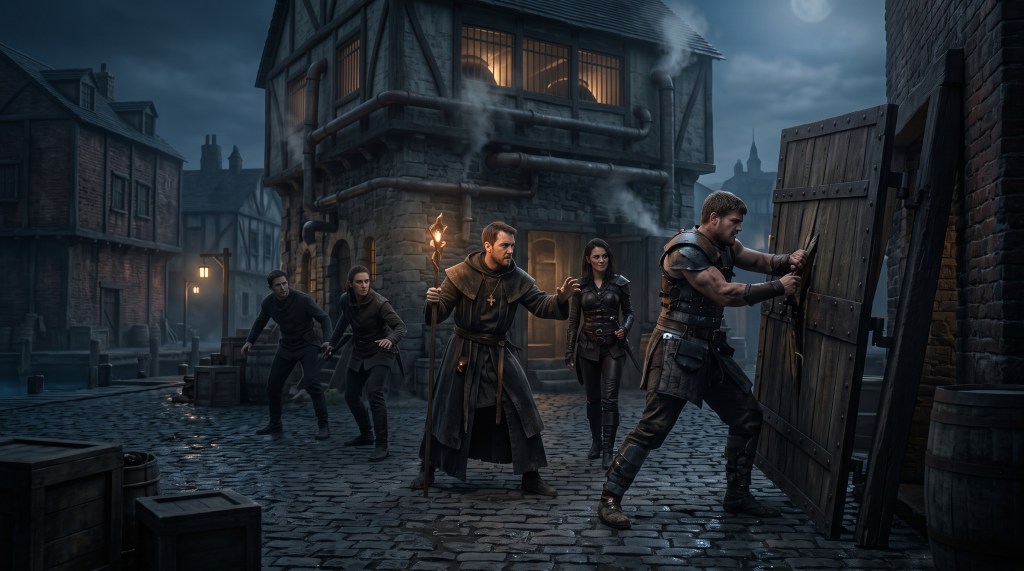
“Everyone ready?” Cat inquired, after Beldere verified no one else was in the apartment or scrying. The other three nodded solemnly as they backed into the corners of the great room. With a simple act of will, Catwright emptied the contents of his amulet’s storage space onto the floor. There was a cacophony of sound as armor, weapons, and other valuables cascaded onto the stones. Fortunately, the rooms were quite soundproof. Beldere sighed heavily, while Seleger and Chatwick grinned like children receiving Winterfest gifts.

The room was filled with weapons, armor, coins, and mundane travel gear. Cat started to realize just how difficult it would be to sort through it all. The pile of loot was almost waist-deep. “Anything hostile?” Cat asked, looking at Beldere.

“No, not that I can tell. I will ask for protection just in case.” Beldere bowed his head and murmured to his deity. Cat felt his skin thicken and his mind accelerate, his reflexes sharpening as the enhancement took hold.

The next three hours were spent sorting and counting. The boys found two large chests inside storage rings filled with coins and gems; there were also over a dozen items with significant enchantments. “We need an arcane specialist,” Seleger said, swinging an axe that Beldere indicated had a magical aura. The priest could only identify an item’s general nature and relative strength, not its specific abilities.

“Do you know one?” Chatwick asked, still energetic even as morning approached.

“No, not really.” Seleger yawned. “I know of a few, but not well enough to ask a favor like this. Identifying all this properly could be expensive. We have close to thirty thousand gold worth of gear here, but the wrong mage will overcharge us.”

“Can’t we just play with them until we figure it out?” Chatwick almost whined.

“It’s not that simple,” Seleger replied. “It can take immense resources and experimentation to find triggering words or mechanisms. Many items have hidden uses that only someone specifically versed in the field could fathom. Older items, or those created by another culture, could have completely different methods of activation.” He held up a lacquered piece of wood that Beldere said radiated “ethereal conflict.”

“This wand could do anything from shooting magic bolts to raising a force shield, or even have multiple effects. The trigger is likely some obscure word in a dead language. It could also be keyed to a specific user, meaning we could never use it without an enchanter to change the bond.” Chatwick was happy to take the older boy’s word for it, but Seleger kept going. This time, he held up a glowing blue vial. “If this were a standard Mecran military supply, this would enhance your speed. But this was taken from a mercenary company that has traveled everywhere. There are hundreds of alchemists using different recipes. The effects could last for ten seconds or ten minutes—or it could just be a fancy laxative.”

Cat stopped listening as Seleger began to explain to Chatwick that a laxative was not a sleeping potion. They needed to be up in a few hours for the tournament. He needed to talk to Gemma and perhaps hire her company; she could find information and people for him. He, personally, lacked people skills.

“It makes you poop?” Chatwick guffawed.

“…Yes.”

“And people will pay for that? Carry it around with them?”

“…Well…”

“I think it’s time we get some sleep,” Cat interrupted. “Seleger and I don’t need as much, but you have a long day ahead, Chat.”

Seleger looked thoughtful. “Now that we’re rich, maybe we can spring for some more enhancements for Chatwick.”

Cat shrugged. “Sounds good to me.” He nodded toward Beldere. “In the meantime, ask Bel for a refresh after breakfast. It should help.” The priest nodded in agreement.

The crowd for Cat’s morning workout was becoming ridiculous; at least two hundred people were straining for a look. He might have to find a new area for his routine or skip it altogether. When he finished, he tried to brush off the questions as he headed for the gate, but Lord Kagin’s grandson was insistent. He was a tall, lean boy, perhaps a year older than Catwright, and the others made way for him.

“We must arrange a time to spar!” Cat was fairly sure the boy’s name was Wendyl, but he had only heard it in passing. The noble wasn’t exactly rude, but he wouldn’t let the matter go until they confirmed a time and place.

“Are you in the tournament?” Cat asked.

“Well, of course.”

“Then I’ll see you there.” Cat walked off, leaving the young lord spluttering.

The competition started early. Competitors were already warming up for the first matches by the time Catwright, Seleger, and Chatwick arrived. Beldere was already there, being one of the few tournament-experienced healers in the city. The young priest was insistent that he be the one overseeing any matches involving Cat. Far from being annoyed, Cat was relieved that someone intimately aware of his limitations would be watching over him.

The junior sword contest was essentially a game of tag: the first to score five strikes won the round. The strikes did not need to cause damage, which greatly favored aether and aquavae fighting styles. Since anyone under twenty with basic skills could join, there was a huge range of ability. Cat mainly stayed with aether forms, dancing around his opponents until they made mistakes. He finished most matches in less than a minute and took very few hits.

Chatwick made it to the third round, which surprised and delighted him. However, he was eliminated quickly by a slim blonde girl with a saber. She disarmed him immediately and took five points before Chatwick could retrieve his weapon.

“That was pig-shit,” Chatwick said, disgusted. “She didn’t play fair.”

“Battle is seldom fair,” Catwright intoned.

“I think I’m a little bit in love,” Seleger sighed.

Seleger was eliminated in round four by a dual-saber-wielding young man who moved like the wind: Wendyl Kagin. Catwright knew they would face each other in the final bout. I guess I won’t try aether form against that one, Cat thought. It certainly didn’t work out for Seleger.

Catwright had a prodigious audience for his fourth-round match against the girl who had bested Chatwick. He wasn’t sure if the crowd was there for him or her, but it didn’t matter.

“I’m Brigit Dunancer,” she said coyly.

“Catwright,” he responded, with a barely perceptible nod. His experience with women his own age was limited. Brigit’s flirtatious look reminded him of the tactics Gemma used to distract him in their early matches at Ironwood Fort.

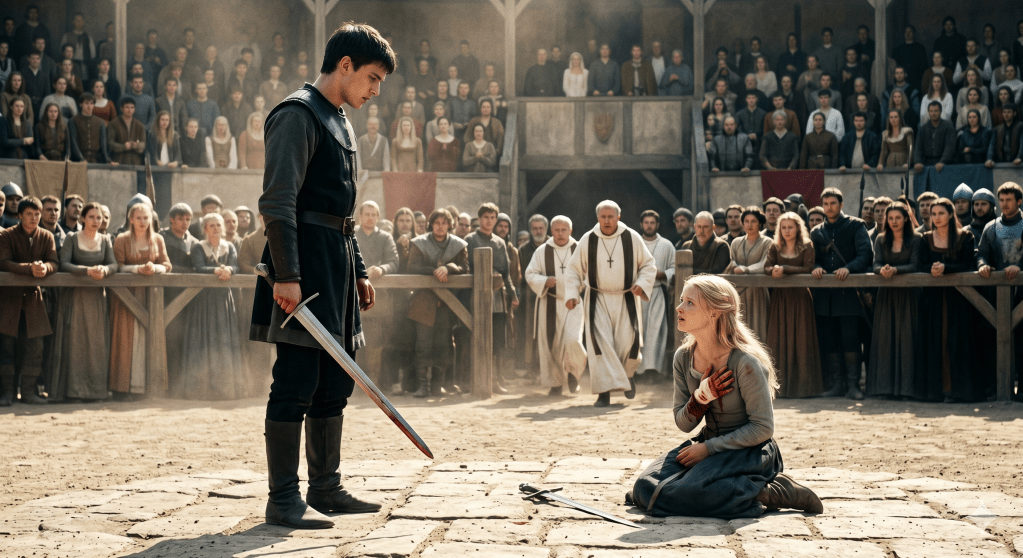
Brigit smiled brightly as the fight started. Within seconds, she overextended; Cat sliced the hand that held her saber. Blood sprayed, and the blade fell to the stones with a clatter, along with several of her fingers. He poked her four more times in rapid succession as she clutched her ruined hand to her chest. There was booing from the sidelines, then a hushed silence as he loomed over her.

Only now, after it was over, did he notice that she was pretty. She hunched down to retrieve her sword with her good hand, trying not to cry. Do not apologize, he told himself. She was an opponent. The priest will fix her hand. If she had watched him fight, she would have known her lunge wouldn’t work. He struggled with the rigid ideas that had been drilled into him: She is a woman; she will manipulate you with tears. But as she looked up, her blue eyes straining not to overflow, he realized she wasn’t manipulating him—she was in pain and humiliated. He tried to soften his expression but didn’t know what to say. “Brigit,” he said simply, inclining his head before turning away.

“Every time I think you’ve gone and become a little soft-hearted,” Seleger said wistfully, “you go and prove me foolish.”

“You didn’t have to do that for me, Cat,” Chatwick added. “You could have just beaten her the normal way.”

“I didn’t do it for you. She left herself open.”

“If that helps you slumber, big fellow,” Seleger grinned. “I think I might apologize to her on your behalf.” As expected, Seleger followed through. Brigit’s hand was already healed; Beldere had seen to it. Within two minutes, Seleger and the girl were talking amiably.

The final youth match took place an hour later. Wendyl strode into the arena, confident but not cocky. He was a lean, hard boy of seventeen, with shoulder length wavy brown hair, wielding sabers that were the work of master smiths. His movements spoke of intensive training in the air forms. “Now that you are done maiming little girls, are you ready for a real challenge?” He taunted Cat with an aristocratic sneer. It was a practiced move meant to get under his skin, but Cat saw through it. The boy was scared. Cat simply shrugged and advanced.

Wendyl danced around him, his blades a whirlwind. Cat countered with a sweeping, fire-oriented defense, hoping to knock a weapon out of the young noble’s grip, but the boy was too wise for that. Cat decided to go off-script; he lunged left in what looked like an earth-powered charge. Wendyl reacted with a predictable counter, so Cat stopped, took a half-step inside the boy’s guard, and slammed his pommel into the side of Wendyl’s head.

Wendyl collapsed in a clattering heap, unconscious, his throat nearly pierced by one of his own sabers. Catwright gave him four more shallow wounds for good measure and walked away to let the priests work.

Cat scanned the crowd, noting the dismay from a group of young female onlookers. He spotted Gemma sitting with Seleger, Chatwick, and Brigit.

Gemma grinned as he approached. “Cat, you’ve truly become the instructor now. Miss Dunancer was just telling us how much she enjoyed your lessons.” Cat glanced at Brigit, who glared at him coldly. Where had he heard that surname before? Seleger and Chatwick were chatting with a group of boys who were apparently fans of Brigit. They went silent as he approached.

“No need to be afraid!” Seleger waved his hands dramatically. “I will protect you!”

Cat ignored Brigit and filtered out Seleger’s antics. “Gemma,” Cat met the woman’s eyes, “would you walk with me?”

“I would be delighted!” she beamed. Cat swore he saw gold coins in her eyes.

“Beldere talked to you?” Cat guessed once they had escaped the japes of Seleger’s cadre.

“He did. I’m surprised you’re letting him read your thoughts. I guess slaughtering mercenaries brings you closer.”

Cat sighed. He would never be comfortable with her barbs, but he wasn’t taking the bait today. “I need to hire your company for information gathering.”

“That is what we do.” Her face turned thoughtful. “I’m guessing you don’t want the local leadership to know, and Beldere won’t help because it involves putting you in more danger.”

“You are a credit to your craft,” Cat smirked.

“You are going after the Slavers’ Guild.” Her eyes widened slightly, though she seemed more excited than afraid.

“Yes, among other things. I don’t feel like sitting around while they take shots at me. I want to know where the money is coming from, who the major players are, and any relationship to Luarca the Unseen. I also need a reliable spell-crafter and a merchant willing to work directly with me.”

“Oh, is that all?”

“It’s a start. I might need specialized reinforcements later. I know how to handle a hostile force in an enemy city, but I have little idea how to do it in a friendly one. I could get into serious trouble with the Baron before I’m done.”

Gemma grinned. “Spikey has a wager that you’ll be confined to quarters before the tournament is over.”

“He what?” Cat spluttered. “How much are you in for?”

“I wouldn’t want to sway the odds, but I know a place you can lay low if needed.”

Cat considered it. He didn’t have any real rank here, and the Mecran military was poor at gathering intelligence without druids. “I’ll keep that in mind. For now, the castle is fine, but I’d like a more private place to train.”

“I’ll look into that. We’ll start with one hundred gold for now.”

Cat pulled a sturdy leather drawstring pouch from his amulet. He concentrated for a moment as Gemma’s eyes brightened at the clinking sound. He handed over the secured bundle.

“Not even going to negotiate?” Gemma smirked. “You’re going to get taken advantage of.”

“I wouldn’t know how. Perhaps you can find me a tutor in the mysteries of money.” He shrugged. For now, the information was priceless.

“I’ll find you tomorrow after the adult matches,” Gemma said, her grin looking predatory.

The adult matches the next day were longer and more technical. By the fourth round, most competitors were fatigued, but Cat was used to training sixteen hours a day. He found the first few matches to be not much more difficult than the youth rounds because his opponents were slow and predictable.

His fourth-round opponent was Lord Cachemas Echimedes. He was fast, skilled, and patient. Cat was actually sweating by the time he scored the fifth point; Cachemas had nicked him twice.

After the match, the lord approached him. The man was handsome—late thirties, with a strong jaw and grey eyes. “How old are you, boy?”

“A season past sixteen, my lord,” Cat said.

“A mutual acquaintance informed me of your need for a mage and a merchant.”

“Yes.” Cat was surprised Gemma had worked so quickly.

“I have a son, a year older than you. He can perform both roles. He is studious, but I think he relies too heavily on magecraft. I want him to learn swordwork. He has agreed that your instruction will be the price of his services.”

“Sounds too good to be true,” Cat said suspiciously.

“My family is nobility by virtue of wealth.” Lord Echimedes explained that they were merchants with interests in most major markets. “My instincts indicate you may be a lucrative asset. Having someone close to you could be profitable. I hoped that if that person were my son, it would allay suspicions that I’m working with your enemies.”

Cat was intrigued. “You want me to let your son spy on us as payment?” Cat chuckled. “It’s not the worst proposal I’ve had this week.”

“I did some research,” Echimedes continued. “I know of your father and grandfather. I have met your mother, and I’m aware that even those close to you don’t know who she is. I’m aware of the bounties for your capture. It seems like a lot of resources to allocate toward an unknown swordsman.”

“You are remarkably well-informed. I’m willing to meet your son.” This merchant had met his mother? What else does he know?

“Please accept this.” He handed Catwright a nondescript gold band. “This ring will allow us to find and communicate with you.”

Cat handed it to the approaching Beldere for inspection. “It is as he says,” the priest confirmed. “There is also a perception enchantment on it; you won’t be allowed to wear it for your next fight.”

Should I be worried about the enchantment? Cat asked mentally.

I don’t believe so, Beldere replied. It’s most likely meant to help you hear the person on the other end with less difficulty.

“We are staying at the castle,” Cat told the Lord. “Perhaps we could arrange a meal. We’d like to meet your son before we formally agree.”

“It would be an honor.”

The final bout was against a man called Tiberius, one of Lord Kagin’s personal guards. He was an impressive man, six-and-a-half feet tall and heavily muscled. After a few failed feints, Cat realized that in a straight-up fight, Tiberius would likely kill him.

The fight wore on, and Cat realized he wasn’t going to tire the man out. He had to get dirty. Using his agility, Cat moved inside and began landing body blows. Tiberious was shocked when Cat blocked one-handed and landed solid punches with his off-hand. The punches didn’t score points, but they did damage.

Eventually, Tiberius caught on and delivered a kick to Cat’s gut that sent him spinning. Cat blocked an overhand chop just in time while recovering. As Tiberious pressed the offensive, he stepped an inch too far forward. Cat hammered the man’s left knee with a devastating side-kick. A snapping sound echoed through the arena.

A groan rose from the crowd. Cat felt the bite of a blade in his left shoulder, but he snapped two quick thrusts into the guard’s ribs as he disengaged. It was over. Tiberius had no maneuverability left.

“Would you like to yield?” Cat asked, thinking that few people would like to be slowly taken apart and humiliated while they awkwardly defended on one leg.

“I did not think you would hit so hard,” the man replied, smiling through the pain. “I appreciate the opportunity to end this without losing more dignity.” Tiberius dropped his sword and surrendered. Cat gave him a sword salute.

The Prodigy Trap: Why the FAA’s Training “Filter” is Breaking the NAS

Image by Gemini

A Quick Note: Before we dive in, I need to be clear: the following is my personal perspective based on two decades in the trenches. These opinions are mine alone and do not represent the official stance of the FAA or any other government agency. I’m speaking as a controller and a trainer, not as a spokesperson.

Twenty years ago, when I started as an Air Traffic Control Specialist, the “sink or swim” mentality wasn’t just a philosophy; it was the bedrock of our culture. Back then, the FAA’s approach resembled a high-pressure filter designed to throw candidates into the meat grinder to see who came out the other side intact. The goal was simple: find the elite “prodigies” who could handle the heat without breaking a sweat. But today, that same mentality is the very thing breaking the National Airspace System. By clinging to this archaic filter, we are burning through the talent we desperately need while leaving our complex facilities understaffed and our Certified Professional Controllers (CPCs) utterly exhausted. It’s time to stop hunting for unicorns and start building a resilient system that values stability over a few lucky stars.

The core of the problem lies in how we view the relationship between resilience and speed. In almost every other high-consequence industry, redundancy is a feature, not a bug. Yet, in ATC training, we treat “extra time” like a shameful failure. We prioritize speed above all else, weeding out anyone who doesn’t possess near-instantaneous processing power from day one. However, after training dozens of controllers, I’ve learned a secret the Agency refuses to acknowledge: a controller who takes twice as long to certify isn’t a “lower quality” controller. In many cases, they are actually superior. They tend to be more methodical and disciplined in their approach to safety. They have built the deepest muscle memory and the most stable situational awareness because they’ve seen more repetitions and worked through more “bad” days. By forcing speed, we lose people who could provide a reliable backbone for the NAS.

This lack of “Systemic Margin” is what makes our current environment so brittle. In a complex environment, Systemic Margin is the safety buffer that exists between normal operations and a total collapse. When you operate with no margin, the system is fragile—one person calling in sick, one radar failure, or one unusual weather pattern causes a total safety event. If we doubled OJT hours, especially at our level 10–12 facilities, we would finally build a shock absorber into the system. We need to accept that if a controller needs help when the sectors get saturated, it doesn’t mean they aren’t capable; it means we need more controllers to shoulder the burden. By training for volume rather than just elite proficiency, we could distribute the load across more people, ensuring safety through redundancy rather than relying on a few “superhumans” to carry the entire weight of the sky. What if you didn’t have to ask the CIC or Supervisor to be your handoff, because you already had one?

Unfortunately, we are currently trapped in a staffing death spiral. Facilities are so short-staffed that we can’t afford to pull experienced controllers off the boards to provide quality instruction. This creates a loop where the “instructional capacity” is nonexistent, and training becomes a burden rather than an investment. To break this, the FAA must professionalize the instructor role. We need Certified Professional Instructors (CPIs) who are compensated and incentivized based on trainee success rather than just “working the boards.” Right now, OJT is often just an extra chore for a tired controller. If we officially designated a career track for instructors, we would transform training from a drain on resources into a self-sustaining engine of growth. The 10-25% in the moment compensation we currently earn is just hazard pay, instructors should get a permanent hourly pay bump and get a bonus every time someone gets certified. Controllers should be competing for the right to be trainers, not hiding from the responsibility. We also need to move away from learning from instructors who haven’t worked real traffic in decades and focus on those currently in the trenches.

This shift in philosophy must also extend to the way we modernize—or fail to modernize—our technology and our hiring pipeline. The FAA’s “Flight Plan 2026” talks a big game, boasting a $22 billion investment in the Brand New Air Traffic Control System (BNATCS). On paper, it looks like progress; in reality, new tech is a hollow promise if it isn’t standardized across the board. Right now, we are asking trainees to learn facility-specific quirks on “antiquated last-millennium trash” while the Agency promises a high-tech future that usually only reaches a handful of elite facilities, leaving everyone else behind. If we want a universal training standard, we need a universal interface. New technology is only as useful as the person plugged into it, and if that person is still fighting legacy equipment that belongs in a museum, we haven’t actually moved the needle.

Furthermore, we need to address the bottleneck at the very start of the career. Secretary Duffy has streamlined the hiring process from eight steps down to five, effectively “supercharging” the influx of new bodies. But let’s be honest: flooding the facilities with a bunch of new people without the capacity to train them is just moving the pile. We are seeing record-breaking Academy classes of 600+ trainees, yet many of these people will show up at their first facility and sit around for months, or even years, waiting for a training slot that doesn’t exist. We are still relying on an Academy system that most of us recognize as a “shit test”—a hurdle that measures the ability to study general knowledge but offers little to no help when you actually step onto the floor of a high-complexity facility.

If we are serious about building up rather than weeding out, we have to rethink where the “weeding” happens. We should be expanding the Enhanced AT-CTI program to allow collegiate graduates to bypass the Academy entirely. By shifting the academic heavy lifting to the university level, we ensure that the people showing up at the facility are already fundamentally sound and ready to work traffic, not just ready to pass a multiple-choice test. At the same time, we have to get real about incentives. It takes a lot to motivate experienced controllers to leave a stable life and move to a staffing-challenged, high-stress Level 12 facility. The only people that will do it for less than 50k are the inexperienced and the desperate. For a veteran controller, that amount doesn’t even begin to cover the cost of the burnout and the increased workload they are being asked to absorb. To fix the staffing death spiral, we need real incentives that acknowledge the value of “tribal knowledge” and the sacrifice required to fix a broken facility.

Finally, we need to fundamentally overhaul our “gym.” The current 2026 budget includes funding for upgraded Tower Simulation Systems, but quite frankly, we’ve heard this song before. Most of us are still working with antiquated, last-millennium trash. We don’t need a new building or a legacy room; we need virtual reality sims and high-fidelity repetition. We need to stop using the simulator as a “final exam” designed to catch failures and start using it as a training gym where a trainee can experience a decade’s worth of emergencies and “black swan” events in a few months. For every hour of live traffic, a developmental should have two hours in a sim seeing the weird and the dangerous until their response is automatic. This would free up their mental bandwidth for the nuances of live traffic, leading to higher success rates and a much more resilient workforce. We don’t need a few elite stars to save the day; we need a solid, well-rested, and deeply trained workforce that can handle the volume of the future.

The Alternator is Always Broken

Image by Mike ‘The Eclipse’

I can’t remember if I’ve done one of these before, so here I go (again?). I have owned, rented, and leased a good variety of vehicles over my life, and I have a lot of opinions about them as a result. At different stages of my life, I have purchased for looks, engine size, and practicality. The experience is more than just driving the car; the negotiation, repairs, and drama involved in purchasing and maintaining a vehicle have contributed to some of the most emotional moments of my life. Perhaps my advice can help some of you keep from making the same mistakes.

My first car was a 1988 Buick Skylark I bought for $3,200 at a used car lot in Yuma, Arizona. It was an “old lady beige” color and had a transverse V6 engine. I bought it because one of my friend’s parents had the same car when I was a kid, and it felt nostalgic. It was 1997, and I didn’t know how to haggle or have any credit to speak of, so I took what they gave me and had my first car payment at an outrageous interest rate. I was a Marine who delivered pizza in the evenings, so I drove the hell out of that car. After 100k miles, it broke down a lot. I was in the hobby shop on base almost every other weekend fixing something on it.

It was durable, though. I was T-boned at an intersection in San Diego and was able to drive the three hours back to Yuma after pulling the fender off the wheel, even though the insurance company said it was totaled. The guy who hit me had a little Honda Civic and did not drive away. His insurance company was kind enough to give me $3,700 for the car, which was nice since it was almost paid off and the payout was more than I had paid for the car. In retrospect, it was probably a thank-you for not claiming any injury. I was working nights at Little Caesar’s, and my boss’s husband was a mechanic and auto body repair guy. For $700, he fixed my alignment, replaced the front quarter panel, repaired the cracked bumper, and repainted the car a sparkling cobalt blue. I paid the car off and had over a thousand extra in my pocket. I drove it for another two years before giving it to my future mother-in-law at the time in San Diego. She drove it for another four years before she passed away, and I eventually donated it to a charity I don’t remember.

In my quest to find a car that wouldn’t break down every other week, I decided I would get something brand new. I was a Corporal in the Marines making the big bucks, still in Yuma. After several frustrating encounters with car dealers, I settled on a 1999 Hyundai Accent on sale at the end of the year for $8,900. I found eBay that year and sold off my childhood toy collection, which paid for a good chunk of it. It still seemed expensive to me for what it was, but it was probably the most dependable car I ever owned. I delivered pizza with that car almost thirty hours a week for the next five years. I commuted every weekend from Yuma to San Diego to see my girlfriend for almost a year until I was assigned to MCAS Camp Pendleton. I was able to pack everything I owned into that little car, and it still made it over the mountains. I made a few cross-country trips in it, including going to Maine and back, and then to Iowa and back. We got a flat tire just outside of Spokane, Washington, on the way back, and I think that was the only thing that ever went wrong with it until the transmission broke just after 120,000 miles. When they told me what it would cost to replace the transmission, I gave it away to the mechanic for $300 and had my first midlife crisis.

I was working as a 911 dispatcher, which was only a couple of blocks from my house, so I didn’t really need a car. My wife at the time had just bought a new Dodge Magnum and decided that the money in savings was going toward her Lasik procedure. I tried to be understanding, but underneath I was brooding and angry. There were a variety of other issues going on, but that’s not what this post is about, so moving along. After weeks of walking and biking everywhere, something broke, and I decided I needed and deserved a new car. I was doing the eBay thing at the time because it’s hard to deliver pizza when you’re a dispatcher and don’t have a car. Our spare bedroom in our little two-bedroom condo was full of books, and I decided to liquidate them so I could buy a car. This made my wife happy, but I was in a downward spiral, auctioning off my collection for pennies on the dollar.

Shopping for the car was a hassle since I had to bike everywhere, and no one takes you seriously at a car dealership when you arrive on a bicycle. I never had a good relationship with car salesmen, but my dislike intensified greatly that summer. I finally found an internet sales representative at a Mitsubishi dealer. He let me custom order the Eclipse that I wanted: a sunburst orange, hardtop Spyder with an automatic transmission and ground effects package. It had a 3.8-liter V6 engine, sport-tuned suspension, and wide, high-speed-rated Pilot tires. It had orange leather seats and an awesome sound system with a subwoofer in the back. It took seven weeks to arrive and cost $36k. Worth every penny.

Perhaps not entirely coincidentally, I filed for divorce about six months after buying that car, and what followed were the greatest five years of my life. I visited so many national parks in that car, including Sequoia, Yosemite, Zion, Rocky Mountain, Great Smoky Mountains, and even Acadia. It was fast, comfortable, and relatively reliable. I never delivered pizza in that car, and I washed it every week. When the transmission started slipping at 120k miles, I traded it for a Hyundai Veloster, and it feels like my happiness never recovered.

The Veloster was an adequate vehicle. Hyundai was easy to work with compared to other car dealers, and I was able to complete the trade in about 90 minutes. However, the Veloster was underpowered and underwhelming compared to the Eclipse. This brings up an important point regarding car models and their packages: I rented a low-end Eclipse on a trip to Denver one time, and it was such a piece of crap it made the Veloster seem like a high-end vehicle in comparison. It’s something to keep in mind when you see two of what appear to be the same car with a $20k difference in the price tag. You get what you pay for.

The Veloster had all the bells and whistles, and everything worked well, aside from a couple of annoying features. If the car was wet and you opened the hatchback, the water would run right down into the car. The back seat was so small that someone over 5’10” would need to lean forward so their head didn’t hit the top of the hatchback. The transmission would buck if you slowed down for a stoplight and then tried to accelerate right before the car stopped. It was so bad I took the car in twice thinking something was wrong. The mechanics assured me that it “was just how the car was.” There were no major issues, but I traded it in at 120k miles for a Nissan Maxima because I wanted something with four doors for the kiddo and the car seat.

I have not had the best relationship with Nissan. The deal with the Maxima went fine, but back when I was looking—before I got the Eclipse—I had an issue. I thought my midlife crisis car was going to be a Nissan Z. I remember arriving at the dealer after an all-nighter; I worked 5 PM to 5 AM as a 911 dispatcher. I told them I wanted my payment to be under a certain amount. I had about $10k to put down (I hadn’t quite finished selling off all my eBay stuff yet) and excellent credit. I also knew they could accommodate me if they wanted to because my brother was a Toyota dealer at the time and was trying to get me to buy an ugly-ass Avalon.

The salesman kept me waiting for over 45 minutes—after I had already been there for about an hour browsing and test driving—and came back to me with a payment a hundred dollars a month more than I asked for. I told him it wasn’t going to work and began to walk off. He asked me to stop while he asked his manager if there was anything they could do. I waited around some more. Keep in mind, it was almost noon by now, I hadn’t slept since noon the day before, and I had to go to work in five hours. They came out almost 45 minutes later with an offer that was still 50 dollars more a month than I wanted. I was pissed. As I was walking away, trying not to explode into a physical altercation, they came running back out saying that the head manager could get me the deal I wanted with an even lower interest rate and two dollars a month less than what I was asking for. I would like to say that I politely declined and asked, “Where was that offer two hours ago?” but what I actually said was something more like, “Too late, fuck off and eat a bag of dicks.”

My second bad experience was after the Maxima purchase when I was looking into purchasing a Pathfinder my current wife was leasing from them. I had first looked into trading it for another new Pathfinder lease, but they were telling me they would only give me $16k when the car was worth over $20k. I thought, “Okay, I will just pay the $16k residual and keep it or sell it to someone else for $5k more.” Right from the start, there was resistance. The dealer told me I had to call the finance people, and the finance people told me I had to physically go to the dealer. It took almost a week of phone tag to work out, but they finally settled on me coming into the dealer to do the paperwork. As I was filling out the paperwork, one of the managers came up to the guy I was working with and said, “Oh, there is this new law in effect that says we have to charge you $1,000 for a post-lease inspection,” or some such nonsense. I was already pretty livid with the runaround I had dealt with all week, and this little tweak made me burn. The clerk I was working with looked embarrassed to be adding the extra fee to the paperwork, but I was making phone calls. I found a Nissan dealer 30 miles away that had never heard of this law, so I drove there and purchased the Pathfinder for $16k with no issues. I took the Pathfinder to CarMax where they valued it at $24k, then I went to Jeep, where they paid off my $16k loan and gave me $8k toward a new Jeep Grand Cherokee lease.

I purchased the Midnight Edition Nissan Maxima used with 12k miles for $22k. This was before the Pathfinder incident. The car ran well and had decent power. It was a lot easier to deal with the car seat than with the Veloster. There was an issue where my drivetrain (or something) was leaking before the warranty ran out. I took it to the dealer, and they fixed it with no issues and gave me a loaner while they did the work. However, around 120k miles, I was stranded in a parking lot because the car wouldn’t start. AAA came out, gave me a jump, and said it was just the battery. This was concerning since I knew the battery was only about six months old, but I didn’t worry about it until a week later when the car died again and left me stranded. AAA jumped me again, and I drove it to the place where I bought the battery—a mechanic I’d been using for years—and asked them to take a look at it. They did a full diagnostic and said the battery was dead, but they could find no other issues. They replaced the battery and sent me on my way. I was thinking alternator, everybody was thinking alternator, but the mechanic allegedly could not find anything wrong with it.

A week later, I was stranded again on the I-5 North in the no-man’s-land between Oceanside and San Clemente for three hours in the August heat. I had AAA tow me directly to the mechanic again and asked them to figure it out. The next day they said it was, in fact, the alternator and they could replace it for $1,500. I was already over the Maxima and appalled at the price. The place was under new management, and I should have made more noise, but I didn’t want the hassle of towing it all over town for another quote, and I couldn’t get a good trade-in for a car that wasn’t running. I paid the price and traded it in for a new Subaru Crosstrek a week later. I do not use that mechanic anymore.

The Subaru deal was the easiest car purchase I ever made. I bought a Sun Blaze Pearl (orange) Wilderness Edition thinking I was gonna be all outdoorsy. I came in with a CarMax valuation of my Maxima and told them I wanted a 3-year loan with less than 3 percent interest, $3,500 off the sticker price, and a trade-in price for the Maxima that was at least what CarMax offered. They came back with everything I asked for less than five minutes later. I know, I should have asked for more. They then sat me down with some kind of insurance salesperson who tried to sell me extra protection and features for everything. She seemed offended when I turned everything down. If I accepted even half of what she offered, it would have doubled my car payment! “What will you do,” she asked, “if you get a crack in your windshield and you have to pay $1,900 to replace it because of the sensitive cameras installed?” She didn’t really like my response, which was: “If my windshield is cracked so badly that I can’t see out the window and it can’t be patched, I will trade the car in for something else that does not have a useless camera in the window.” It turns out that this $1,900 camera does not even record video; it’s just a fancy motion sensor. After I politely told her I would not be purchasing any of the extra insurance policies and started openly questioning if I should purchase such a delicate vehicle, she finally let me go.

I should not have bought the Subaru. It is a perfectly adequate car in most ways, and I mostly got it because of the 5-star crash rating for my kiddo, thinking we would do some real backcountry camping trips. It turns out my son is not quite that adventurous. The car is heavy, and even though it is a four-cylinder, it gets worse gas mileage than my Maxima or Eclipse. My wife’s 4×4 Jeep Grand Cherokee gets better gas mileage. You cannot permanently disable the function that makes your car turn off at every light; you have to remember to push the button to turn it off every time you start the car. If you forget and end up in stop-and-go traffic—which is every day for me—the car will buck and kick because it can’t decide if it should shut off or not.

Furthermore, you can’t disable all of the collision and lane change alarms. Sometimes I like to open up and do the I-5 road slalom. There are so many alarms and bells going off it sounds like a McDonald’s kitchen at lunchtime. When I go up the hill close to my house, the “out of lane” alarm goes off every time even though I’m in the only lane available. I’ve had the collision alarm go off a few times when going to pass or change lanes, and it scared the crap out of me because I didn’t see anything, and it turns out nothing was there. When you go around corners and there are trees in the median, the front collision alarm goes off. If something heavy, or your dog, is in the passenger seat, the seat belt alarm goes off continuously until you buckle it.

Finally, when you use the proximity unlock on the driver’s door, it only unlocks the driver’s door. If you use it on the passenger door, it unlocks everything. This is an issue because at night when I open the driver’s door and try to unlock the other doors for passengers, there is no light on the door panel to show which button to push, so I have to get out my phone flashlight to look. As soon as you start the car, however, the door panel lights up so you can see the buttons. I have asked Subaru about this during every oil change, and they do not have a solution. My work around is to just unlock the car from the passenger side at night. It’s embarrassing.

I suppose I should touch on some cars that I’ve had tertiary experience with since they were technically purchased or leased in my name. My ex-wife’s first car was a 1997 Geo Metro. I think we bought it used for peanuts. It was dependable and got good gas mileage, and that’s about the best I can say for it. It was underpowered and tiny. You couldn’t drive too fast because of the fear for your life. It was kind of like being on a large skateboard. We gave it to my brother in 2006 when we got the Dodge Magnum. My brother drove it for years, even after it lost one of the cylinders and most of the normal electronics—including the hatchback and passenger door—stopped working. He sold it for $300 when he moved back to Maine in 2009. I remember seeing it a few years later being driven by someone else. I could tell it was the same car because of the huge scratch in the driver-side door where my wife had hit a pole in the ground. All of the paint was faded, so the car was more gray than black, but it was still running.

The Dodge Magnum was a nice-looking car with the oversized rims we had. It did not feel underpowered even though we only had the V6, and the turn radius was surprisingly good for its size. The rear visibility was terrible and caused at least one minor collision when my wife was backing out of a parking spot. Overall, it was a glorified, overpriced station wagon.

My current wife had a Mercury Mariner and a Nissan Pathfinder, neither of which I drove very much. I liked the Pathfinder more because it was newer and not falling apart like the Mercury. My current wife’s last two cars have been 4×4 Jeep Grand Cherokees. They were three-year leases. The first one barely saw 12,000 miles and left us stranded in the desert on the way to Las Vegas. It was no-shit 118 degrees out, and we were there for almost three hours with no water. Apparently, the fuel pump went out. Jeep roadside assistance was non-existent. After I finally figured out the website, they just sent me a text asking me to pay $647 before they sent someone out to the wrong location. I declined. Good thing I have AAA. The Jeep dealer in Las Vegas, where it was towed, did not offer apologies or a courtesy vehicle. Apparently, Jeep does not do courtesy vehicles. So we had to Uber all over Las Vegas all week while they fixed the truck. I would like to mention at this point that my experience with Hyundai and Mitsubishi roadside assistance was amazing, even better than AAA. This was twenty-plus years ago, though, and I know things change.

Our second Grand Cherokee is basically the same vehicle but newer. I would never have done Jeep again, but the wife insisted, and it was easy. I came in with a CarMax offer, and Jeep accepted it and gave me a decent lease without much haggling. Our second Jeep barely reached 3,000 miles when it left us stranded in the driveway. The battery was dead. I tried to jump it myself, but for some reason, it wouldn’t start even after charging for 40 minutes. I called AAA to take a look. They jumped it and it started—for about 90 seconds—and then it died. It would not start again. AAA said it looked like the car still thought it was “on,” so it just stayed frozen. No power meant we couldn’t put the car in neutral or release the e-brake. AAA had to drag it out of the driveway and spend 30 minutes getting it onto the ramp truck. Again, Jeep was not apologetic and said they did not have loaner vehicles. They replaced both batteries and told us to come pick it up. I can’t believe people take these pieces of junk off-roading into the middle of nowhere. We’ve barely had the vehicle a year; I can’t wait to see what adventures the next couple of years hold.

I know you’re probably thinking: “He talks about CarMax having reliable estimates for car values; why doesn’t he buy from there?” To put it simply, CarMax has a crappy selection of higher-mileage, ugly cars. I have walked around the lots for hours and scanned online. The cars are always slightly too old, the wrong version, or the wrong color. If CarMax could custom order me a new version of what I wanted, I would probably buy from them because otherwise, they seem pretty solid, and the experience there is so much better than a car dealership.This is my sage advice to anyone purchasing a vehicle in the modern age: Don’t. Get a job within walking distance of the neighborhood you love to live in, or work from home. If that is not feasible, then order online if you can, even if it costs a bit extra. Car dealerships and dealers are, by and large, terrible people and places. Avoid them for the sake of your sanity. Buy new if you can, unless you like fixing cars or know a friendly mechanic. Used cars come with unknown baggage. Ride a bike and save up. Get your maintenance done in a timely manner. If your engine seizes because you haven’t changed the oil in 30,000 miles, or you have a blowout on the highway because your tires are bald as shit, you have no one to blame but yourself. Get AAA; even new cars break. Get something you like that speaks to who you are. Driving around the “practical” car gets old fast. Don’t buy a Jeep, or any Chrysler product for that matter, if you can help it. Good luck.

Chapter Eleven: Unseen Threads

Image by Gemini

They partook of the Barbarians’ hospitality for one more drink, but it was already full dark and there was still work to be done. The air was crisp with winter’s approach and no longer hummed with the raw tension of impending battle. Instead, a quiet resolve settled over Catwright. He’d seen versions of power on this day that were beyond his understanding and capability. It was a challenge to overcome, and a level of skill to aspire to and surpass.

He stood with Beornen, exchanging final courtesies. The towering man, his face flushed with drink, clapped Cat on the shoulder. “The road ahead is long, young Isubane. Walk it with open eyes and a ready blade.”

“And you, Beornen. May your tankard be ever full.” Cat offered a genuine smile, a rare sight these days. “I will be back for more lessons if you will have me.”

“Yes, yes! I must see you dance the elemental forms like Garath has said. It would entertain us greatly to see such a display!”

As they departed, leaving the robust laughter and clinking tankards of the encampment behind, Cat’s companions fell into their usual formation. Chatwick talked quietly with Beldere, learning the intricacies of mastering his own mind. Seleger walked with a newfound caution, his eyes scanning the tree line, lost in his own contemplative world.

We have one more stop to make, Cat mentally projected to his three friends.

Beldere looked over, his brow furrowing. No, this is exactly the type of trouble you need to stay away from! The priest had scanned Cat’s surface thoughts.

And yet trouble seems to be finding me. I’m not going to hurt anyone; I just want to talk. I need information, and where better to get it?

And the temple of Uloamana happens to be between us and the citadel, Seleger added. He could not read thoughts, but he was not stupid. Chatwick looked excited but stayed mentally silent, since he was still suppressed by Beldere.

That’s the name! I couldn’t remember anything other than it was some obscure nature god, Cat thought.

Obscure? Uloamana is to the Ssythe what Neador is to us. They share many of the same tenets.

Oh good, so relatively friendly then?

No! Not at all, Beldere countered. Most Ssythe still hate us. They respect Neador but see him as young and weak, and humans as parasites.

Would you rather I went to a temple of Isulas or Isuna?

Don’t be an ass, Catwright. Do you really think the druid council or the lord of Osenvale would condone a temple to one of the snake lords?

Yes, yes I do.

That brought Beldere up short, and an intense mental—and sometimes verbal, for the sake of Chatwick—debate ensued. All three of the others believed the druids would let sacrificial religions into Mecre if the practice was limited to livestock and they thought it would maintain peace. The boys had all stopped in the road at this point for long enough that the four facet leaders had approached.

“Something you boys would like to share?” Sergeant Lovine asked with a pointed look at Catwright.

“Yes, we’re going to make a quick stop on the way home for some information gathering and religious enlightenment,” Cat stated simply. Beldere put his head in his hands. Seleger smiled, looking a little sick. Chatwick giggled.

“The Ssythe temple?” Lovine’s voice was tight, a rare edge to his usual calm. He too was not an idiot and knew what lay along their path southward. “My lord, that is… unwise. Their deities are not like Neador. They are primal. Their priests are known for violence when roused, and they guard their sacred sites with a ferocity that makes even the barbarians seem tame.”

Cat’s gaze fixed on the path ahead and he began to walk. “Beornen spoke of Old Ones—beings that even he, with his power, fears. He told me to seek knowledge. These Ssythe priests, they commune with ancient things. If anyone knows more about this ‘Unseen’ creature, it’s them.”

“But the risk, my lord,” Lovine pressed, stepping to walk beside him. The other facet leaders looked tense, like they wanted to speak, but they respectfully let Lovine take the lead. “Their gods demand strange rites. Their priests are not known for hospitality to outsiders, especially humans. And do you really want more attention from their gods?”

“I understand the risks,” Cat said, his voice hardening. “But I prefer not to be the one reacting. I need a better idea of what we’re up against.” He met Beldere’s gaze, a flicker of the old defiance now sharpened by a new, grim determination. “I need answers, Sergeant. And I will get them.”

Beldere sighed, a sound of resignation. “Shamans of Uloamana are not known for violence, and they are not necessarily friendly or beholden to any of the other more warlike Ssythe factions.”

Lovine looked between Beldere and Catwright. “Very well.” He nodded towards Beldere. “We abide by Neador’s will, Priest.” He turned abruptly and shouted, “Get me a runner!”

The four boys continued walking as Sergeant Lovine conducted his soldierly duty of informing the Duke that his charges were going to do something dangerous. The runner streaked by them on the way to the citadel as the temple of Uloamana came into sight.

The Ssythe temple was not a grand edifice of carved stone or polished wood. It was a place swallowed by a small forest in the style of Neador, except this vegetation was more tropical and dense. Gnarled trees grew in unnatural spirals, their branches interwoven to form a living, shadowed canopy. Strange, luminous fungi pulsed softly on the moss-covered ground, casting an eerie emerald glow. The air here was thick and humid, heavy with the scent of damp earth, decay, and something else—a musky, reptilian odor that prickled the back of Cat’s throat.

“You must understand that I am almost completely helpless here,” Beldere said. “This is a place of power. Even a devotee of mediocre faith could likely suppress us all.”

“I understand and accept the risks,” Cat shrugged. “You can wait outside the aura if you are worried.” Beldere just gave him a look that carried the divine weight of unsaid expletives.

They found the priest in a clearing dominated by a colossal, petrified tree, its bark like ancient scales. It must have been delivered to the city on a massive barge. After another look, Cat realized it was actually some kind of dwelling, a door cunningly concealed in the crevices of the bark. The shaman was immense, even for a Ssythe. Cat assumed it was male since the females rarely left their communities, but he wouldn’t know how to tell if asked. Its crocodilian head was ancient and scarred, the hide a mosaic of deep greens and browns. Its eyes, golden and slit-pupiled, held depths that seemed to stretch back to the world’s genesis. He sat cross-legged—a posture that looked profoundly uncomfortable for his anatomy—surrounded by crude bone and feather totems.

As they approached, Beldere stepped forward, his hand raised in a gesture of peace, murmuring words in a language Cat didn’t recognize—a low, guttural cadence that seemed to vibrate with the very earth. The Ssythe priest merely watched, massive jaws unmoving, incapable of human speech.

Then, a shimmer of Velamdolc mana gathered around the priest’s head, a soft, purplish glow. It flowed outwards, not just to Beldere but to Catwright and his companions, forming a direct mental link. It was less intrusive than Beldere’s, more like a projected thought, but the voice that echoed in Cat’s mind was ancient, dry as sun-baked stone, decidedly male, and utterly devoid of warmth.

“You come seeking answers, little human. You believe yourself important. You believe the gods remember your name, your struggles.”

Cat felt a prickle of annoyance. “I seek understanding of my enemies, of the one called the Unseen.”

The mental voice offered something akin to a dry chuckle. “The Unseen is like a hungry whelp. It consumes sentients for power, not caring for consequences. Like many others, they are merely what they are. And the gods… they do not care. They do not remember. Your plight, your precious ‘war,’ is but a fleeting ripple in the vastness of their slumber, or their endless games.”

A cold wave washed over Catwright. The indifference in the priest’s mental voice was absolute, chilling. “Why seek me in particular if not for the actions of my grandfather?”

“Your actions, yes, godslayer. Yet it is not the snake gods who want your soul. Your problems, young one, are caused by mortals. By their greed, their fear, their petty schemes for power. The Unseen seeks ascension through a ritual, yes, but it is mortal ambition that has paved its way, mortal hands that have gathered its components, mortal minds that have been twisted to serve its hunger. You took something that does not belong to you—a spark of chaos, hunger, and vengeance. Unknowingly, perhaps unwillingly, but you have it and they want it. Your path, your suffering, is your own.”

Cat was vaguely aware of Beldere tensing up next to him, but his skin was still crawling from the way the priest had emphasized “your actions.”

“I’m confused about what I supposedly took. A spark?” As he said it, Beldere tensed again, and anxiety bled through their connection.

“Ah, I see that he has not told you. That is between you and your priest then.” There was an edge of disappointment from the Ssythe and resignation from Beldere. Cat just gave Beldere a look. It could wait.

“Why are you helping us?” It occurred to Catwright that the ancient lizard priest had no reason to do so.

“My patron takes pity on the ignorant, even humans. Also, it gives reason to ask a favor of the godslayer.”

“A favor?” Cat felt a sinking sensation.

“Kill that snake, Trellix, for me.”

“Trellix?” Cat felt like the name was familiar.

“The mutant who is brokering between the Ssythe and the Gavanti for your tainted soul. His end would benefit us both.”

The Velamdolc shimmer faded, and the Ssythe priest closed his golden eyes, dismissing them. The message was brutal in its simplicity, a stark contrast to the comforting tenets of Neador. Cat felt a surge of frustration, then a flicker of doubt. Chaos, hunger, vengeance? What was that about?

The return journey to the citadel was quiet, the Ssythe priest’s words echoing in Cat’s mind. He wanted to question Beldere about what the priest was withholding, but it just didn’t seem important compared to the other events of the day. He arrived to find a summons awaiting him. Duke Jemelyn, Natalia, Dain, and Lord Kastin awaited him in the Duke’s private study, the air thick with unspoken tension.

“Catwright,” Duke Jemelyn began, his voice unsurprisingly stern, “we have received disturbing reports. Reports of your… unauthorized visit to a Ssythe temple.”

Cat frowned. It was certainly not the reprimand he was expecting. What about the hundreds of dead mercenaries? He decided to play whatever game this was for the moment. “I need permission to visit a temple?”

Lord Kastin, in an obvious attempt at reason, steepled his fingers. “The Ssythe are not to be trifled with, young Isubane. Their ways are obscure, and their gods are often malevolent. Such a visit could be seen as an affront, a provocation. It could invite unwanted attention.”

“Unwanted attention?” Cat looked at Seleger for support.

Seleger shrugged in Cat’s direction as if in apology. He replied in a whisper that carried through the room. “He’s a politician; being vague is a job requirement.”

Cat ignored Lord Kastin’s tight expression and tried to elicit some clarification. He was, however, even less adept at subtlety than Seleger. “We were responsible for killing over three hundred people, but you want to talk about some old priest?” The temperature in the room seemed to drop.

Dain, ever pragmatic, tried to entice calm. He moved his hands in a downward motion and used a gentle voice. Cat couldn’t help but think it was the same voice one would use on a temperamental child. “We understand the mercenary attack was… unfortunate. But that particular risk was accounted for, Catwright. We can deal with mercenaries. This Ssythe priest, however, is a different matter entirely.”

Natalia was less restrained. “What did he tell you? Did he curse you? Did you make any pacts?”

Cat felt a surge of frustration. They were missing the point entirely. He took a deep breath to focus; the authority figures in the room were assuming he hadn’t thought things through. He responded to Dain first. “Lord Sulwood, the mercenary attack is a symptom of a larger problem.” He looked at Natalia and tried to soften his voice, channeling his inner Seleger. He could be courtly if he had to. “Lady Sulwood, I’m quite sure a non-human probationary priest of a deity outside of the Mecran pantheon would not be careless enough to attempt anything untoward while a priest of Neador was present, especially while a full quad of soldiers were formed up right outside of his temple.”

Cat’s attempt to mollify his wife seemed to spur Dain to more diplomacy. “Perhaps you are overestimating the influence. You seem to be suggesting that the mercenaries were in league with your enemies, when they were just trying to collect on a contract.”

“I am saying,” Cat took another deliberate breath to maintain his calm, “that my enemies, through arcane or divine power, directly manipulated a mercenary group into attacking me, knowing that it would likely cause casualties on both sides.”

Duke Jemelyn was not convinced. “Our priests or magi surely would have noticed such power being gathered.” He looked to Natalia.

“It would take a nearly divine power to affect so many at once, and they would already need to have at least some inclination toward the action they committed,” she advised.

“The effect is very subtle,” Beldere said. “I believe the victims are isolated one by one, or in small groups, and influenced by Trellix or his subordinates who seem to have mentalist abilities, which are technically neither divine nor arcane.”

Cat felt the subtle shift as Beldere made his comment, and the quartet arrayed against the boys finally started paying more attention. The conversation went a bit more smoothly after that, and Cat sat back and let Seleger and Beldere do most of the talking. Plans were forming in his head. There were things that needed to get done quickly, and things he could not ask his military escort to do.

The Art of Chili

Image by Gemini

A good crockpot chili has been a staple of mine over the years, not just to take a bit of the chill out of the winter air, but also as a healthy, hearty meal that can be made in bulk. I took this original recipe off the internet long ago, back when eBay was still young and we used MySpace instead of Facebook. So, I don’t know who to give credit to, but I’ve made enough modifications and alternate versions over the years that I feel comfortable sharing what I know without offending anyone specific. There are as many ways to make chili as there are days in the year, but let me share my way. It isn’t gourmet by any means, but it’s delicious, it gets even better after a day or so of storage, and when I bring it to parties and gatherings, I rarely have leftovers.


The Base: Beans and Tomatoes

The foundation of my chili is beans and diced tomatoes. I generally try to keep the ratio two-to-one, beans to tomatoes, but there’s a lot of room for variety here. I usually start with two cans of black beans, two cans of pinto beans, and two cans of diced tomatoes. I generally use the organic, canned varieties you can buy at Costco.

  • You can certainly use kidney beans as well.
  • You can even use bagged dry beans if you don’t mind soaking them overnight, then boiling and simmering. It’s a lot more work and preparation. For some reason, my chili never seems to have quite the right texture if I soak my own beans, but it still tastes great, and bulk dry beans are dirt cheap.

Adding the Meat

Next, you need the meat. I like a lot of beef, so I generally use 1.5 to 2 pounds of ground beef with this recipe.

  • Handling the Fat: If you are using fatty beef, you will definitely want to cook it separately and drain at least some of the grease. If you prefer a greasy chili, though, feel free to just toss it right into the crockpot.
  • The Sausage Swap: You can replace some or all of the beef with ground Italian sausage or do a 50/50 beef and sausage mix. You can buy pre-ground sausage or just buy the links, remove the casings, and chop it up yourself.
  • A Personal Note: Some people make chili using chicken or turkey, but this has never turned out well for me. I’m just not a fan of overcooked chicken—maybe I just don’t know how to do it right.

Vegetables and Peppers

I like a lot of veggies in my chili. I add at least one full onion and at least one, sometimes two, bell peppers. I like to use a red and a green one for color. You can add other peppers, too.

  • For Heat and Flavor: If I’m making chili just for me to take to work, I will take a small jar of jalapeños and dump the whole thing in, juice and all. If I’m making it for the family, I use just a few diced jalapeños and maybe some serranos or poblanos. I will not ruin my chili with habaneros.
  • More Veggies: I chop a lot of mushrooms into my chili. You can use canned if you want, but I prefer using fresh white mushrooms. I put thin-sliced black olives in when making for myself, but my wife and kid don’t like olives.

Spices and Finishing Touches

There are a lot of spices that make chili what it is. You need at least 3 tablespoons of chili powder and at least 2 tablespoons of minced garlic—not that powdered stuff. Cumin and black pepper are good, too, probably not more than a teaspoon each unless you really like it.

  • Some people add salt; I usually do not.
  • I usually add a couple teaspoons of hot sauce, like Tabasco or Cholula.

Put everything in the crockpot on high for the first hour and then low for the next six to eight hours.

Enjoy your chili over the next week, or put some in the freezer for next month. Some people pollute their chili with unnecessary dairy like sour cream and cheese, but if you really don’t care about your health, this dish goes great with a bag of Fritos scoops and an IPA.

The Hidden Power of “Input Hygiene” in the Digital Age

Image by Gemini

In a world drowning in data, we often focus on output: what we create, what we post, and what we achieve. But what about the input?

The sheer volume of information, entertainment, and distraction thrown at us every second is unprecedented. We are constantly consuming—from social media feeds and 24/7 news cycles to endless streaming options and notifications. This constant stream of digital input is the invisible force shaping our mental landscape, our energy levels, and even our sense of self-worth.

If we want clear thought, focus, and genuine self-improvement, we can no longer afford to treat our minds like a passive dumping ground for whatever the internet throws our way. It’s time to practice Input Hygiene.

What Is Input Hygiene?

Think of it this way: You wouldn’t eat junk food all day and expect to feel energized and healthy. The same principle applies to your mind. Input Hygiene is the conscious, deliberate process of curating what you allow into your attention. It’s about protecting your mental space from low-quality, toxic, or simply overwhelming information.

Why It Matters Now More Than Ever

  1. Combating Digital Fatigue: That feeling of mental exhaustion isn’t just from work; it’s often from the relentless cognitive load of processing endless, uncurated information. Reducing noise frees up energy for things that actually matter.
  2. Protecting Your Baseline Happiness: Constant exposure to curated “highlight reels” on social media or sensationalized news narratives can warp your sense of reality and hijack your mood. Filtering your input helps you maintain a healthy, balanced perspective.
  3. Cultivating Deep Focus: Your brain is constantly being trained to handle tiny, rapid bursts of information (the scroll). Improving your Input Hygiene retrains your attention span, allowing you to engage in deeper work, reading, and thought.

Three Simple Steps to Better Input Hygiene

1. Audit Your Information Sources

Take a mental inventory of everything you consume on a typical day. Where is the majority of your input coming from?

  • Identify the “Junk Food”: What sources consistently leave you feeling anxious, jealous, or simply drained? Unfollow, mute, or block them. Your news feed is not a moral obligation.
  • Seek “Nutritious Food”: Actively seek out sources that inspire you, teach you a new skill, or provide balanced, well-researched perspectives. Think: books, long-form articles, thoughtful podcasts, or accounts that genuinely add value.

2. Implement “Digital Intermittence”

Just as intermittent fasting gives your body a break, digital intermittence gives your mind a break.

  • The First and Last Hour: Commit to making the first hour after waking up and the last hour before bed device-free. Don’t start your day reacting to the world’s demands or end it scrolling. Use this time for reflection, reading, or planning.
  • Scheduled Checks: Instead of checking email or social media whenever a notification pops up, schedule three specific times a day (e.g., 9 AM, 1 PM, 5 PM) to engage with them. In between, the apps are closed.

3. Control Your Defaults

We often fall into poor habits because they are the path of least resistance. Change the default setting of your devices and environment to support better choices.

  • Silence the Notifications: Turn off non-essential push notifications for everything except direct calls and texts.
  • Move the Apps: Remove distracting apps (like social media or games) from your home screen and put them in a folder buried on a third screen. The slight friction makes you think twice before opening them.
  • Make Knowledge Accessible: Put a physical book, a notebook, or a hobby project right next to your couch or bedside table. Make the healthy input the easier choice.

The Takeaway: Your mind is the engine of your life, and the quality of your output is entirely dependent on the quality of your fuel. Start treating your attention with the respect it deserves. Start practicing Input Hygiene today.

Why Dale Carnegie’s Wisdom Still Influences a Digital World

Image by Gemini

In a world of fleeting likes and curated online personas, is a book from 1936 still relevant? A book with a title so bold it sounds like a manual for manipulation: How to Win Friends and Influence People. You might see it on a shelf, its tan cover and classic font looking like a relic from a bygone era. Yet, tucked beneath the dust of time is a simple, profound truth: Dale Carnegie’s principles are not just relevant—they are more essential than ever.

When Carnegie wrote his book, the world was on the cusp of a great transition. Industries were growing, commerce was globalizing, and the skills of communication and human connection were becoming paramount. Today, we stand at a similar precipice, but the medium has changed. Our “friends” exist in social media feeds, and our “influence” is measured in clicks and shares. The fundamental human need for connection, however, has not changed one bit. Carnegie’s timeless principles offer a powerful antidote to the superficiality of modern interaction, providing a road map for building genuine relationships in an age of digital disconnection.

The Core: Beyond Manipulation to Authenticity

The most common misconception about How to Win Friends and Influence People is that it’s a guide to becoming a smooth-talking, manipulative salesperson. The title, unfortunately, gives this impression. But if you read the book, the opposite is true. Carnegie’s principles are not about coercion; they are about empathy, respect, and genuine interest in others. He teaches that to “win friends” and “influence people,” you must first understand them.

Consider the bedrock of his philosophy: The only way to get the best of an argument is to avoid it. In the age of Twitter flame wars and comment section battles, this principle is a revolutionary act. We are constantly conditioned to defend our points, to “win” the online debate. Carnegie suggests a different path—one of de-escalation and understanding. He argues that by avoiding conflict, we preserve the relationship, the very foundation of influence. This isn’t about giving up on your beliefs; it’s about recognizing that people are not swayed by being proven wrong. They are swayed by being heard.

Another cornerstone is a principle that seems almost too simple to be profound: Be a good listener. Encourage others to talk about themselves. In a world where everyone is a brand manager of their own life, constantly broadcasting their achievements and opinions, genuine listening is a superpower. When someone truly listens to you, without interruption or the urge to formulate a response, it’s a rare and powerful feeling. Carnegie knew that human beings crave validation and the feeling of being understood. By giving people your full attention, you build trust and rapport in a way that no clever retort or social media post ever could.

Our modern communication tools—email, text, social media—are incredibly efficient, but they often strip away the very humanity of our interactions. The nuance of a tone of voice, the sincerity in a person’s eyes, the warmth of a handshake—these are all lost. As a result, misunderstandings are rampant, and genuine connection can feel scarce. Carnegie’s principles are a call to return to the basics. They remind us that before we “like” a post or send a quick text, we must remember the person on the other end. He encourages us to think about what is important to them, to find common ground, and to express genuine admiration. This isn’t just about professional networking; it’s about enriching our personal lives and building a community that feels less like a performance and more like a shared experience.

The Introvert’s Secret Weapon

Carnegie’s wisdom is a secret weapon for those who are naturally introverted, offering a powerful, low-energy approach to building meaningful relationships. Introverts often thrive in one-on-one interactions and feel drained by large group settings. They are natural listeners and observers. Carnegie’s principles don’t require you to become a loud, bubbly conversationalist; they empower you to lean into your natural strengths and use them to your advantage.

Carnegie’s most repeated advice—Be a good listener. Encourage others to talk about themselves—is tailor-made for the introvert. Extroverts may dominate a conversation with their own stories and ideas, but the introvert’s power lies in their ability to make others feel truly heard. For an introvert, a social gathering can be a daunting landscape. Instead of trying to “work the room,” an introvert can use Carnegie’s method to find one or two individuals and engage them in a deep, meaningful conversation. By asking thoughtful questions and giving their full, undivided attention, they are not only making a powerful impression but also conserving their social energy. The focus shifts from the pressure to “perform” to the simple act of genuine curiosity.

This principle is even more relevant in the digital age. In a virtual meeting, an introvert might struggle to speak up, but in a follow-up email or a private message, they can use their listening skills to their advantage. A simple, “I really appreciated your point about the Q3 projections. Could you elaborate on how you see that affecting our team?” shows that you were paying attention, values their input, and is a non-threatening way to build a connection.

Carnegie also taught the power of asking questions instead of making direct, confrontational statements. This is a subtle but profound tool for introverts. This method avoids conflict, shows respect, and saves energy. It puts the conversational ball in the other person’s court, allowing you to listen and think. For the introvert, this is a path to influence that doesn’t rely on being the loudest voice in the room. It’s about being the most thoughtful.

Perhaps the greatest lesson for introverts is that Carnegie’s methods only work when they are sincere. Introverts have a built-in advantage here; their interactions are often more deliberate and less performative. When an introvert gives a genuine compliment or shows sincere interest, it carries more weight. In our digital world, where authenticity is a buzzword but often feels in short supply, a person who truly listens and asks thoughtful questions will stand out.

The Blueprint for Professional Success

Let’s now bring this timeless advice into the boardroom and the digital office. The modern professional landscape—defined by virtual meetings, remote teams, and platforms like LinkedIn—might seem miles away from Carnegie’s 1930s world, but his wisdom is, in fact, the blueprint for success in this new era of business.

LinkedIn is a professional networking platform, but it’s also a digital stage where Carnegie’s principles can shine.

  • Don’t Criticize, Condemn, or Complain: Posts that criticize or complain do not build your reputation; they diminish it. A true professional uses a positive, constructive tone. Sharing success stories and highlighting the achievements of others builds a much more valuable personal brand than negativity ever could.
  • Become Genuinely Interested in Other People: Instead of seeing LinkedIn as a place to broadcast your own accomplishments, see it as a research tool. Before a virtual meeting, spend a few minutes on the other person’s profile. When you start the conversation with, “I saw your recent article on AI in marketing, and I found it incredibly insightful,” you’re showing genuine interest, instantly moving the interaction from a transactional exchange to a personal, meaningful conversation.
  • Give Honest and Sincere Appreciation: The “like” button on LinkedIn is too shallow. When you appreciate a colleague’s work, express it in a comment or a direct message. A simple, specific note like, “That was an excellent point you made in the meeting today…” is far more powerful than a “thumbs up.” This kind of sincere appreciation not only makes the other person feel important but also solidifies your professional relationships.

The principles are also vital for navigating the new reality of virtual meetings. A simple, genuine smile can be seen by everyone and instantly creates a positive, open atmosphere. Similarly, use their name when you’re talking to someone: “That’s a great idea, Sarah,” or “Thanks for clarifying that, Mark,” makes the person feel seen and valued in a setting where they could easily become just another participant.

The Paradox of Humility

Carnegie’s most counterintuitive and powerful piece of advice is: If you are wrong, admit it quickly and emphatically. In a world that often rewards projecting an image of perfection, this principle feels like an act of vulnerability. But Carnegie argues the exact opposite. He suggests that admitting you are wrong is not an act of surrender but a demonstration of strength, integrity, and humility.

Carnegie understood a fundamental truth of human psychology: people are more willing to listen to you and trust you when they know you are not afraid to be human. When you make a mistake and own it, you disarm potential conflict and earn respect. The person who admits their mistakes is seen as trustworthy and credible. The person who constantly defends their errors, no matter how small, is seen as insecure and dishonest.

This principle is even more crucial in the workplace. When a project goes wrong or a deadline is missed, the temptation to assign blame is immense. However, a true leader follows Carnegie’s path. Admitting, “I take full responsibility for the miscommunication on this project,” doesn’t make you look weak. It shows that you are a person who owns the outcome and can be trusted to fix a problem. Furthermore, it creates a safe environment for others. When a leader openly admits their own blunders, it gives permission to the rest of the team to do the same.

A Timeless Invitation

Throughout this series, we’ve deconstructed the timeless wisdom of Dale Carnegie, proving that his principles are not outdated relics but essential tools for our modern, digital world. We’ve seen how they move beyond manipulation to build authenticity, empower introverts to find their voice, and serve as a blueprint for success in professional life. Let’s now bring all these threads together to understand how to integrate this philosophy into our everyday lives, making these powerful habits a natural part of who we are.

The genius of Carnegie’s work is that his principles are not a series of one-off actions. They are a mindset. They are a philosophy of life rooted in one core idea: the desire to feel important is one of the deepest urges in human nature. Every principle he taught—from remembering a person’s name to giving sincere appreciation—is designed to fulfill that fundamental need in others.

The key to making these principles work is sincerity. It’s easy to read the book and think of it as a checklist, but if these actions are not rooted in a genuine interest in the other person, they will feel hollow and transactional. The true power of Carnegie’s method lies in the internal shift you must make. Start with curiosity. This shift from a self-focused mindset to an other-focused one is the most transformative part of the process.

In our hyper-connected but often disconnected world, the people who stand out are those who build a legacy of trust. This isn’t a one-time event; it’s the cumulative result of a thousand small interactions. These are the people we gravitate toward, the people we trust, and the people we want to work with. They are the living embodiment of Carnegie’s teachings. They have mastered the art of making others feel important and, in doing so, have built a network of loyalty that is unbreakable.So, is How to Win Friends and Influence People still relevant? The answer is a resounding yes. Its principles are not about manipulating others but about understanding and connecting with them on a deeply human level. They are a timeless invitation to be a better person—a more empathetic listener, a more humble leader, and a more sincere friend. In a world that often celebrates ego, Dale Carnegie’s work reminds us that true influence is not about asserting power but about building relationships. It’s a road map for creating a life filled with purpose, connection, and success. The digital age has simply given us new and more powerful platforms to apply this enduring wisdom. The tools may change, but human nature does not. The true art of winning friends and influencing people remains the same, and it begins with you.

The Power of Consistency: The Silent Engine of Success

Image by Gemini

Consistency is a cornerstone of success, a force that transcends the mundane and elevates the ordinary to the extraordinary. In a world that glorifies instant gratification and celebrates overnight sensations, the quiet power of consistency often goes unnoticed, yet it is arguably the most potent factor in achieving long-term goals. This is true not only in personal endeavors like health and productivity but also in the cutthroat world of business. The journey to mastery, whether in a craft, a career, or a habit, is not a single leap but a series of small, intentional steps taken repeatedly over time. It is the unwavering commitment to a process, even when the results are not immediately visible, that separates the successful from the stagnant.

The principle of consistency is simple: small actions, performed consistently, lead to massive results. It’s the difference between trying to climb a mountain in one bound and steadily walking up a winding path. Each step, no matter how small, brings you closer to the summit. Without consistency, effort is fragmented and fleeting. A burst of intense work followed by a week of inaction is far less effective than a steady, moderate pace. This is the law of compounding in action. Just as a small investment grows exponentially over time, consistent effort in any area of life accumulates, building momentum and creating a force that is nearly unstoppable.

The Business of Consistency: Lessons from Global Giants

In the world of business, consistency is a non-negotiable component of a winning strategy. It’s what builds brand loyalty, fosters trust, and ensures a predictable customer experience. Two of the most powerful examples of this are McDonald’s and Starbucks.

McDonald’s: The Unchanging Burger

McDonald’s didn’t become a global powerhouse by inventing the most gourmet hamburger. In fact, their success is built on the very opposite: a relentless focus on uniformity. No matter where you are in the world—New York, Tokyo, or Cairo—you know exactly what to expect when you order a Big Mac. The taste, the texture, the presentation, and even the speed of service are remarkably consistent. This predictability is a form of value for the customer. In a world of infinite choices and variables, McDonald’s offers a reliable, safe, and familiar experience.

Their consistency extends beyond the product itself to their operational systems. The famous “Speedee Service System” developed by the McDonald brothers and later perfected by Ray Kroc was a blueprint for an assembly-line kitchen. This system ensured that every hamburger was made the same way, every time, reducing errors and increasing speed. This operational consistency allowed them to scale their business globally without sacrificing the quality or predictability that their customers had come to expect.

Starbucks: The Consistent Cup of Coffee

Similarly, Starbucks didn’t dominate the coffee market with the world’s best-tasting coffee. They did it by creating a consistent and comforting “third place” —a space between home and work. Their success is rooted in the consistent delivery of a specific experience. You can walk into any Starbucks anywhere in the world and know that you will find a similar layout, a familiar menu, a predictable Wi-Fi connection, and a specific ambiance.

This consistency allows Starbucks to charge a premium for their products. Customers aren’t just paying for the coffee; they are paying for the reliable experience. The friendly barista, the familiar scent of roasting beans, the low hum of conversation—these are all part of a carefully crafted, consistent brand experience. When a new competitor opens up, they might offer a better cup of coffee, but they can’t immediately replicate the deep-seated trust and familiarity that Starbucks has built over decades of consistent operation. This consistency becomes a powerful competitive advantage that is difficult, if not impossible, to copy.

The Battle Against Inconsistency: Overcoming Challenges

While the benefits of consistency are clear, so are the challenges. Our lives are often chaotic, filled with unpredictable variables that threaten to derail our best-laid plans. Issues like shift work, a demanding family life, and unexpected events can make maintaining a routine feel like a Sisyphean task. However, overcoming these challenges is not about having a rigid schedule but about developing a resilient and flexible system of habits.

The Demands of Shift Work

Shift work, by its nature, disrupts the natural rhythm of life. It can make a traditional 9-to-5 routine impossible, affecting sleep patterns, social life, and even physical health. For a shift worker, consistency cannot be about doing the same thing at the same time every day. Instead, it must be about a flexible, responsive approach.

  • Mini-Habits: Instead of a long, daily workout, a shift worker might focus on “mini-habits.” This could be doing a five-minute stretching routine upon waking, or a 10-minute walk during a break. The goal is to make the habit so small that it is impossible to fail.
  • Trigger-Based Routines: Rather than a time-based schedule, a shift worker can create a trigger-based one. For example, “after my last cup of coffee, I will review my to-do list for 10 minutes.” This links a new habit to an existing one, making it easier to remember and stick to, regardless of what time of day it is.
  • Flexible Planning: Using a weekly or bi-weekly plan rather than a daily one can be more effective. A shift worker can map out their exercise and meal-prep days based on their schedule for the upcoming week, ensuring that they prioritize their goals even when the day-to-day routine is in flux.

The Demands of Family Life

A demanding family can feel like the ultimate barrier to personal consistency. Children’s needs, a partner’s schedule, and the unpredictable nature of home life can leave little room for personal habits. The key here is not to fight against the chaos but to integrate your habits into the existing family structure.

  • Involve the Family: A consistent habit like exercise doesn’t have to be a solo activity. You can go for a family walk, play a sport with your kids, or turn a chore into a game. This not only keeps you consistent but also models healthy behavior for your children.
  • Create “Pocket” Time: Even with a demanding family, there are small pockets of time that can be used for consistent habits. This might be 15 minutes before the kids wake up, 10 minutes while they’re doing homework, or a brief period after they’ve gone to bed. These small pockets, used consistently, add up to significant progress over time.
  • Communicate and Negotiate: Talk to your partner about your goals and how you can work together to achieve them. Perhaps you can trade off responsibilities so that you both have dedicated time for your personal habits. This creates a system of mutual support, reinforcing your commitment to consistency.

The Rewards of Consistency

The true power of consistency is revealed in its transformative effects on our lives. From our health to our professional lives, the ripple effects are profound.

Consistency in Diet and Exercise

The world of health and fitness is a perfect case study for the power of consistency. A single gym session will not transform your body. A week of healthy eating will not make you healthy for life. True, lasting health is the result of thousands of small, consistent choices. It’s the decision to choose a piece of fruit over a cookie, to go for a 20-minute walk when you don’t feel like it, and to get enough sleep night after night.

Consistency in diet and exercise leads to physiological adaptations that a sporadic routine simply cannot. It conditions your muscles, strengthens your cardiovascular system, and improves your metabolism. It’s not about intensity; it’s about persistence. The person who consistently exercises three times a week and eats a balanced diet will achieve far better results than the one who works out intensely for a week and then quits. The body, like a well-oiled machine, thrives on a predictable and consistent routine.

Consistency in Habits and Productivity

Beyond diet and exercise, consistency is the key to unlocking productivity and mastering new skills. A writer who consistently writes 500 words a day will have a finished novel at the end of a year. A musician who consistently practices for 30 minutes a day will, over time, develop a level of skill that is indistinguishable from natural talent.

Consistent habits build momentum and create a sense of identity. When you consistently practice a skill, you begin to see yourself as someone who is good at that skill. This shift in identity is one of the most powerful motivators for continued action. It’s no longer about forcing yourself to do something; it’s about living up to the person you believe yourself to be.

The consistency of habit also reduces the mental friction of starting a task. When a habit is ingrained, you no longer have to debate with yourself about whether or not to do it. The decision has already been made, and the action becomes almost automatic. This frees up mental energy that can be used for more creative or complex tasks.

Conclusion: The Quiet Power of the Compound Effect

In a world that is obsessed with instant results and dramatic transformations, it’s easy to overlook the quiet, steady power of consistency. But it is this very power that builds empires, masters skills, and transforms lives. It’s the unglamorous, day-to-day grind that, over time, creates something magnificent.

Whether you’re a business owner striving for brand loyalty, a parent trying to fit in a workout, or a writer working on your magnum opus, the principle is the same. Don’t fight for perfection; fight for consistency. Start small, be flexible, and create a system that works for your life, not against it. Because in the long run, it won’t be the moments of brilliance that define your success. It will be the unwavering commitment to the small, consistent actions you took along the way.

The Undying Echo: Why Napoleon Hill’s Think and Grow Rich Still Resonates in the 21st Century

Image by Gemini

Introduction: A Legacy Forged in Thought

In the vast and ever-evolving landscape of self-help and personal development, few books have achieved the enduring resonance of Napoleon Hill’s Think and Grow Rich. Published in 1937, amidst the Great Depression, it emerged not as a fleeting fad, but as a meticulously researched compendium of principles distilled from interviews with some of the most successful individuals of Hill’s time – Andrew Carnegie, Henry Ford, Thomas Edison, and many others. For over eight decades, its pages have been turned by millions seeking to unlock their potential, achieve their dreams, and, as the title boldly suggests, think their way to prosperity.

Yet, in a world transformed by technology, globalization, and a pace of change unimaginable in Hill’s era, a pertinent question arises: Is Think and Grow Rich still relevant? Has its wisdom, born from a different time, become obsolete in the face of new challenges and opportunities? The unequivocal answer is a resounding yes. Far from being a relic of the past, Hill’s masterpiece offers a timeless framework for success, applicable to both personal growth and professional achievement in the 21st century. This post will delve into the core tenets of Think and Grow Rich, illuminating how its principles continue to empower individuals and shape the trajectories of businesses in our modern world.

The Enduring Power of Thought: More Than Just a Title

At the very heart of Think and Grow Rich lies the fundamental premise that our thoughts are powerful, formative forces. Hill dedicates significant attention to the concept of “Definiteness of Purpose,” urging readers to cultivate a burning desire for their goals and to translate that desire into concrete plans. This isn’t merely about positive thinking; it’s about the deliberate and persistent focus of one’s mental energy.

In today’s hyper-connected and often chaotic world, the ability to cultivate clarity of thought and maintain focus is more crucial than ever. We are constantly bombarded with information, distractions, and competing priorities. Social media, endless notifications, and the “always-on” culture can fragment our attention and dilute our intentions. Hill’s emphasis on “Definiteness of Purpose” serves as a powerful antidote to this modern malaise. It reminds us that without a clear vision of what we want, and a relentless pursuit of that vision, we risk drifting aimlessly.

  • Personal Relevance: For individuals navigating career choices, personal relationships, or health goals, the principle of Definiteness of Purpose provides an anchor. Instead of succumbing to the pressures of conformity or fleeting trends, individuals can leverage this principle to define their unique path, set meaningful goals, and systematically work towards them. The clarity that comes from a definite purpose allows for effective decision-making, resilience in the face of setbacks, and the unwavering commitment required to achieve ambitious targets.
  • Business Relevance: In the business world, “Definiteness of Purpose” translates directly into a clear vision, mission, and strategic objectives. Companies that thrive in today’s competitive landscape are those with a laser focus on their core competencies, their target audience, and their value proposition. Startups, in particular, often succeed or fail based on their ability to articulate a clear purpose and execute on it with unwavering conviction. Even established corporations, to remain agile and innovative, must constantly revisit and reaffirm their purpose, ensuring their efforts are aligned and their resources are optimally deployed. The ability to filter out noise and concentrate on strategic imperatives is a hallmark of successful leadership, directly echoing Hill’s foundational principle.

Faith and Autosuggestion: Programming the Subconscious for Success

Hill dedicates an entire chapter to “Faith,” not in a purely religious sense, but as a state of mind that empowers belief in the attainment of one’s desires. He argues that faith, coupled with persistent positive emotion, can influence the subconscious mind, which then works to manifest those beliefs into reality. This is intricately linked to the principle of “Autosuggestion,” where individuals consciously feed their minds with positive and constructive thoughts, affirmations, and mental images of their desired outcomes.

The concept of programming the subconscious mind through repeated thought and emotion has found increasing validation in modern psychology and neuroscience. The power of visualization, affirmations, and self-talk is widely recognized in peak performance coaching, sports psychology, and cognitive behavioral therapy.

  • Personal Relevance: In an age where mental health awareness is paramount, the principles of Faith and Autosuggestion offer practical tools for cultivating a positive mindset. Combatting self-doubt, overcoming limiting beliefs, and building resilience are crucial for personal well-being and achievement. By consciously choosing to focus on positive outcomes and internalizing belief in one’s capabilities, individuals can overcome anxiety, improve self-esteem, and break free from patterns of negative thinking that hinder progress. The consistent practice of autosuggestion can literally rewire neural pathways, fostering a more optimistic and proactive approach to life’s challenges.
  • Business Relevance: For entrepreneurs and business leaders, maintaining faith in their vision, even in the face of adversity, is often the differentiator between success and failure. Building a successful enterprise is fraught with risks, setbacks, and moments of profound doubt. Hill’s principles provide a mental framework for navigating these challenges. Leaders who embody “Faith” inspire confidence in their teams, investors, and customers. Furthermore, the application of autosuggestion can extend to organizational culture. By consistently articulating a positive vision, reinforcing core values, and celebrating successes, leaders can cultivate an environment of belief and optimism within their company, fostering innovation, collaboration, and a shared commitment to excellence. Marketing and branding, too, are powerful forms of autosuggestion, aiming to instill belief and desire in the minds of consumers.

Specialized Knowledge and Imagination: The Fuel for Innovation

Hill emphasizes the distinction between “general knowledge” and “specialized knowledge.” While general knowledge is abundant, it is specialized knowledge, combined with an active imagination, that leads to significant breakthroughs and wealth creation. He posits that imagination is the workshop of the mind, where plans are formulated and ideas are given form.

In the 21st century, where information is readily available but differentiation is key, this principle is more pertinent than ever. The “information age” has given way to the “knowledge economy,” where the ability to acquire, synthesize, and apply specialized knowledge is a competitive advantage. Furthermore, the rapid pace of technological advancement demands constant innovation, making imagination an indispensable asset.

  • Personal Relevance: The modern workforce demands continuous learning and upskilling. Individuals who thrive are those who commit to acquiring specialized knowledge in their chosen field, staying abreast of industry trends, and anticipating future demands. This might involve pursuing advanced degrees, certifications, or engaging in continuous self-study. Moreover, the ability to think creatively, to connect disparate ideas, and to envision novel solutions is highly valued in every profession, from engineering to artistic endeavors. Personal growth in this context means cultivating curiosity and actively seeking out opportunities to expand one’s specialized knowledge and imaginative capacity.
  • Business Relevance: Companies that consistently innovate and maintain market leadership are those that prioritize the development and application of specialized knowledge within their teams. Investment in research and development, employee training programs, and fostering a culture of continuous learning are direct manifestations of this principle. Beyond simply acquiring knowledge, however, businesses must cultivate an environment where imagination can flourish. Brainstorming sessions, cross-functional collaboration, and encouraging risk-taking are all ways to harness the collective imagination of an organization. Disruptive technologies and business models are born from imaginative leaps, not merely incremental improvements. The ability to envision a future that doesn’t yet exist, and then to leverage specialized knowledge to bring that vision to fruition, is the hallmark of truly transformative businesses.

Organized Planning and Decision: The Bridge Between Desire and Reality

Desire, faith, and knowledge are potent, but without a concrete plan of action and decisive implementation, they remain dormant. Hill stresses the importance of “Organized Planning,” breaking down goals into actionable steps, and the critical role of “Decision,” emphasizing the need to make swift and firm choices. He warns against procrastination and indecision, recognizing them as major obstacles to success.

In today’s fast-paced business environment, agility and rapid decision-making are paramount. Market conditions shift quickly, competitors emerge unexpectedly, and opportunities can be fleeting. The ability to formulate a clear strategy and execute it with precision is what separates successful ventures from those that stagnate.

  • Personal Relevance: Procrastination is a perennial human challenge, and in a world of endless distractions, it can be amplified. Hill’s emphasis on organized planning provides a practical antidote. Whether managing personal finances, pursuing a new skill, or planning a major life event, breaking down complex tasks into smaller, manageable steps is essential. Furthermore, the ability to make timely and informed decisions, even in the face of uncertainty, is a vital life skill. Indecision can lead to missed opportunities and paralysis by analysis. By cultivating a habit of decisive action, individuals can maintain momentum and achieve their objectives more efficiently.
  • Business Relevance: Strategic planning, project management, and operational efficiency are all direct applications of Hill’s principle of Organized Planning. Businesses that excel are those with well-defined processes, clear timelines, and accountability structures. Furthermore, in an era of rapid change, the ability of leaders to make swift and accurate decisions is crucial. Delays in decision-making can result in lost market share, diminished competitive advantage, or missed investment opportunities. Companies that empower their employees to make decisions at appropriate levels and foster a culture of decisive action are more adaptable and resilient in a dynamic marketplace.

Persistence: The Unbreakable Spirit

Perhaps one of the most universally acclaimed principles in Think and Grow Rich is “Persistence.” Hill asserts that without persistence, all other principles are rendered ineffective. He describes it as the sustained effort required to overcome obstacles, setbacks, and temporary defeat. It is the unwavering determination to continue, even when success seems elusive.

In the modern world, where narratives of overnight success often dominate, the gritty reality of persistence can be overlooked. However, every truly significant achievement, whether in business, science, or art, is a testament to persistent effort over time.

  • Personal Relevance: Life is replete with challenges. Whether it’s a difficult academic course, a demanding fitness goal, or navigating personal loss, persistence is the engine that drives us forward. In an age of instant gratification, the ability to delay rewards and maintain focus on long-term goals is a powerful differentiator. Think and Grow Rich provides a powerful reminder that setbacks are not failures, but opportunities for learning and recalibration. Cultivating mental toughness and an unyielding commitment to one’s vision is crucial for navigating the inevitable ups and downs of life.
  • Business Relevance: Entrepreneurship is often described as a rollercoaster, and persistence is the seatbelt. Building a successful business requires navigating market fluctuations, competition, funding challenges, and internal hurdles. Many promising ventures fail not due to a lack of good ideas, but a lack of persistence in the face of adversity. Leaders who embody persistence inspire their teams to push through difficult periods. Companies that demonstrate resilience and an unwavering commitment to their long-term vision are better positioned to weather economic downturns, adapt to market shifts, and ultimately achieve sustainable growth. The stories of iconic companies like Apple, Amazon, and Microsoft are all testaments to periods of intense struggle and the ultimate triumph of persistence.

The Master Mind Principle: Collective Intelligence in Action

One of Hill’s most unique and powerful concepts is the “Master Mind” principle. He defines it as “the coordination of knowledge and effort, in a spirit of harmony, between two or more people, for the attainment of a definite purpose.” Hill believed that when individuals with diverse skills and perspectives come together with a common goal, their collective intelligence and creative power far exceed the sum of their individual contributions.

In the 21st century, the Master Mind principle finds myriad expressions in collaborative work environments, strategic alliances, and the burgeoning “gig economy.” The increasing complexity of challenges, both personal and professional, often demands interdisciplinary approaches and collective problem-solving.

  • Personal Relevance: The concept of a personal “Master Mind” group is invaluable. This could be a group of trusted mentors, peers, or friends who offer support, accountability, and diverse perspectives on personal goals. Whether seeking career advice, navigating a personal challenge, or pursuing a creative endeavor, the insights and encouragement from a well-chosen Master Mind group can accelerate progress and provide invaluable emotional support. The rise of coaching circles, mastermind groups, and online communities dedicated to specific interests are all modern reflections of this principle.
  • Business Relevance: The Master Mind principle is the bedrock of effective teamwork, strategic partnerships, and corporate alliances. In today’s interconnected global economy, no single individual or company possesses all the knowledge and resources required for sustained success. Collaborative innovation, joint ventures, and outsourcing are all manifestations of businesses leveraging the Master Mind principle. Cross-functional teams are designed to harness diverse expertise to solve complex problems. Agile methodologies, prevalent in software development and beyond, emphasize collaborative problem-solving and rapid iteration, aligning perfectly with the spirit of the Master Mind. The most successful organizations understand that their collective intelligence is their greatest asset, and they actively foster environments that encourage synergistic collaboration.

The Sixth Sense and the Universal Mind: Intuition and Beyond

While perhaps the most abstract of Hill’s principles, “The Sixth Sense” speaks to the power of intuition, inspiration, and tapping into a universal reservoir of intelligence. Hill suggests that through the diligent application of the other principles, one can open themselves to insights and guidance that transcend ordinary thought.

While “Sixth Sense” might sound mystical, modern discussions around intuition, creative flow states, and even artificial intelligence’s ability to “learn” and “predict” suggest a deeper understanding of how information is processed and insights are generated. Neuroscience is increasingly exploring the subconscious processes that lead to flashes of insight and “gut feelings.”

  • Personal Relevance: In a world saturated with data, the ability to trust one’s intuition, to listen to that “inner voice,” can be a powerful guide. Many successful individuals across various fields speak of moments of inspired thought or sudden clarity that propelled their work forward. Cultivating mindfulness, reflection, and even creative pursuits can help individuals tap into this intuitive capacity, leading to more innovative solutions and better personal decisions. It’s about developing a deeper connection with one’s inner wisdom, beyond pure logical deduction.
  • Business Relevance: While businesses rely heavily on data and analytics, the role of intuition in strategic decision-making cannot be underestimated. Visionary leaders often speak of a “gut feeling” or an inexplicable sense of direction that guides their most significant choices. In complex and uncertain environments, where data alone may not provide all the answers, the ability to synthesize information with an intuitive understanding of market dynamics or human behavior can be a significant advantage. Furthermore, fostering a culture that allows for creative breakthroughs and “aha!” moments, recognizing that innovation often springs from unexpected insights, aligns with the spirit of the Sixth Sense.

Conclusion: A Blueprint for All Generations

Napoleon Hill’s Think and Grow Rich is not a magic formula or a simplistic “wish fulfillment” guide. It is a profound exploration of the psychological and philosophical underpinnings of success, meticulously laid out in a systematic framework. Its enduring relevance lies in its focus on universal principles of human endeavor, principles that transcend specific eras or technological advancements.

In the 21st century, with its unprecedented access to information, global interconnectedness, and rapid change, the wisdom contained within Think and Grow Rich is arguably more critical than ever. It provides a timeless blueprint for:

  • Personal Development: Cultivating a powerful mindset, fostering unwavering persistence, embracing continuous learning, and building supportive relationships.
  • Business Success: Establishing clear vision, fostering innovation, making decisive choices, building high-performing teams, and demonstrating resilient leadership.

The book’s appeal is not in offering quick fixes, but in providing a foundational understanding of how success is cultivated from within – through the power of thought, the strength of belief, the discipline of planning, and the unwavering spirit of persistence. As long as human beings aspire to achieve, to grow, and to create, the principles articulated by Napoleon Hill will continue to serve as a beacon, guiding individuals and organizations toward their fullest potential. Think and Grow Rich is not just a book to be read; it is a philosophy to be lived, and its echoes will continue to resonate for generations to come.

Isubane’s Echo, Chapter 10: The Unveiling

Image by Gemini

Walking cleared the mind. Cat wished the walk stretched another twenty miles, but he had barely one to sort through his jumbled thoughts before reaching the encampment of Beornen’s Barbarians. His friends remained silent; Beldere simply stared forlornly at the ground, his tears gone. The soldiers’ jokes, an attempt to drain adrenaline and emotional overload, carried to him. The air hung thick with stunted empathy; Cat still smelled the blood, saw the vacant eyes of what were, moments ago, living, breathing fathers, sons, daughters, and mothers. Guilt and sadness wrestled for dominance, drowning the relief of being alive and unscathed, and the hollow pride of victory.

“It’s a good thing old Catwright isn’t trying to cause trouble; I don’t know if the city could handle it if he truly applied himself. Told you all this would be an exciting assignment!” Spikey’s voice, Cat knew, carried intentionally, fishing for an emotion, a reaction. Anything.

Cat turned, bringing the soldiers to a staggering halt. “Yes, Spikey, things are about to get very exciting,” he said, his voice calm but hard. “I wasn’t making a real effort before, but now I feel I have good reason. There will be a great deal of trouble in our future,” he paused dramatically, “if you choose to stay. I have plans that may not align with your job descriptions. I want you to think long and hard about where your true loyalties lie, because the Duke and his druid council might dislike what I do next. If family and loved ones depend on you, you may want to seek a new assignment, because being around me will soon become far more dangerous.” He resumed walking, leaving the now-silent soldiers exchanging trepidatious glances.

“That goes for the three of you as well; this was just the first battle in a war. I wasn’t raised to lose wars.”

“I will stand with you, my lord.” Chatwick’s unusually sober voice declared, his hand on the hilt of his new sword. The stark sincerity of his proclamation made Cat smile.

“Thank you, my friend,” Cat said, “and please, just call me Cat.”

“I’m here, for as long as my mother lets me stay,” Seleger said wryly. Cat was surprised she hadn’t already arrived, tucking her boy into a security box and dragging him back to Breckan’s Hold.

“Let me in,” Beldere urged.

“Yes, you’re right.” Cat sighed. “I’m ready to let you link with me. I think you should link with all of us. I’ve been stubborn and foolish. If we’d been linked, that encounter could have gone very differently. I ignored the advantages of our working together for my selfish pride, and for that, I apologize.” It had been difficult to admit the truth to himself, but speaking the words, finally surrendering, felt good. Cat already sensed the initial probe of Beldere’s awareness, and with a small, mutual effort, the mental barriers formed a small aperture.

I’m here. The touch of Beldere’s mind felt soft and reassuring. Cat had linked with battlemages, battle priests, and druids before, but this felt more personal, warmer, yet at the same time, he focused his will to avoid panicking and pulling away from the intrusion.

Can you see my plans?

Some of them.

I want you to train as well, wear armor, learn to defend yourself.

Very well.

Linking, or “creating thought webs” as some soldiers called them, facilitated instant, efficient communication. It demanded discipline and practice to learn, but it significantly increased any fighting force’s effectiveness.

Heees inmyhead in my head my ohohohohooooooh, I hope we can we can stop to pee soon needtopeeneed to pee… hungry smell sausages oh mmm pork sausage, Watcher’s britches look at… breasts breasts big beautiful bouncing bosomes, so soft so smooth and… The stream of thought cut off abruptly.

Beldere sighed aloud. “It may be some time before Chatwick can join with us fully.” Seleger laughed so hard he nearly fell over.

“I think I see a public latrine up on the left,” Cat said.

Moments later, the humor faded as a palpable tension demanded caution. Rounding the last corner, they saw the Barbarians’ encampment: a newly raised rock berm guarding the front, and three dozen mercenaries armed with projectile weapons behind its defenses.

A towering man stood before them, wearing a gleaming breastplate over well-worn leathers, a variety of weapons strapped all over him. He stood relaxed, yet ready. Beornen’s voice boomed. “Greetings, Lord Isubane and friends, please forgive our wariness. I heard you just destroyed a much larger mercenary company. If you’ve come for trouble, you’ll find us no easy meat.” Cat believed him; he knew from his conversations with Garreth that the Barbarians hired for quality, not numbers. Their leader emanated a power unlike anything the young warrior had experienced. It was an aura of lithos, and something more.

“We’re not looking for trouble. You invited me here.” He wanted to say much more, but it had already been a long day, and Cat felt he’d exhausted his week’s supply of speeches.

The Barbarians in front and the soldiers behind both relaxed. “Come then and enjoy our hospitality; we have drink and more drink, and some food. Killing makes you thirsty.” Cat wished he could say he hadn’t personally killed anyone, but he knew it would sound hollow.

“Gunther and many of his lieutenants were friends of mine,” Beornen began once they were all seated and served a large draught of dark beer. “They weren’t great friends or smart friends, but they were decent people considering their line of work.” The tone felt challenging but not overly harsh. This was a man who understood some of the situation but wanted a better explanation.

Cat would not apologize, nor would he avoid responsibility. “I know greater powers are at work here, yet I didn’t take the threat seriously until today. For selfish reasons, I overprepared for something I didn’t think would happen. My enemy convinced others to do its work, through gold or magic or both, I’m not sure. Either way, it’s gained, and we’ve lost.” Catwright took a long swallow of the smooth, dark drink. Beornen considered him for a long moment.

“What would you have done if you knew for sure they were coming?”

“I would have confronted them immediately.”

Beornen laughed. “Just like that, eh? Well, that might have worked. What will you do now?”

“I have a lot of confronting to do.”

Beornen steered the conversation toward more pleasant matters. They discussed martial training and the logistics of running a mercenary group. Cat listened with great interest, and Beornen happily talked about his barbarians. The mercenary leader was not truly a barbarian, but he had been raised among some of the more civilized tribes of the northern plains. They practiced a martial form called Stoakchau, which complimented the forms of lithos very well. Cat had heard of the fighting style but wasn’t proficient. He had learned dozens of forms from most of the known realms, but his instructors considered the nomadic tribal styles too undeveloped to bother with. Beornen was a master of lithos and had taught what he could to his company, making them an excellent group for fortification defense.

“Garreth wanted me to offer you a job, but I don’t think you’d take it. Also, I’m not sure I want your enemies.”

Catwright smiled. “No, I don’t think you can afford me. I was actually going to offer you a job.”

Beornen laughed along with several of his lieutenants, including Garreth. “A good mercenary company avoids work that gets them killed. I have a feeling I know what you want.”

“There’s this creature called the ‘unseen’ that wants to capture me and use me in some sort of ritual. How much to go and kill it for me?”

Beornen’s smile turned grim. “You should seek out the king of Mecre with that request; that seems a proper quest for the Everborn himself. I’ve heard of this creature, but I know only myth and legend, and that it’s far too dangerous to take lightly. Such figures exist in many cultures: the Ssythe, the Grulken, the Etyrack, and the Liephen, to name a few. My people call these beings ‘Old Ones’; they are great powers among their species, evolved beyond mortals but not quite gods, though they hunger to take that next step. You might compare them to dragons, or elder druids, or the Mecran elemental knights, but not nearly so benevolent. If this thing moves so boldly, it must believe it’s close to ascension. Do not underestimate what it will do to achieve its goals. I’d warn you to proceed with caution, but I see that’s not your way.”

“Where should I start, and who would help?”

“Educate yourself; start with the libraries and scholars of this great city. For the rest, you’ll need subterfuge. The Red Hand is a good group for this; most of their people are in the city. I believe a few members of Echo Company and the Shifting Sands are also in the area, but some of them are almost as vile as the slavers. As for allies, people with grudges are bound to be looking for ways to strike back. Just don’t pour more ale than your cup can hold.”

“I appreciate your suggestions. Garreth speaks highly of you, and I consider him a good judge of character.”

“He speaks well of you also,” Beornen stood abruptly. “He also says you can fight.” Catwright had to smile; he had known it was coming but felt excited nonetheless. Despite all the carnage less than two hours ago, it was barely a warm-up compared to what he was used to.

For the first time in almost two years, Catwright found himself completely outmatched. Beornen wielded an active lithos aura which slowed the younger warrior considerably. The mercenary commander complimented the boy on simply standing under the intense gravity magic. Cat had trained under similar spells’ effects and knew the trick was to shift his stance, focusing on his own lithos movements and mana, to guide the opposing mana around him and negate the crushing effect. Yet Beornen could actively move and alter the aura, unexpectedly shifting it to throw Catwright off at opportune moments. The larger man could also manipulate metal, increasing his axe’s speed or changing its direction without regard for momentum. This effect even extended to Catwright’s weapon and armor to some degree, though it obviously took greater effort. Still Cat almost dropped his sword twice. Beornen casually admitted that with enough time he could weaken normal metal enough that a sword would break and steel plate crack like glass. He heated up the boy’s armor a bit to prove his point, and if not for the leather padding, Cat’s skin would have burned badly. It grew uncomfortable enough that Cat dismissed his armor for a bit to cool off. At one point, Cat tried grappling with the barbarian, managing an effective chokehold, but before he could apply any real pressure, he began to feel nauseous and weak. He struggled to breathe, and his vision darkened. “Stop!” The word, imbued with the power of a divine order, froze Beornen, a look of surprise crossing his face, and Cat immediately felt better. Beldere was angry, the most intense Cat had ever seen him.

Beornen, still locked in place, managed to form words. “I wouldn’t have caused him any permanent harm, priest.”

“You were seconds away from a point of no return,” Beldere’s voice quavered. “I don’t think I could have brought him back from that.”

“I was aware; I only wanted him to loosen his hold a bit.” Beornen moved again, stretching his limbs. “There are metals and minerals inside the body, and when I make contact with the skin, I can manipulate those as well. I simply wanted to show that wrestling someone like me isn’t a good idea.”

“Point taken.” Cat remained lightheaded, and his muscles responded slowly; he had to focus just to stay standing. Beornen still looked at Beldere.

“You are powerful for one so young. I am an empowered disciple of Toram the Harbinger, yet you held me in place, helpless, with but a word. Toram is no fledgling god like your Watcher of the Wood, so your faith must be strong indeed.”

“You’re a priest?” Cat asked, finally able to move his mouth. “Is that how you manipulate your aura?”

“I am a Herald of Toram, though my blessings come in the form of empowerment for myself and the warriors around me. I have a great affinity for what you call lithos, as do many of my people, but the aura is aided by runecraft.” He removed his breastplate by using his aura to flip some quick-release latches and gently lower it to the ground. He then peeled back his leather shirt to reveal two symbols, both a little larger than an inch square, glowing with a sapphire hue, engraved onto his chest.

“Dwalven runes?” Seleger spoke up with interest. “On your skin? I always thought they had to be on metal.”

“The Dwalven craft them onto their armor and weapons because their items are virtually indestructible by our standards. They also know the secrets of crafting and so can carve as many as they like and also repair them properly. Doing the same for mundane arms would be quite expensive.”

“Can’t your runes be ruined by being cut or disfigured, like slave runes?” Cat asked.

“No, this is a much more elaborate binding than a simple slave brand. It’s also soulbound, so as long as I survive, they will regenerate.”

“Wow,” Seleger whistled. “That must have cost…”

“About twenty-five thousand gold each, yes.” He watched the boys’ eyes widen and simply smiled. “Worth every copper? No?” Cat could only nod in agreement. The lithos aura had completely flummoxed him, and he had trained specifically to counter such magic. On a battlefield, very few people would adapt in time to survive a second attempt.Beornen, with his singular, awe-inspiring power, was merely a man – a formidable warrior, yes, but still a man. Yet, this man spoke of ‘Old Ones’ with a deference that chilled Catwright to the bone. What ancient, unimaginable powers did those beings wield, if even Beornen and his company of fierce barbarians felt such dread? Cat needed to learn, to grow stronger, for the true war, he knew with chilling certainty, had only just begun.