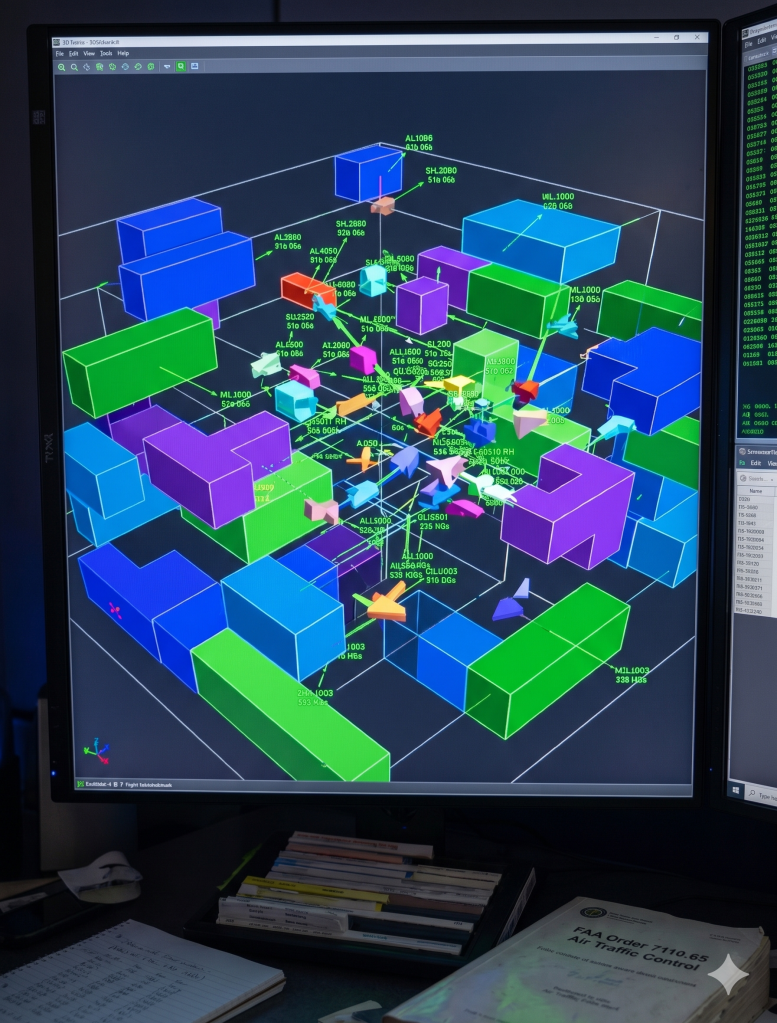
Image by Gemini
Standard CYA Disclaimer: Just to be explicitly clear before anyone gets their headset in a twist, this post is entirely my own personal opinion and in absolutely no way represents official FAA policy, procedure, or bureaucratic doctrine.
Let’s be real for a second. If you look at an Air Traffic Control (ATC) tower, it essentially looks like the world’s most stressful LAN party. You’ve got a bunch of people wearing headsets, staring intently at glowing screens, chugging caffeine, and calling out coordination.
So, naturally, the internet has asked: why don’t we just hire hardcore gamers to do this? If a 19-year-old can micromanage a sprawling interstellar empire in StarCraft II while simultaneously flaming their teammates in Discord, surely they can tell a Boeing 737 to turn left, right?
Well, yes and no. Having spent plenty of time inside these arenas, I’ve got some distinct opinions on the subject. Human reality is wonderfully, terribly messy and difficult to pin down to patterns and concrete responses. Let’s look at the actual pros and cons of tossing a gamer the keys to the national airspace, with a healthy dose of pragmatism attached.
The Pros: Where the “Gamer Buffs” Apply
- God-Tier Reflexes and Multitasking: Gamers are conditioned to process an absurd amount of visual data simultaneously. Checking the minimap, tracking cooldowns, and dodging incoming fire translates pretty well to scanning a radar screen, reading altitude tags, and anticipating flight paths.
- Panic? What Panic?: When a raid boss goes into its enrage timer, you don’t freeze; you execute the mechanics. Gamers are uniquely accustomed to solving spatial puzzles while being bombarded with high-stakes sensory input. That cold, mechanical focus is exactly what you want when a sudden thunderstorm reroutes 15 planes at once.
The Cons: The Glitches in the Real-World Matrix
Here is where the fantasy crashes headfirst into the tarmac.
1. The Tech Downgrade: Welcome to the 1970s
Modern gamers are spoiled. They are used to 144Hz refresh rates, predictive algorithms, ultra-low latency, and intuitive User Interfaces designed by armies of UX experts. The FAA, on the other hand, runs on infrastructure that frequently feels like it was coded on a potato during the Nixon administration. Handing a modern gamer a piece of ancient, monochromatic terminal equipment with a clunky keyboard and zero ergonomic interface is going to cause immediate psychological damage. There are no hotkeys to save you here, and the system definitely doesn’t auto-save.
2. The “Rulebook” vs. The YouTube Tutorial
In gaming, if you don’t know how to do something, you watch a 5-minute video or you just brute-force it until you figure out the mechanics. Aviation strictly prohibits the “fuck around and find out” learning methodology. To be an air traffic controller, you have to memorize thousands of pages of incredibly dry, complex federal regulations. Gamers who rely on intuitive, experiential learning are going to hit a massive brick wall when handed a textbook the size of a cinderblock and told to memorize the exact separation minimums for wake turbulence.
3. Voice Chat is Real Life Now
We all know what online gaming lobbies sound like. Now imagine that, but instead of a troll, it’s a highly stressed 55-year-old airline captain who has been flying for 10 hours and wants to know why you just put him in a holding pattern. ATC requires crystal-clear, professional, and empathetic communication. You have to deal with frustrated pilots and stressed coworkers in the same room. There is no mute button, and you can’t just log off when the vibes get bad.
4. The Boolean Reality Check
This is perhaps the biggest disconnect. Video games, at their core, are just code. They follow strict Boolean logic. Even the most complex games run on predictable rules. Local control in a video game might look like this simple conditional:
If x = true and {b, c, d} = true, then response = y
If the runway and final are clear, the plane is ready, and the weather is fine, then issue takeoff clearance. Simple.
Real-life airborne scenarios, however, completely abandon binary logic in favor of terrifying, fluid chaos. A busy sector isn’t an equation you can solve; it’s a living, breathing mess. The logic looks a lot more like this:
If target = x while:
- a = true
- b = false
- c = maybe
- d through m = developing scenarios
Then response y = unknown quantity with 9 time-based variables.
You might want outcome x, but a is true, b is false, c is a solid “maybe” depending on the pilot’s mood or how much coffee you’ve had, and variables d through m are actively developing weather cells and other aircraft that may or may not have experienced pilots. Your required response y suddenly equals an unknown quantity with a dozen potential points of conflict. Games teach you how to solve a puzzle with a programmed solution. Reality requires you to manage a puzzle where the pieces are actively changing shape while you hold them.
The Ultimate Sorting Hat: Defining a “Gamer”
When the FAA launched its recruitment campaigns explicitly targeting “gamers,” it raised a lot of eyebrows—and a lot of casual players thought their 5,000 hours exploring the fields of The Elder Scrolls just punched their ticket to a six-figure aviation career.
But “gamer” is an incredibly broad umbrella. Spending thousands of hours wandering a beautiful, single-player open-world RPG builds patience and immersive focus, but it does absolutely nothing to train the specific high-velocity, high-entropy neural pathways required in a busy terminal radar approach control (TRACON) environment. To survive a rush in the tower, you don’t need a lore expert; you want the cognitive wiring of someone who has spent 5,000 hours in an intense, high-actions-per-minute (APM) competitive environment like Call of Duty. Those are the players who have spent years tracking multiple high-speed targets on a mini-map, processing rapid peripheral noise, and executing split-second spatial decisions while under intense pressure.
So, how exactly does the FAA separate the casual Animal Crossing cozy gamer from the elite multi-tasker? They don’t do it by looking at your Steam Wrapped or checking your Xbox achievements. Instead, they let the Air Traffic Skills Assessment (ATSA) exam act as the ultimate sorting hat.
The ATSA is essentially a grueling, four-hour gauntlet of gamified cognitive tests disguised as basic computer programs. One module forces you to navigate a radar-style screen to prevent incoming numbered blips from colliding, all while flashing rapid-fire math equations at the bottom of the screen that you must solve simultaneously. Another section rapidly flashes single digits on the screen, forcing your working memory to calculate the mathematical difference between the current number and the previous one, constantly erasing the old data to make room for the new.
The FAA doesn’t care what games you play on your couch; they use a specialized, high-stress simulator to see if your brain inherently possesses the fluid intelligence, spatial orientation, and divided attention that high-level gaming provides. If you can handle the ATSA’s version of a chaotic multi-front raid without tilting, you’re the exact kind of “gamer” they are looking for.
Shattering the Stereotype
At the end of the day, there is a lot of variety implied in the term “gamer.” Gamers are just people, and no single archetype completely fits this mold. In fact, over the last couple of years, I’ve watched a few avid gamers completely fail out of air traffic control training. The skillset doesn’t automatically translate. I’m actually more of an RPG over FPS guy myself, and I’ve done just fine over the last 30 years.
You want to know who does have a perfect track record? Professional motorcycle racers. I can definitively say that 100 percent of the professional motorcycle racers I have seen apply for this job have made it through training with flying colors. If you want to talk about high-speed spatial processing, managing developing threats, and split-second survival instincts under crushing G-forces, look at the track, not the keyboard. Note, I am not recommending you race motorcycles to prepare for Air Traffic. I’m simply giving an example of how little value statistics have without context.
The Final Score
Should we recruit gamers for ATC? Honestly, it’s not the worst idea—some aviation aptitude tests already look a lot like retro arcade games. The raw mental hardware is definitely there with gamers, but let’s be real: that’s true for most humans. Bringing in a fresh crop of button-mashers doesn’t solve the real problem. Turning a top-tier gamer into a controller requires a massive software update—they still have to survive ancient technology, study like a law student, communicate like a hostage negotiator, and accept that real life doesn’t run on ones and zeros (and, of course, that there’s no respawn). Ultimately, the systemic bottleneck isn’t who we train; it’s how we train. Until the FAA culture is ready to commit to modernizing a grueling, rigid training pipeline that regularly chews up and spits out perfectly capable minds, changing the target demographic on the recruiting posters is just moving deck chairs on the Titanic.