The Prodigy Trap: Why the FAA’s Training “Filter” is Breaking the NAS

Image by Gemini

A Quick Note: Before we dive in, I need to be clear: the following is my personal perspective based on two decades in the trenches. These opinions are mine alone and do not represent the official stance of the FAA or any other government agency. I’m speaking as a controller and a trainer, not as a spokesperson.

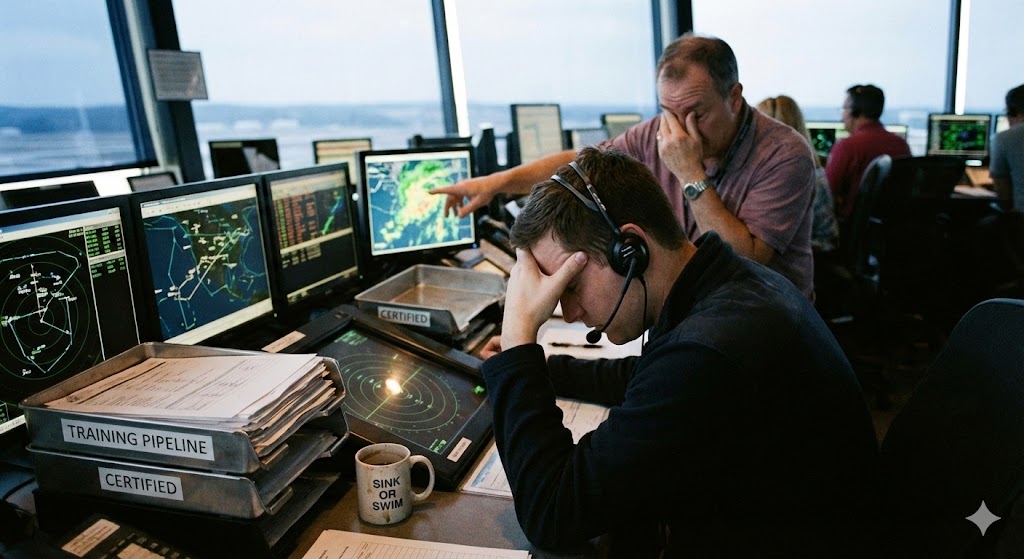
Twenty years ago, when I started as an Air Traffic Control Specialist, the “sink or swim” mentality wasn’t just a philosophy; it was the bedrock of our culture. Back then, the FAA’s approach resembled a high-pressure filter designed to throw candidates into the meat grinder to see who came out the other side intact. The goal was simple: find the elite “prodigies” who could handle the heat without breaking a sweat. But today, that same mentality is the very thing breaking the National Airspace System. By clinging to this archaic filter, we are burning through the talent we desperately need while leaving our complex facilities understaffed and our Certified Professional Controllers (CPCs) utterly exhausted. It’s time to stop hunting for unicorns and start building a resilient system that values stability over a few lucky stars.

The core of the problem lies in how we view the relationship between resilience and speed. In almost every other high-consequence industry, redundancy is a feature, not a bug. Yet, in ATC training, we treat “extra time” like a shameful failure. We prioritize speed above all else, weeding out anyone who doesn’t possess near-instantaneous processing power from day one. However, after training dozens of controllers, I’ve learned a secret the Agency refuses to acknowledge: a controller who takes twice as long to certify isn’t a “lower quality” controller. In many cases, they are actually superior. They tend to be more methodical and disciplined in their approach to safety. They have built the deepest muscle memory and the most stable situational awareness because they’ve seen more repetitions and worked through more “bad” days. By forcing speed, we lose people who could provide a reliable backbone for the NAS.

This lack of “Systemic Margin” is what makes our current environment so brittle. In a complex environment, Systemic Margin is the safety buffer that exists between normal operations and a total collapse. When you operate with no margin, the system is fragile—one person calling in sick, one radar failure, or one unusual weather pattern causes a total safety event. If we doubled OJT hours, especially at our level 10–12 facilities, we would finally build a shock absorber into the system. We need to accept that if a controller needs help when the sectors get saturated, it doesn’t mean they aren’t capable; it means we need more controllers to shoulder the burden. By training for volume rather than just elite proficiency, we could distribute the load across more people, ensuring safety through redundancy rather than relying on a few “superhumans” to carry the entire weight of the sky. What if you didn’t have to ask the CIC or Supervisor to be your handoff, because you already had one?

Unfortunately, we are currently trapped in a staffing death spiral. Facilities are so short-staffed that we can’t afford to pull experienced controllers off the boards to provide quality instruction. This creates a loop where the “instructional capacity” is nonexistent, and training becomes a burden rather than an investment. To break this, the FAA must professionalize the instructor role. We need Certified Professional Instructors (CPIs) who are compensated and incentivized based on trainee success rather than just “working the boards.” Right now, OJT is often just an extra chore for a tired controller. If we officially designated a career track for instructors, we would transform training from a drain on resources into a self-sustaining engine of growth. The 10-25% in the moment compensation we currently earn is just hazard pay, instructors should get a permanent hourly pay bump and get a bonus every time someone gets certified. Controllers should be competing for the right to be trainers, not hiding from the responsibility. We also need to move away from learning from instructors who haven’t worked real traffic in decades and focus on those currently in the trenches.

This shift in philosophy must also extend to the way we modernize—or fail to modernize—our technology and our hiring pipeline. The FAA’s “Flight Plan 2026” talks a big game, boasting a $22 billion investment in the Brand New Air Traffic Control System (BNATCS). On paper, it looks like progress; in reality, new tech is a hollow promise if it isn’t standardized across the board. Right now, we are asking trainees to learn facility-specific quirks on “antiquated last-millennium trash” while the Agency promises a high-tech future that usually only reaches a handful of elite facilities, leaving everyone else behind. If we want a universal training standard, we need a universal interface. New technology is only as useful as the person plugged into it, and if that person is still fighting legacy equipment that belongs in a museum, we haven’t actually moved the needle.

Furthermore, we need to address the bottleneck at the very start of the career. Secretary Duffy has streamlined the hiring process from eight steps down to five, effectively “supercharging” the influx of new bodies. But let’s be honest: flooding the facilities with a bunch of new people without the capacity to train them is just moving the pile. We are seeing record-breaking Academy classes of 600+ trainees, yet many of these people will show up at their first facility and sit around for months, or even years, waiting for a training slot that doesn’t exist. We are still relying on an Academy system that most of us recognize as a “shit test”—a hurdle that measures the ability to study general knowledge but offers little to no help when you actually step onto the floor of a high-complexity facility.

If we are serious about building up rather than weeding out, we have to rethink where the “weeding” happens. We should be expanding the Enhanced AT-CTI program to allow collegiate graduates to bypass the Academy entirely. By shifting the academic heavy lifting to the university level, we ensure that the people showing up at the facility are already fundamentally sound and ready to work traffic, not just ready to pass a multiple-choice test. At the same time, we have to get real about incentives. It takes a lot to motivate experienced controllers to leave a stable life and move to a staffing-challenged, high-stress Level 12 facility. The only people that will do it for less than 50k are the inexperienced and the desperate. For a veteran controller, that amount doesn’t even begin to cover the cost of the burnout and the increased workload they are being asked to absorb. To fix the staffing death spiral, we need real incentives that acknowledge the value of “tribal knowledge” and the sacrifice required to fix a broken facility.

Finally, we need to fundamentally overhaul our “gym.” The current 2026 budget includes funding for upgraded Tower Simulation Systems, but quite frankly, we’ve heard this song before. Most of us are still working with antiquated, last-millennium trash. We don’t need a new building or a legacy room; we need virtual reality sims and high-fidelity repetition. We need to stop using the simulator as a “final exam” designed to catch failures and start using it as a training gym where a trainee can experience a decade’s worth of emergencies and “black swan” events in a few months. For every hour of live traffic, a developmental should have two hours in a sim seeing the weird and the dangerous until their response is automatic. This would free up their mental bandwidth for the nuances of live traffic, leading to higher success rates and a much more resilient workforce. We don’t need a few elite stars to save the day; we need a solid, well-rested, and deeply trained workforce that can handle the volume of the future.
What can we do for you?

Image by Michi S from Pixabay

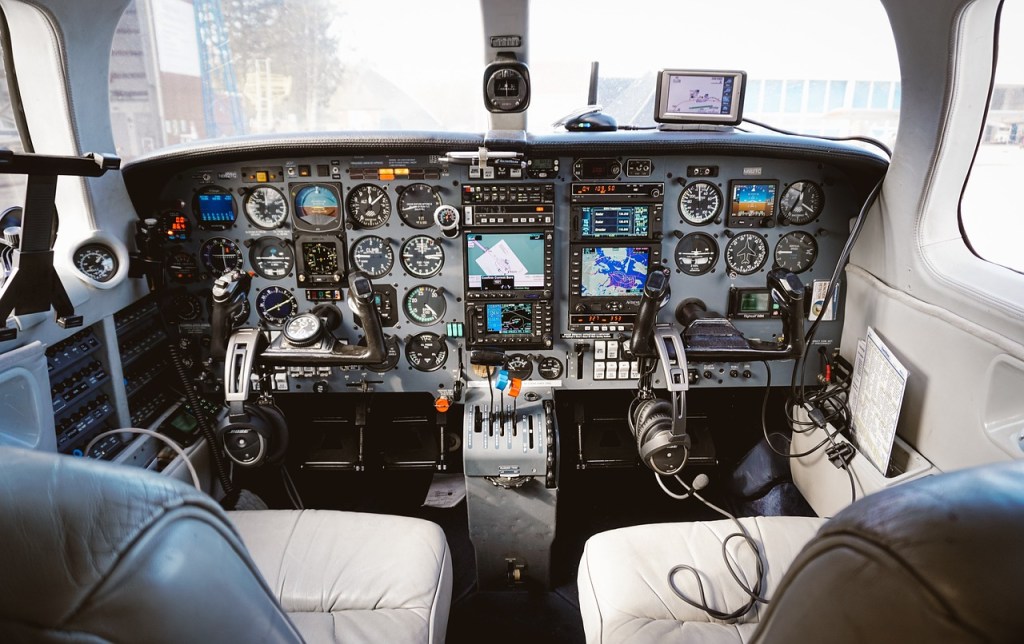
When pilots tour an air traffic facility one of the most common questions is: What can we as pilots do to make the lives of air traffic controllers easier? We do appreciate the concern. As you can imagine, this particular topic is often discussed in detail when it’s just us controllers, but we tend to be a little more political when our customers are in the room. Yes, customers. Whether we like it or not, air traffic is a service industry. That certainly doesn’t mean that the customers are always right, because if they were, air traffic controllers would be out of a job. Here is my disclaimer before we get too far: The views and opinions expressed in this blog are my own and do not represent the official policies, positions, or opinions of the Federal Aviation Administration (FAA) or any other governmental agency. I do not speak on behalf of the FAA, and any information provided is based on my personal experience and knowledge.

Air traffic controllers are aware of the stress that pilots face, many of my fellow controllers are pilots, some of them were even pilot instructors. That being said, when we’re on the spot and stressed out, we tend to have little tolerance for poor piloting. We generally don’t lash out directly unless we’re really at the end of our rope (which can happen several times on a bad day). On frequency you may notice a hardening of tone, a shortness that indicates we have a lot on our plate and the latest pilot error has just drastically increased our workload. 

I think this reaction to stress is only human. After almost 30 years of stressful work, I still lose my temper sometimes. I think I’ve only raised my voice twice to my wife in 13 years. I get angry more often with my 8 year old son, but I’m even keeled enough where just a slight change in tone lets him know he messed up. I might say something like “I know jumping on the couch is fun, but it would be a shame if that resulted in the Playstation power cord being lost for the rest of the day.” But still, I have probably seriously raised my voice to him 3 times in the last 2 years, and he can really push my buttons. I get pissed off at a pilot almost everyday of the week, sometimes more than once a day. I generally don’t express it out loud in any way and it only lasts a few minutes, but in that moment I feel more disrespected than from anything my wife or kid has ever done. Part of this comes from the fact that most people are not risking lives or property when they mess up, so our expectations tend to be higher. Also keep in mind that I talk to hundreds of pilots every day, so from that perspective one or two isn’t bad.

It’s not that the pilot necessarily made some huge mistake or did something intentionally wrong, it’s the particular situation. Imagine you are already stressed out, at the end of your mental capacity trying to keep 12 other people happy and one person has to go and break the flow by slapping you in the face, or careening into the final or following the wrong airplane or circling in your departure corridor. Objectively, I get it, pilots are human and they make mistakes. Also, I work at a training airport and many of the pilots are either students, very inexperienced or the dreaded ‘weekend warriors’. The problem is, and this may be my age talking, I believe it’s getting worse.

There are a few common issues that I have seen an increase in over the past 18 years at my particular airport. Flight planning seems to be a big one. I don’t know if it’s the reliance on technology or a change in culture but more aircraft are coming to the airport with little to no idea where they are going. They have more trouble finding the airport than back in the day when they were just using VORs and TACANs. I’ve had a pilot try to get a landing clearance telling me that according to their IPad they were five miles south. We had them squawk ident and scrolled out the RADAR to find them almost 30 miles south in restricted military airspace. 

There are more people coming off the runway onto the taxiway and not knowing which FBO (fixed base operator) they want to go to. They might want self-serve fuel and not know that they exited on the wrong side of the runway, They get clearance to county transient parking and end up turning into the restricted commuter ramp and never tell ground control they need progressive taxi instructions.

Yes, I am venting a little. I should mention that the vast majority of professional pilots are spot on and know exactly what they are doing. It can actually be quite enjoyable to work with a half-dozen aircraft that all respond immediately and correctly to every instruction. 

Let’s get back on track and talk about flight planning. I’m not a pilot but I did some flight planning and navigation training in the Marine Corps. We spent about 80 hours in the air flying all over the country keeping track of everything from fuel to our exact location. We used a variety of tools including pen and paper, an antiquated calculation device we called a ‘whiz wheel’, TACANs, VOR/DME, INS(inertial navigation system), pressure, and celestial navigation. Yes, I have navigated on a moving aircraft going 400 knots with a flipping sextant sticking out of the top of the aircraft, taking three star, sun or moon readings at 4 minutes each and using an almanac to triangulate our position on a chart and then dead reckoning to adjust the heading. Our instructors had fancy hand held Global Positioning System (GPS) devices, which were new at the time, to check our work. Despite all the amazing technology of the 90’s, the one thing that kept us afloat were checklists. Yes, checklists. We had so many checklists that we had checklists for our checklists. I have heard that pilots use these things too.

I’m sure flight planning has changed quite a lot in the last 30 years, but who knows, in the tower we still have paper versions of everything. I would hope that you are plotting your route of flight on a valid up to date published chart or digital version. You want to know if you are creeping up on or going through a class B, C, or D airspace and who you should be talking to. You want to know about the artillery range that you’re flying right next to. You should be aware if you are on someone’s final or in their departure corridor. Know the new landmarks. Southern California changes relatively fast. That reservoir you used as a landmark 3 years ago might be a condo development and those smoke stacks on the shore that were such an eyesore have been torn down and if you forgot where they were, suddenly you’re careening into my departure corridor. Know the airport layout. 

So you’re a little lost in the air, you call in 7 miles east when you are actually 5 miles due north and you are asking to land on a runway that doesn’t exist. We got you. Now we know you are new and will guide you in with caution (as soon as we verify you’re going to the correct airport.) Yes, people try to land at an uncontrolled airport 7 miles north of us all the time thinking it’s us. Sometimes they succeed. There are some funny stories there which I’m pretty sure I’m not allowed to tell. Just make sure you are landing at the right airport or the runway might be half as long as you think it is, or even better your aircraft is surrounded by Marines with loaded rifles before you even get on the taxiway.

Awareness of your location is a key concept that deserves some more time. Again, more and more often aircraft seem to be flying through arrival and departure corridors without talking to anyone. Fairly often a slow mover (ie. Skyhawk, Cherokee or almost any single engine prop) will call up on a 10 mile final at 3500 feet asking for a straight-in to the runway, completely oblivious to the global express descending out of 6000 4 miles behind them. Or someone will be off shore in the departure corridor circling at 3000 feet ‘whale watching’ while departing jets are trying to climb through that altitude. Then there is the classic response when you tell certain pilots that what they are doing is not safe, it’s something to the effect of: ‘well we’re VFR and this is uncontrolled airspace so…’. I can’t help but think, who are they going to take with them on their flaming plummet with that attitude?  It’s like walking through an active rifle range, having faith people will see you and stop firing, or maybe the big sky theory is going to save them. But then again, I suppose it’s job security.

So you’re on the ground, landed and safe. Wait, what’s a safety area? The safety area is a protected area on either side of the runway that needs to be kept clear in case an aircraft veers off the runway. Apparently this is not common at other airports but our runway safety area goes right up to the taxiway. Make sure you are up to speed on the runway and taxiway markings at the airport where you are landing. If you stop inside the safety area, air traffic control is not supposed to land or depart any airplanes on the runway. You can imagine how happy the bizjets are to be sent around because some cessna stopped just over the white line and is fishing for a ground frequency. Poof, 500 to 1000 dollars up in fumes depending on the type of jet and how far they have to fly to get back on final. All because someone didn’t scope out the airport they were flying into.

If you need help or don’t know where you are going, please say something. I know sometimes controllers can sound intimidating and impatient, and I suppose to a large extent we are, but it is our job to help you. If you need help, tell us. We can’t read your mind and when we’re busy we rely on the idea that pilots will do exactly what they are supposed to do in order to keep our plan in motion. If something disrupts the plan, then we adapt, but it’s more work and probably shortens our lifespans. If I tell you to follow the Mooney on a 3 mile final and you tell me you have traffic in sight, I’m not expecting you to follow the Centurion on a 1.5 mile final where your base turn tries to t-bone the Mooney. If you are not sure where your traffic is just tell us you’re still looking or ask us to call your base turn. 

I notice more pilots who do not know basic instructions and terminology. I understand that companies want the ground school to be relatively easy because, well, more customers is more money, but maybe we can have a more comprehensive review at the end or something? We issued a go around once to a pilot who had no idea what we were talking about. After the resulting pilot deviation, they had to call on the phone and have us explain to them how to do a go-around. Seriously. More often I’m getting pilots who don’t know what ‘the option’ is. This is a clearance that means you can do a full stop, stop and go, touch and go, or low approach. I use this often because about one in five student pilots will go around anyway and about one in ten will do whatever they want regardless of what you tell them. I get it, they are training and nervous. If I clear them for the option, then I’m ready for any surprises. At least twice a week I hear something like ‘Ah, no tower we’re actually requesting a touch and go…’ and I have to explain how yep, that is part of the option.

Ok, that was a lot of ranting. To summarize, in order to help controllers more, pilots can plan better, listen carefully to the frequency, speak up if they are confused or not sure of something, and study hard before you get into that plane by yourself. I feel like somewhere in that sentence could be a basic mantra for living your life, but that’s a topic for another post. 

Now that we’ve ragged on pilots for a while let’s talk about what controllers can do better. What? Controllers aren’t perfect? What blasphemy is this! It’s true though, we are all human and until that blessed day when our future AI overlords take our jobs too, you have to deal with us. 

Controllers tend to talk fast. This happens to me fairly regularly. I get excited and start going full speed and about the third time I hear ‘say again?’ I realize it’s time to calm down, take a breath,  slow my speech rate, and focus on proper enunciation. Some controllers never figure it out and they become more frustrated with the pilots’ lack of comprehension and compliance. It makes a long and frustrating career for those controllers. Controllers have hearing problems too. I know my baseline goes down every year and I have to keep turning the volume up loader. Between my poor ears and the number of foreign pilots training, one of my favorite phrases has become ‘Say Again?’.

Controllers can be mean. Most of us have large and strong egos because they need to be in order ro resist the pummeling they take on a regular basis. This is a good thing, trust me you want the controller who is excited and loud and confident over the one who is apathetic and uncaring. Unfortunately after enough time on our high pedestal we tend to look down upon the lesser mortals and might start spouting sarcasm. We can be condescending, passive aggressive and patronizing but will never curse at you, at least not on the recorded line. The vitriol slips out now and then, sometimes subtle, sometimes not so much. I think a lot of controllers could benefit from some basic customer service training.

Distractions are one of the safety concerns that we get educated on regularly. It can be anything from someone telling a joke in the background to a tour standing behind you asking questions that subconsciously competes for that limited attention span. Other issues include problems at home, family strife, sick loved ones, or money problems that cause your mind to drift and introduce more risk. These are all known issues that the Agency (FAA) is aware of and spends a ton of money trying to fix. We do have a lot of options that we can use to deal with our drama, but again our egos come into play and we think we are fine to be at work or we don’t want to let down our co-workers or we don’t have any time off left. I do have some strong opinions about these issues, but I’ll save that for another blog post, perhaps after retirement.

There is a lot more that can be improved upon by both sides. Some of the controller issues which I have not mentioned deserve several posts of their own or perhaps a small book to dive into, and I’m not ready to broach those areas yet. It eventually comes down to human beings being flawed and oh yeah, money. I want to give a shout out to all the people who work hard to keep our national airspace safe and efficient. There are some real heroes out there in my industry that work diligently despite the barriers of politics, short sighted hiring and antiquated training practices, to make sure aviators are safe and on time. 

I would also like to thank bizjet and airline pilots for their professionalism and consistent desire for self and passenger preservation. We can’t see everything after all. I am humbled daily by all that you do. I would also like to give a shout out to all the pilot trainers out there. I can’t imagine the guts it takes to sit next to a student pilot and put your life in their hands. I think you’re all crazy. Amazing but crazy.

If I continue posts on this topic, I think I will focus on more instructional philosophy toward air traffic controllers. If there is any particular subject you would like me to go more in depth on, let me know and I will be sure to answer with my completely biased and somewhat professional opinion.