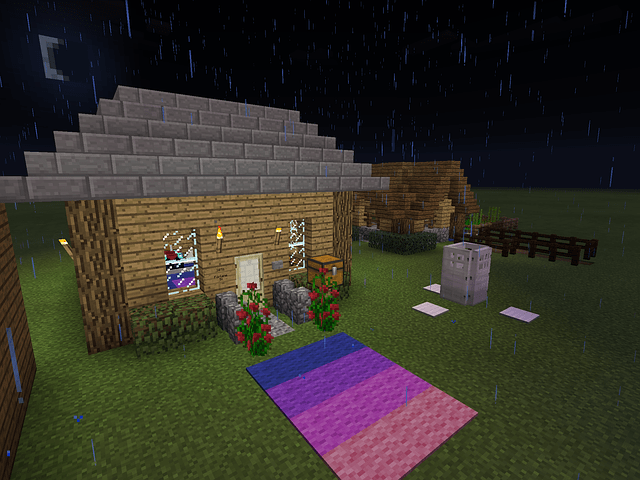
Image by SkyeWeste
Minecraft is the first game my son and I completed together. By completed I mean defeating the ender dragon in survival mode and seeing the credits scroll by. We had been playing for a while, dodging the endermen and waging a sort of primitive trench warfare against the dragon when my son said “Dad, if we just put on pumpkin heads the endermen will ignore us.” We put on our new carved helmets and the rest is history. He was five, and I was so proud as we watched the credits scrolling by, reminding me of the first time I beat Mario Brothers so long ago. Since then my Mom and one of my brothers have also started playing, joined occasionally by my wife.
If you have gone this far with the game, you appreciate the time and effort involved, and you also probably won’t need to read the rest of this post. If you have not, you may well be missing out on the cross generational, cross dimensional, geologically magical adventure that is Minecraft.
Minecraft, since its official release in 2011, has captivated millions of players worldwide, becoming one of the best-selling video games of all time. Its simplistic graphics and seemingly straightforward gameplay might not initially suggest a recipe for addiction, yet it has a magnetic hold on its audience. So, what is it about Minecraft that makes it so addictive? I’ve tried to explain this to friends and family for years but it’s hard to articulate its nature properly, especially to adult gamers who look at minecraft as ‘just a kid’s game’.
Minecraft’s most compelling feature is its sandbox nature, which allows players to build and explore without predefined objectives. This open-ended creativity is a significant draw. Like life, exploring minecraft is quite like an infinite box of chocolates. In Minecraft, players are limited only by their imagination. Want to build a replica of the Eiffel Tower? Go ahead. Feel like constructing an underwater city? No problem. This freedom to create and modify the game world offers endless possibilities and keeps players coming back for more.
I’ve had fellow gamers scoff and tell me that I should just play Ark, as if better graphics makes a better game. Although I do love taming armies of dinosaurs, you can’t really dig in Ark, it is not a true sandbox in my opinion. At some point I may need to make a separate blog post on what constitutes an actual sandbox. Some people think a true sandbox is basically a game development engine, but the game should have some set qualities otherwise very few people will invest the time to learn all the tools. Other people seem to think any game with an open world and questionable or non-existent storyline is a sandbox game. Yet none of the better graphics games seem to come close to the scope and versatility that is Minecraft. I would say that 7 Days to Die is the closest thing I’ve seen to an actual sandbox game with decent graphics. Please feel free to comment with your opinions.
Unlike many other games, Minecraft starts you off with a blank canvas. The absence of a rigid storyline allows players to forge their path, setting and achieving personal goals. This creative freedom is akin to playing with digital Lego blocks but on a much grander scale. The satisfaction derived from seeing a project come to life, block by block, is immensely rewarding and addictive. I should mention that Lego Fortnite is coming along nicely but still has a way to go to compete with Minecraft. ‘A’ for effort Epic!
Minecraft offers vast, procedurally generated worlds filled with diverse biomes, hidden treasures, and mysterious caves. The sense of discovery and adventure is a powerful motivator. Every new world is unique, providing fresh landscapes to explore and secrets to uncover. The game’s procedural generation ensures that no two worlds are the same. This randomness fuels curiosity and encourages players to venture into the unknown. The excitement of what lies beyond the next hill or within a dark cave keeps players engaged and eager to explore further.
The survival mode in Minecraft introduces elements of danger and resource management. Players must gather resources, build shelters, and fend off hostile mobs like zombies and creepers. This survival aspect adds a layer of challenge and urgency that can be thrilling and addictive. Managing resources effectively is critical to survival. Players must mine for materials, hunt for food, and craft tools. The satisfaction of progressing from basic wooden tools to diamond-encrusted armor provides a strong sense of accomplishment and growth. Battling mobs and planning defenses adds a strategic element to the game. The adrenaline rush of surviving a night filled with zombie attacks or successfully navigating a perilous cave system enhances the game’s addictive nature.
Minecraft’s multiplayer mode allows players to join servers, collaborate on massive projects, or compete in mini-games. The social aspect of Minecraft fosters a sense of community and camaraderie.Working with friends or other players on large-scale projects can be incredibly fulfilling. The collaborative effort of building cities, amusement parks, or intricate redstone contraptions strengthens bonds and enhances the gaming experience. Minecraft has a vibrant online community with countless servers catering to different play styles, from creative building servers to competitive PvP (player vs. player) arenas. The ability to join and contribute to these communities adds another layer of engagement and addiction.
Minecraft’s educational potential is another factor contributing to its addictive nature. Many schools and educators use Minecraft as a tool for teaching various subjects, from math and science to history and art.The game encourages problem-solving and critical thinking. Players must figure out how to gather resources, build structures, and survive in a challenging environment. These problem-solving aspects are not only educational but also highly engaging. Minecraft promotes creativity and innovation, essential skills in today’s world. The game’s redstone mechanics, for instance, allow players to create complex machines and circuits, fostering an interest in engineering and technology. My son has a Minecraft world that simulates the periodic table of elements, allowing the combination of protons, neutrons and electrons to create any element, and then further facilitating the building of molecules with those elements.
Mojang, the developers of Minecraft, continually release updates that add new features, biomes, mobs, and mechanics. This constant evolution keeps the game fresh and exciting. The extensive modding community further extends the game’s lifespan. Mods can add new dimensions, gameplay mechanics, and even entirely new games within Minecraft. This endless stream of content ensures that players always have something new to explore and experience.
Despite its challenges, Minecraft can be incredibly relaxing. The simple act of mining, building, and exploring at your own pace can be therapeutic. The game’s repetitive actions, such as mining or farming, can induce a state of mindfulness and focus. Many players find solace in the game’s peaceful moments, where they can escape the stresses of the real world and immerse themselves in their virtual creations. After a stressful day of work it’s hard to beat zoning out with beer in hand just digging for diamonds.
Minecraft fosters a deep sense of personal investment and ownership. The time and effort players put into their creations generate a strong emotional attachment to their worlds and projects. Unlike many other games where progress can be reset or lost, Minecraft worlds can be preserved indefinitely. This sense of permanence adds value to players’ efforts and achievements, making the game more meaningful and addictive. I have a world that I’ve been enhancing over the course of 4 years. I call it my ‘trophy world’ not only because it stays in survival mode so I can earn in-game trophies, but because it is an evolving monument to my own creativity and diligence.
Minecraft’s addictive nature can be attributed to its blend of creativity, exploration, survival challenges, social interaction, educational value, continuous updates, therapeutic qualities, and personal investment. Each of these elements contributes to a deeply engaging and immersive experience that keeps players coming back, time and time again. For me and my family it offers a virtual environment where we can gather and work towards common goals while we catch up and spend quality time together even though we live on opposite sides of the country. Whether you’re a master builder, an intrepid explorer, or a survivalist at heart, Minecraft offers something for everyone, making it one of the most compelling and addictive games ever created.
 The Upgrade Blog