Image by Gemini
A Quick Note: Before we dive in, I need to be clear: the following is my personal perspective based on two decades in the trenches. These opinions are mine alone and do not represent the official stance of the FAA or any other government agency. I’m speaking as a controller and a trainer, not as a spokesperson.
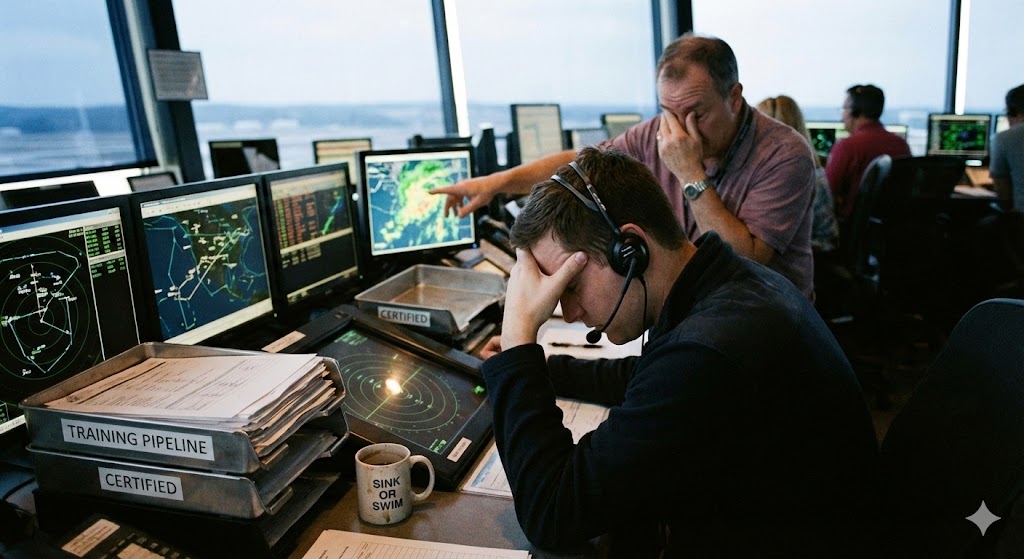
Twenty years ago, when I started as an Air Traffic Control Specialist, the “sink or swim” mentality wasn’t just a philosophy; it was the bedrock of our culture. Back then, the FAA’s approach resembled a high-pressure filter designed to throw candidates into the meat grinder to see who came out the other side intact. The goal was simple: find the elite “prodigies” who could handle the heat without breaking a sweat. But today, that same mentality is the very thing breaking the National Airspace System. By clinging to this archaic filter, we are burning through the talent we desperately need while leaving our complex facilities understaffed and our Certified Professional Controllers (CPCs) utterly exhausted. It’s time to stop hunting for unicorns and start building a resilient system that values stability over a few lucky stars.
The core of the problem lies in how we view the relationship between resilience and speed. In almost every other high-consequence industry, redundancy is a feature, not a bug. Yet, in ATC training, we treat “extra time” like a shameful failure. We prioritize speed above all else, weeding out anyone who doesn’t possess near-instantaneous processing power from day one. However, after training dozens of controllers, I’ve learned a secret the Agency refuses to acknowledge: a controller who takes twice as long to certify isn’t a “lower quality” controller. In many cases, they are actually superior. They tend to be more methodical and disciplined in their approach to safety. They have built the deepest muscle memory and the most stable situational awareness because they’ve seen more repetitions and worked through more “bad” days. By forcing speed, we lose people who could provide a reliable backbone for the NAS.
This lack of “Systemic Margin” is what makes our current environment so brittle. In a complex environment, Systemic Margin is the safety buffer that exists between normal operations and a total collapse. When you operate with no margin, the system is fragile—one person calling in sick, one radar failure, or one unusual weather pattern causes a total safety event. If we doubled OJT hours, especially at our level 10–12 facilities, we would finally build a shock absorber into the system. We need to accept that if a controller needs help when the sectors get saturated, it doesn’t mean they aren’t capable; it means we need more controllers to shoulder the burden. By training for volume rather than just elite proficiency, we could distribute the load across more people, ensuring safety through redundancy rather than relying on a few “superhumans” to carry the entire weight of the sky. What if you didn’t have to ask the CIC or Supervisor to be your handoff, because you already had one?
Unfortunately, we are currently trapped in a staffing death spiral. Facilities are so short-staffed that we can’t afford to pull experienced controllers off the boards to provide quality instruction. This creates a loop where the “instructional capacity” is nonexistent, and training becomes a burden rather than an investment. To break this, the FAA must professionalize the instructor role. We need Certified Professional Instructors (CPIs) who are compensated and incentivized based on trainee success rather than just “working the boards.” Right now, OJT is often just an extra chore for a tired controller. If we officially designated a career track for instructors, we would transform training from a drain on resources into a self-sustaining engine of growth. The 10-25% in the moment compensation we currently earn is just hazard pay, instructors should get a permanent hourly pay bump and get a bonus every time someone gets certified. Controllers should be competing for the right to be trainers, not hiding from the responsibility. We also need to move away from learning from instructors who haven’t worked real traffic in decades and focus on those currently in the trenches.
This shift in philosophy must also extend to the way we modernize—or fail to modernize—our technology and our hiring pipeline. The FAA’s “Flight Plan 2026” talks a big game, boasting a $22 billion investment in the Brand New Air Traffic Control System (BNATCS). On paper, it looks like progress; in reality, new tech is a hollow promise if it isn’t standardized across the board. Right now, we are asking trainees to learn facility-specific quirks on “antiquated last-millennium trash” while the Agency promises a high-tech future that usually only reaches a handful of elite facilities, leaving everyone else behind. If we want a universal training standard, we need a universal interface. New technology is only as useful as the person plugged into it, and if that person is still fighting legacy equipment that belongs in a museum, we haven’t actually moved the needle.
Furthermore, we need to address the bottleneck at the very start of the career. Secretary Duffy has streamlined the hiring process from eight steps down to five, effectively “supercharging” the influx of new bodies. But let’s be honest: flooding the facilities with a bunch of new people without the capacity to train them is just moving the pile. We are seeing record-breaking Academy classes of 600+ trainees, yet many of these people will show up at their first facility and sit around for months, or even years, waiting for a training slot that doesn’t exist. We are still relying on an Academy system that most of us recognize as a “shit test”—a hurdle that measures the ability to study general knowledge but offers little to no help when you actually step onto the floor of a high-complexity facility.
If we are serious about building up rather than weeding out, we have to rethink where the “weeding” happens. We should be expanding the Enhanced AT-CTI program to allow collegiate graduates to bypass the Academy entirely. By shifting the academic heavy lifting to the university level, we ensure that the people showing up at the facility are already fundamentally sound and ready to work traffic, not just ready to pass a multiple-choice test. At the same time, we have to get real about incentives. It takes a lot to motivate experienced controllers to leave a stable life and move to a staffing-challenged, high-stress Level 12 facility. The only people that will do it for less than 50k are the inexperienced and the desperate. For a veteran controller, that amount doesn’t even begin to cover the cost of the burnout and the increased workload they are being asked to absorb. To fix the staffing death spiral, we need real incentives that acknowledge the value of “tribal knowledge” and the sacrifice required to fix a broken facility.
Finally, we need to fundamentally overhaul our “gym.” The current 2026 budget includes funding for upgraded Tower Simulation Systems, but quite frankly, we’ve heard this song before. Most of us are still working with antiquated, last-millennium trash. We don’t need a new building or a legacy room; we need virtual reality sims and high-fidelity repetition. We need to stop using the simulator as a “final exam” designed to catch failures and start using it as a training gym where a trainee can experience a decade’s worth of emergencies and “black swan” events in a few months. For every hour of live traffic, a developmental should have two hours in a sim seeing the weird and the dangerous until their response is automatic. This would free up their mental bandwidth for the nuances of live traffic, leading to higher success rates and a much more resilient workforce. We don’t need a few elite stars to save the day; we need a solid, well-rested, and deeply trained workforce that can handle the volume of the future.
 The Upgrade Blog