Why Controller Burnout Demands an Overhaul
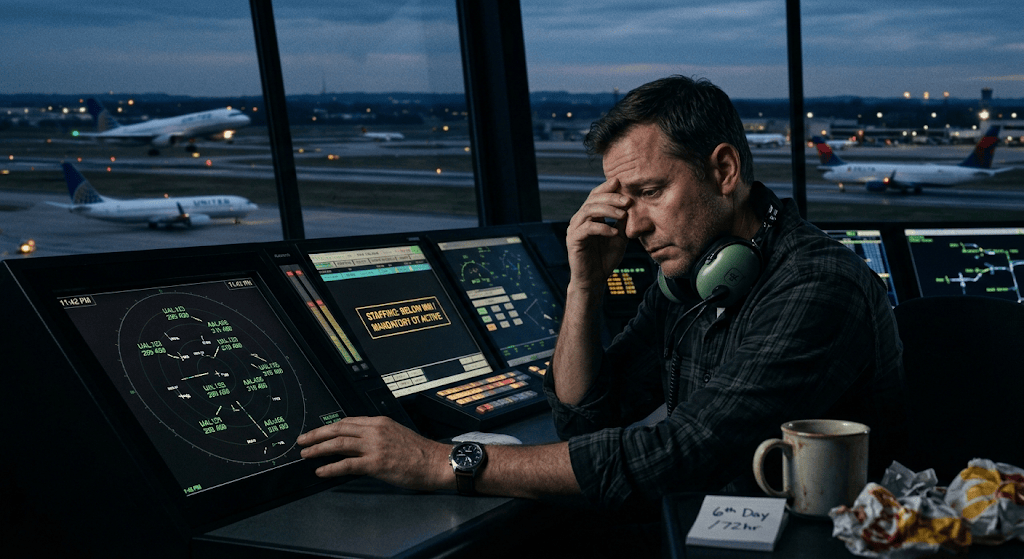
Image by Gemini
Disclaimer: The views, opinions, and analyses expressed in this document are solely those of the author in a personal capacity. They do not reflect the official policy, position, or operational procedures of the Federal Aviation Administration (FAA), the United States Department of Transportation (DOT), or the United States Government. This piece is written strictly for informational and public-interest discussion and does not constitute official regulatory guidance or agency disclosure.
Every single day, millions of travelers step onto commercial airliners trusting that the invisible network guiding them between runways and cruising altitudes is operating at peak mental acuity. Behind the radar screens, however, the Federal Aviation Administration’s (FAA) air traffic control (ATC) workforce is facing a severe crisis of attrition, chronic fatigue, and unaddressed mental health strain.
The Numbers Behind the Staffing Shortage & Forced Overtime
The FAA employs roughly 10% fewer Certified Professional Controllers (CPCs) today than it did a decade ago, despite significant growth in commercial air traffic and airspace complexity. According to repeated findings from the Department of Transportation Office of Inspector General (DOT OIG), the agency has consistently struggled to meet operational staffing targets at critical facilities nationwide.
- Routine 6-Day Workweeks: Chronic understaffing forces widespread mandatory overtime. In extensive facility reviews, controllers at roughly 40% of FAA facilities have been scheduled for mandatory six-day workweeks at least once a month, with high-density facilities working them almost continuously.
- The “Rattler” Schedule: Rotating quick-turn schedules—such as working an evening shift, a day shift, and a midnight shift within a compressed 72-hour window—create acute circadian disruption. A landmark National Research Council report noted that these schedules produce severe sleep deficits that drastically degrade cognitive reaction times.
- Overtime Expenditure: FAA controllers log over 2 million hours of overtime annually—an unsustainable band-aid covering a roughly 3,000-controller deficit across the National Airspace System.
High-Cost Living, Stagnation, and Second Incomes
When I left my job as a 9-1-1 dispatcher to become an Air Traffic Controller, I took a $15,000 yearly pay cut. I assumed I was stepping into a career with higher earning potential and greater prestige. I was wrong. I was treated better in almost every way working for the municipal government.
During my first decade as a controller, I spent countless hours working part-time at a pizza place just to pay the bills. When you finish washing dishes at 1:30 AM and have to report to the tower cab at 6:45 AM, you are not at your best. Living in Southern California, nearly everyone I work with relies on a side hustle or second job to get by. The rare exceptions are typically those who came from family wealth or those with a spouse who out-earns them.
While top-tier ATC pay bands appear competitive on paper, entry-level developmental pay and base salaries in high-cost-of-living metropolitan areas have failed to keep pace with real inflation or the operational demands of the career.
- Junior Controller Pay Deprivation: Developmental controllers assigned to high-tier facilities in expensive real estate markets face starting pay that forces them to rely on gig-economy second jobs just to afford rent. It can take years to achieve full certification, and many wash out before ever reaching full CPC pay.
- Secondary Work Compounding Fatigue: When trainees or certified controllers are forced to take on secondary employment to make ends meet, their off-duty recovery time drops to near zero—directly undermining federal safety mandates designed to prevent cognitive exhaustion.
The Mental Health Stigma & Unseen Casualties
In a job like this, cold sweats and tunnel vision are routine realities. This is not simple adrenaline; it is compounding stress. I have seen trainees hyperventilate into unconsciousness or seize up under pressure. If someone has undiagnosed anxiety, it surfaces within the first few weeks, and their career is over.
People who have worked in emergency dispatch, trauma medicine, or military combat understand the toll. If you have never lived in a constant state of hypervigilance fueled by the knowledge that a split-second error could kill hundreds of people—for hours at a time, multiple times a day—it is impossible to fully comprehend.
That mental health burden is magnified by the constant fear of losing one’s medical clearance.
I recently signed an agency retention incentive agreement to stay past retirement eligibility, but the fine print is unforgiving: if a medical issue disqualifies me from working, I risk having that bonus clawed back. Talk about an incentive to just “suck it up.” If an illness like COVID-19 hits, controllers are forced to weigh the ethical choice of staying home versus the financial penalty of losing tens of thousands of dollars. The system does not even need to frame it as punishment: if you miss enough operational time in a month to lose currency, you must complete an over-the-shoulder evaluation from a qualified supervisor. But when a facility operates with a single non-certified manager and no qualified supervisory staff to conduct the check, regaining currency becomes an administrative trap that risks contract breach.
- The Reporting Trap: FAA medical certification standards historically penalize controllers who proactively seek therapy or psychiatric treatment for depression and anxiety, incentivizing professionals to conceal struggles until reaching a crisis point.
- Elevated Anxiety & Crisis Risk: Studies examining air traffic controller wellness document elevated rates of clinical anxiety and depression compared to the general public. When paired with chronic sleep debt and isolation from relentless overtime, the threat of severe burnout and controller suicide becomes an urgent operational hazard.
Why Structural Reform Is Non-Negotiable
Air traffic control cannot be managed like a standard desk-bound bureaucracy; it is a zero-margin-for-error safety ecosystem. Relying on perpetual six-day workweeks, counter-circadian shift rotations, and inadequate entry wages threatens controller well-being and passenger safety alike.
Modernizing controller compensation, overhauling hiring pipelines, and establishing non-punitive mental health pathways are overdue imperatives required to protect the flying public and safeguard the National Airspace System.

