Why Air Traffic Control is Short Staffed

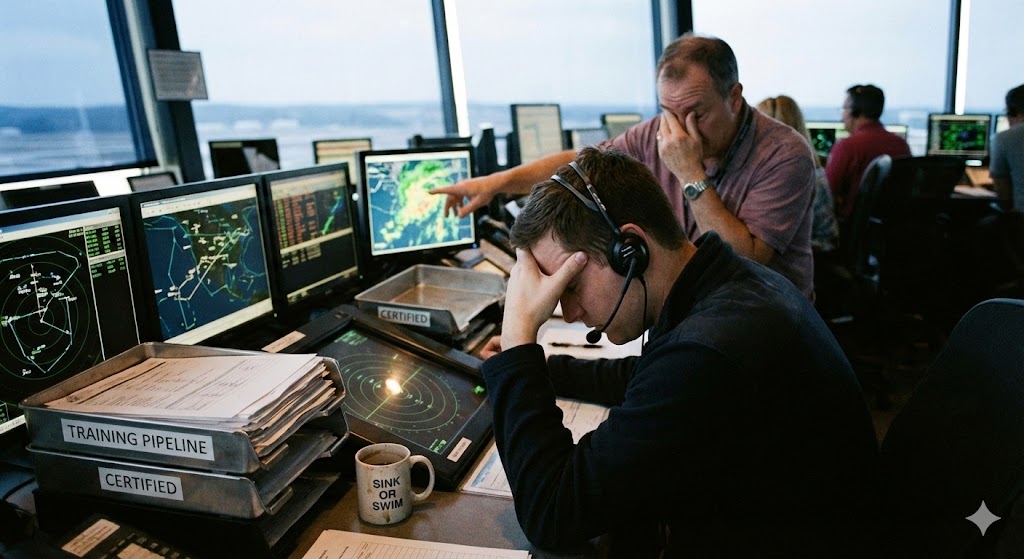
Image by Gemini

Disclaimer: The views and opinions expressed in this blog are my own and do not represent the official policies, positions, or opinions of the Federal Aviation Administration (FAA) or any other governmental agency. I do not speak on behalf of the FAA, and any information provided is based on my personal experience and knowledge.

I’ve been reading a lot of articles about why air traffic control is short-staffed, and since I have some experience in the area, I thought I’d take a crack at it. I have about twenty-five years of experience in the industry, and I’ve trained more than 30 controllers. Only one of them did not make it due to ability, and there were some definite psychological issues there as well. I believe that the agency is short-staffed because of the antiquated philosophy that an air traffic controller somehow has to be smarter and more capable than the average human. Are some people more gifted than others? Of course. If we try to staff our facilities with only the prodigies, however, we will fail unless other fundamental changes are made.

First, let me debunk or confirm a few rumors out there for anyone interested in the job. No, you do not have to have 20/20 vision, as long as you can wear glasses or contacts that correct to 20/20. The pay is good. My wife has a college degree, I do not, and I made twice what she did last year. Let me throw in some caveats. I have been in basically the same position for almost twenty years, so I’ve received a few raises. A new controller starts out making less than I did as a pizza delivery driver in 2003 until they get fully certified, which can take years. My wife gets to work from home, and her health benefits are better than mine. She has relatively little traumatizing pressure on a daily basis. I will talk about chronic stress later. I also worked well over 100 hours of overtime last year, and she didn’t work any overtime. She could make as much as me if she wanted, but she likes to work from home and not be in charge of too many people. The best benefit air traffic has over her job is the retirement pension, which her job does not have. Since so many air traffic controllers die before retirement or soon after, I’m not sure that perk is as great as it sounds.

So here is why we are short-staffed, in my opinion. A crucial part of the reason we are short-staffed is because we are short-staffed. Controllers, in general, already have this idea that they are somehow special and that not everyone is cut out for their job. Now, stack this with the fact that many of them have been doing the job of two or more controllers for so long they’ve forgotten what it was like having an extra person to help out, or maybe they have never experienced full staffing. That controller may be a prodigy who was hired and certified because they have a gift, and the tasks came relatively easily to them. Now they have to train some kid off the street who knows nothing about what they do. I’ll come back to the indoctrination training later. So, since this air traffic controller probably hasn’t had to train anyone in over a decade, and they are used to working with other prodigies, they have no idea how to deal with someone new. So, this new developmental controller endures six to eighteen months of chronic traumatic stress and being told they are just not good enough until they are kicked to the curb.

Chronic traumatic stress, in my opinion, is when you are regularly exposed to intense situations that cause fight-or-flight responses to kick in. This is when your focus narrows, maybe you actually have darkness around the edge of your vision, your heart rate increases, and you have a cold sweat that breaks out all over your body. No, you don’t hyperventilate and pass out; people who have panic attacks can’t be air traffic controllers, sorry. Your body has to process that stress, and it is exhausting and probably shortens our lives. You may have experienced this for short periods of time when skydiving or snowboarding and suddenly the mountain disappears underneath you for a dozen feet, during a medical crisis, or during combat. Many air traffic controllers experience this daily, sometimes for hours on end. After a year or so, your body somehow naturally suppresses the worst side effects, and you learn to deal with it one way or another. I drank a lot of alcohol as a young controller. Some controllers quit during initial training or just mentally give up until the agency forces them out.

Hazing is not as common anymore; there are a lot of rules preventing it, but it still happens in a much more subtle way. There is a constant critique of everything you do, starting with the daily list of faults from your trainer and little comments like “why aren’t you getting this yet?” There are comments from the peanut gallery constantly, and little to no positive reinforcement. Can you imagine how the newer “everybody gets a star” generation clashes with the older “you suck until you can prove otherwise” mentality?

So, we are short-staffed. The certified controllers are trying to certify people who can do their jobs, preferably as well as they can, in about 150 hours. Training times vary greatly and are not remotely consistent. There are facilities that are very basic with one runway and one taxiway, and the operating procedures book is only about fifty pages long, and a trainee gets about 400 hours to get through the facility. There are radar facility sectors that are dozens of times more complex with hundreds of pages of operating procedures, and a trainee only gets 150 hours to get certified. I get that the agency doesn’t want to justify training everyone for five years straight, but maybe they could experiment with other options instead of trying the same thing that hasn’t been working for thirty years. For example, start by doubling all the training hours and see how that affects the metrics. How much more money are you going to waste than you are already wasting by getting rid of people after a year or two of training?

The indoctrination process needs a change. The basic school in Oklahoma City, if you’re a civilian, is pretty much useless. It is a way to weed out candidates that have poor study habits or don’t play well with others. I feel that this can just as easily be accomplished in-house through on-the-job training and/or electronic learning. I spent three months in Pensacola, where Marines and Navy have basic ATC training, memorizing a ton of information, half of which I forgot before I actually started training, and only about ten percent was really applicable to where I ended up working. It is a three-month-long shit test, kind of like boot camp to weed out those that someone with a 1950’s mentality would perceive as weak. I have spent months in Oklahoma City over the years, and maybe five percent of what I learned there was actually applicable to my job. I spent two months learning how to work a final approach and then started out on a sector with no final. After eighteen months of training, I still had not seen a final approach in live training. Was I supposed to remember what I learned in Oklahoma over a year before? Oh, wait, it wouldn’t have mattered because the next sector does not have a final either! I know most people don’t know what I’m talking about, but if there is a pilot or controller among the six people who read this, at least they might get it. Part of the problem is that there are so few people who get it, and even fewer people who get it and who are in a position to do something about it. And why would they? Changing anything in the agency requires the equivalent of an act of Congress, and who wants to beat their head against that wall?

Physical school houses should be going the way of the last millennium, especially for a money conscious entity. I own a pair of VR goggles, I have played around with free development software like Unreal Engine. I think many of our training issues could be solved for pennies on the dollar. Take all those brilliant, experienced people in Oklahoma and have them start producing VR training content instead of wasting their talents teaching general knowledge to a bunch of hungover kids. 

Let’s talk about on-the-job training. I read an article recently where they suggested the agency should outsource more on-the-job training to contractors. I had to laugh. Unless that contractor has been certified at that particular facility and is only teaching on positions where they have been certified, it’s a waste of time and money. Just put the controller directly into on-the-job training instead and give them some extra hours. If I wanted to fly a plane, why would I want to learn the basics from somebody who has only piloted a submarine? You laugh, but there is that much variety between positions and facilities. That’s why having a basic school where everyone learns the same thing is so crazy.

Contractors could be a solution, however, if used differently. Give them a ‘supervisor’ certification on live traffic. This basically means they are not expected to work when traffic is crazy busy; they just have to be relatively safe under general supervision. Give them a raise for every position they certify on, and then let them specialize in simulation training on those positions. When they are not training, use them for staffing as a handoff, an assist, or any control position when traffic is slow. Like a supervisor.

I have mentioned in previous posts that controllers have a lot of ego, and some of them like to complain. That controller who complains that the controller next to them is not as good as they are is the same controller who will complain when there is not enough staffing. I believe that 99 percent of the people who can pass through the basic hoops to get into the FAA are capable of being an asset to the agency with patience and the correct training. Too many egos, however, are still saying that if you can’t get certified in a certain number of hours, you can’t do the job. My theory is that everybody is wired a little differently in the brain. Some people have lived a different lifestyle or have little genetic quirks. I think that eventually all of these people can develop the same neural pathways and have their synapses firing in the same general direction, so to speak.

I can think of at least three examples off the top of my head of controllers that would not be in the agency if they had had a less patient and ‘savvy’  training team. I can think of at least two other controllers who would not be in the agency if their training team hadn’t made mistakes and the agency hadn’t been legally obligated to give them more hours. Think about that, because some trainers did not properly document certain items, trainees were given a hundred or so extra hours and became certified controllers. I’m not going to get into all the loopholes, but let’s just say that for a savvy training team working together, there are a lot of ways to get a trainee more hours. What if the trainers didn’t have to be ‘savvy’? What if trainees just had more time? How many more controllers would we have?

So, there is a class for on-the-job training instructors which the FAA provides, and I recently had the privilege of attending for the fourth time. I was disappointed but not surprised to find that the class has not meaningfully changed since the first time I had it back in 1999. I’m not going to detail all the issues with the class, but one of the things that struck me was the emphasis on protecting your facility so that the developmental can’t get more hours when they are done. Document correctly, don’t haze them, be nice, not because it’s the right thing to do, but because you don’t want to create a reason that person can stay longer and ‘bog down the system’—the ‘system’ which sees trainees kicked to the curb even though the facility might not have another one for months or years, the ‘system’ which has been slapped with cheap, ineffective bandaids for years but never actually overhauled. What are you bogging down? Your ability to have proper staffing?

So that’s my two cents as far as training goes. I mean, I have a lot more to say, but I’m trying to keep this relatively tactful and concise. It’s nice to see that people are starting to pay attention and try to make some changes to get more staffing. These knee-jerk reactions are typical for a government agency, however, and in my opinion, at least two decades too late. They are supposedly offering an extra twenty percent of our base pay for people like me to stay in longer. After taxes, that’s not enough money to pay for my car payment, much less the gas it takes to get to work. There are just so many other options. Honestly, I’m sick of driving; some days it’s almost as stressful as work, and I’m ready to work from home like my wife. A much more dramatic restructuring and shift in mentality is required for a truly effective fix, and that would still take years. It will be interesting to see how things play out, but hopefully, I will be retired well before we see the results or consequences.

So you want to be a Manager Part 1: The Making of a Manager

Image by 愚木混株 Cdd20 from Pixabay

Welcome to the first installment of my five-part series on becoming a manager. It seems like the pinnacle of the American worker’s career, a goal that we set out to achieve as a young motivated new member of the workforce. The reality is kind of a mixed bag and it varies from one industry to another.  I’m going to share some stories from my own career—spanning different industries and roles—and highlight the lessons I learned (sometimes the hard way).  My journey is not exactly a shining example of success. It’s more like a collection of anecdotes and insights to help you navigate your own management ambitions. So, let’s dive in and explore the making of a manager.

For a variety of reasons, I believe that every good employee will eventually have an opportunity to move into a management role. It’s happened to me more times than I can count, sometimes completely by accident. Looking back, I wish I’d had the resources available today—books, classes, the infinite internet—to help me prepare. Take advantage of those opportunities and learn everything you can about your field.

In this series, I’ll break down the differences between management and leadership. I might use the terms interchangeably sometimes, but they do have distinct meanings, which I’ll clear up as we go. I believe becoming a good manager is a natural step for any solid employee. So, if you want to lead, start by being a top-notch worker in your current occupation.

Now, what makes a good employee? Two things: show up on time and do what you’re told. Seriously, few things get under my skin like tardiness. My military background drilled punctuality into me—15 minutes early was the standard. Rushing is stressful, and having to rehash information for those who can’t be bothered to be on time is even more stressful.

Job descriptions might look simple on paper, but real success often means going beyond just following instructions. Performing a task well entails more than just blindly following directions and doing the bare minimum. The big earners are those who can make tough decisions in uncertain situations, especially when those decisions lead to positive outcomes.

But before you can reach that level, you’ll probably have to pay your dues with some good ol’ fashioned “grunt work.” Even when doing those seemingly boring tasks, try to go above and beyond to get noticed. It shows you’re a hard worker and dedicated, which can open doors for you down the line.

Image by Pexels from Pixabay

Speaking of grunt work, let me tell you about my summer job in high school at the University of Maine bookstore. My main task was organizing textbooks for the incoming students. Unlike a library, where you shelve books one by one, college textbooks arrived in massive quantities. 

One morning, I walked in to find a mountain of books dumped in the lobby. The manager, looking annoyed, just told me to “find a place for them” before taking off for the day. He probably wanted me to stash the boxes in the back, but I saw a chance to get creative. Thanks to my experience stacking firewood and hay bales, I built these intricate towers of books in octagonal and hexagonal patterns. They were almost as tall as me and lined the ends of the bookshelves.

The next day, I was called into the office, expecting to get chewed out. Instead, the manager praised my creativity and asked me to teach the other workers how to build those book towers. Sure, I could have just moved the boxes and been done hours earlier, but my initiative made an impression.

That bookstore experience helped me land a job in the zoology department the following year. One task involved data analysis, which sounded cool but was mind-numbingly boring. I spent hours staring at a computer screen, identifying and saving specific curves from data related to horseshoe crabs and human eyesight.

Later, I was asked to analyze data on a computer in the basement. Back then, before networked computers were everywhere, we used those ancient 5 ¼ inch floppy disks, so it was just easier to do the task where all the data was stored and then walk back up the stairs with the results. Walking down those dark stairs to the basement was a bit creepy, but the work was easy, and I zoned out to pass the time. The professor who gave me the task said he’d check on me after two hours, but he must have forgotten. I worked until I finished all the data, finally heading back upstairs almost eight hours later. The professor was still there and couldn’t believe I was still working.

Even though I was only a temp, the professor was impressed with my dedication and found more work for me. I even got to tag along with the zoology team on trips to Acadia National Park, where I discovered Cadillac Mountain, Jordan Pond House, and the amazing lobster bisque with popovers experience. It taught me a valuable lesson: exceeding expectations can lead to some sweet perks.

I eventually left the university for the military, but I’m pretty sure that professor would have written me a glowing recommendation if I’d asked.

Image by Nicole Miranda from Pixabay

My first real taste of management came in the Marine Corps. While they call it “leadership,” in peacetime, it’s mostly about managing day-to-day operations. Think paperwork, organization, scheduling, and training—the typical “desk jockey” stuff. I picture “leadership” as rallying troops to charge into battle, something requiring charisma and cunning. Management, on the other hand, relies on a solid work ethic and good time management skills. (I bet a lot of folks get those confused on their resumes!)

After two years in the Marines, I switched specialties and landed in air traffic control school. As an E-3 Lance Corporal, I had seniority over most of the new recruits. Despite the presence of higher-ranking Marines, I was tasked with getting everyone to class on time. You’d think a bunch of adults could manage that themselves, but the military operates differently. Everyone had to form up and march to school in formation. It wasn’t too bad—right face, forward march, a bit of cadence calling, and off we went. However, I quickly learned that if someone was missing from that formation, it was somehow my fault.

Some might call this a leadership lesson in tracking your troops, but I see it as a management issue. My job wasn’t to inspire punctuality; it was to herd cats. This meant daily roll calls and sending runners to fetch missing Marines from their barracks. The real lesson here is accountability. When you’re in charge, you’re responsible for your team’s actions, no excuses.

I thought I might be replaced as platoon leader, but apparently, I was doing better than my predecessors. My lieutenant, let’s call him “Lieutenant Flutter Kicks” for his fondness for that particular exercise, remembered I was a platoon leader and saw I could run fast and so put me in charge of physical training. Lesson learned: doing one task well can lead to more responsibilities.

My good grades also landed me in charge of study groups. Coming from rural America, I had no experience with study groups and found them a waste of time. Most of the Marines and Sailors didn’t know how to take notes or make flashcards—I ended up teaching them basic study skills! It was mind-blowing but explained why so many seemingly intelligent people ended up in the military instead of college. I’m very grateful for my education; I was luckier than many. (Expect some future blog posts on my thoughts about education!)

Promotion in the Marine Corps, at least back in my day, had little to do with actual job performance. Over 20 years ago, it was all about time in service, physical fitness, rifle marksmanship, and staying out of trouble. I often joked that my quick promotions were thanks to my running and shooting skills, which wasn’t far off!

Imagine ten Marines with the same rank and time in service, but only two promotion slots available. We’d calculate scores based on proficiency, conduct, and physical fitness—sit-ups, pull-ups, and running. Maxing out sit-ups and pull-ups was easy with practice, but running tripped most people up. Luckily, I was a distance runner in high school, giving me an edge. Add in expert rifle scores and a clean conduct record, and promotions came relatively quickly.

In Yuma, I snagged more responsibilities by being a bit senior and willing to work. I figured extra duties would boost my chances of getting certified as an air traffic controller—a tough gig with a 50% fail rate at that particular facility. Suddenly, I was in charge of physical training, thanks to my fitness score, and some one on one instruction from Lieutenant Flutterkicks. Then more tasks landed on my plate because others were either underperforming or simply didn’t want the extra work. Within 18 months, I was managing publications, ground control training, and even barracks cleaning and maintenance. Lesson learned: doing good work gets you more work…and a reputation.

Back then, Yuma was considered a career dead-end. Nobody wanted to be there, and getting certified was tough, so Marines who re-enlisted often got stuck. I requested orders to California for my second enlistment, and everyone laughed, thinking I had no chance. Rumors swirled about Camp Pendleton needing good controllers and someone scouting me. True or not, I re-enlisted with orders to California!

At 23, I arrived at Camp Pendleton as a Sergeant, the second most senior Marine in the tower. Over the next four years, my responsibilities kept growing. The Marine Corps supposedly had leadership and management courses, but I never got to attend. There was always a staffing shortage or some mission keeping me busy. By the time I could schedule myself, I was outranking the courses and busy sending my junior Marines instead.

I wish I’d had that formal training. “Trial by fire” meant a lot of mistakes. I’d love to say I had a natural talent for leadership, effortlessly fixing every situation. But the truth is, I struggled and made every classic mistake in the book. Having that much authority at a young age was a trip. My ego got the best of me. I said hurtful things, humiliated people publicly, procrastinated on tasks I disliked, and delegated the crappy jobs. In the heat of the moment, you face moral dilemmas and define who you are as a leader. It’s easy to resort to sarcasm or trash-talk, but when you’re in charge, everyone listens and remembers. This might be the norm in the military, but I wanted to be better. That’s when I started studying management, devouring every book I could find.

Image by Temel from Pixabay

On a side note, I’ve also managed several pizza places. Compared to the complexities of handling Marines or air traffic controllers, pizza joints were pretty chill. Sometimes I was tired of delivering pizzas, my car was out of commission, or I just wanted to stay late after my shift and tackle the paperwork. What can I say? I was a money-hungry workaholic in my younger days.

Pizza places are almost always understaffed, so everyone’s too busy to stir up drama. Like any workplace, you had your go-getters and your bare-minimum folks. Guess who got the better shifts? The paperwork was straightforward: nightly inventory, ordering supplies, tallying the day’s earnings, and reconciling receipts to ensure nothing was missing. I encountered some lazy managers who’d be $200 short at the end of the night and wouldn’t bother tracking down the discrepancy. Daily earnings rarely topped $6,000, so even if I was only $2 off, I’d spend the extra 15 minutes reviewing everything to ensure accuracy. Sure, I was only making $7.25 an hour, but I had my pride!

Despite the low pay, I’d recommend managing a restaurant early in your career for the experience. You gain valuable skills: inventory, payroll, scheduling, quality control, and reconciliation (balancing the till and ensuring those receipts match the daily sales report). These are fundamental skills applicable to managing people in almost any setting. It shows potential employers you have discipline and integrity—someone trusts you with their money. It might not seem like much, but it can be a stepping stone to managing a larger business or even a government operation.

Image by Shri P from Pixabay

Management in the FAA, at least from my frontline perspective, was nothing like what those management books described. The only real leadership came from the controllers’ union. Forget about strategic planning, meticulous budgeting, or burning the midnight oil to climb the corporate ladder. Our management involved scheduling work and classes, along with rigorous quality assurance procedures to analyze errors and prevent future accidents. Performance management existed, but a controller had to practically commit a crime to face any real consequences.

The FAA sent me to countless management classes that barely helped with my daily work. They focused more on navigating union politics and avoiding trouble. Most instructors were sharp but utterly clueless about the realities of an air traffic facility in the 21st century. We did a lot of touchy-feely team-building exercises, which might be helpful for a brand-new facility, but I already knew my controllers well.

I initially had zero desire to be a manager, but politics, money, and other factors (which I might spill the beans on in other posts) conspired to put me in charge. The tipping point was when three controllers separately urged me to apply for an open management position. They knew I was a known quantity and preferred me over another potential candidate. Flattered and a bit naive, I took the bait. I figured I had no shot, being relatively junior and not exactly the air traffic manager’s favorite.

The application involved answering essay questions about my management experience. Apparently, I did okay because I made the top 20. Then came the interview, which I actually prepared for by researching common questions and practicing my answers. I also picked the brains of other managers about their experiences, so I felt ready. It helped that I was relaxed during the interview, not really caring if I got the job.

A panel of six senior managers grilled me with questions about challenging situations. They wanted to know if I’d encountered specific issues and how I handled them. Turns out, I had experienced them all and had some good stories to tell. I hadn’t always handled things perfectly, but given my relative youth, I think they appreciated my honesty about the consequences and what I learned. I also shared follow-up stories about similar situations and how I improved my approach. The panel kept asking questions, and I must have rambled for over an hour!

The assistant district manager for Southern California called later that week, impressed with my interview. He said I was initially ranked last, but my responses bumped me to the second spot. The top-ranked candidate withdrew after realizing how much their pay cut would be, and I got the job. Lesson learned: be a good storyteller!

So, there you have it – a glimpse into my winding path to management. It wasn’t always glamorous, and I stumbled more than I’d like to admit. But each experience, from stacking textbooks to herding Marines, taught me valuable lessons about initiative, accountability, and the importance of exceeding expectations. Remember, there’s no one-size-fits-all route to management. Explore different industries, embrace new challenges, and never underestimate the power of a well-told story. And most importantly, don’t burn bridges – you never know when you might need a reference or a favor down the road. So, keep learning, keep hustling, and who knows? You might just find yourself in the manager’s chair sooner than you think.

What can we do for you?

Image by Michi S from Pixabay

When pilots tour an air traffic facility one of the most common questions is: What can we as pilots do to make the lives of air traffic controllers easier? We do appreciate the concern. As you can imagine, this particular topic is often discussed in detail when it’s just us controllers, but we tend to be a little more political when our customers are in the room. Yes, customers. Whether we like it or not, air traffic is a service industry. That certainly doesn’t mean that the customers are always right, because if they were, air traffic controllers would be out of a job. Here is my disclaimer before we get too far: The views and opinions expressed in this blog are my own and do not represent the official policies, positions, or opinions of the Federal Aviation Administration (FAA) or any other governmental agency. I do not speak on behalf of the FAA, and any information provided is based on my personal experience and knowledge.

Air traffic controllers are aware of the stress that pilots face, many of my fellow controllers are pilots, some of them were even pilot instructors. That being said, when we’re on the spot and stressed out, we tend to have little tolerance for poor piloting. We generally don’t lash out directly unless we’re really at the end of our rope (which can happen several times on a bad day). On frequency you may notice a hardening of tone, a shortness that indicates we have a lot on our plate and the latest pilot error has just drastically increased our workload. 

I think this reaction to stress is only human. After almost 30 years of stressful work, I still lose my temper sometimes. I think I’ve only raised my voice twice to my wife in 13 years. I get angry more often with my 8 year old son, but I’m even keeled enough where just a slight change in tone lets him know he messed up. I might say something like “I know jumping on the couch is fun, but it would be a shame if that resulted in the Playstation power cord being lost for the rest of the day.” But still, I have probably seriously raised my voice to him 3 times in the last 2 years, and he can really push my buttons. I get pissed off at a pilot almost everyday of the week, sometimes more than once a day. I generally don’t express it out loud in any way and it only lasts a few minutes, but in that moment I feel more disrespected than from anything my wife or kid has ever done. Part of this comes from the fact that most people are not risking lives or property when they mess up, so our expectations tend to be higher. Also keep in mind that I talk to hundreds of pilots every day, so from that perspective one or two isn’t bad.

It’s not that the pilot necessarily made some huge mistake or did something intentionally wrong, it’s the particular situation. Imagine you are already stressed out, at the end of your mental capacity trying to keep 12 other people happy and one person has to go and break the flow by slapping you in the face, or careening into the final or following the wrong airplane or circling in your departure corridor. Objectively, I get it, pilots are human and they make mistakes. Also, I work at a training airport and many of the pilots are either students, very inexperienced or the dreaded ‘weekend warriors’. The problem is, and this may be my age talking, I believe it’s getting worse.

There are a few common issues that I have seen an increase in over the past 18 years at my particular airport. Flight planning seems to be a big one. I don’t know if it’s the reliance on technology or a change in culture but more aircraft are coming to the airport with little to no idea where they are going. They have more trouble finding the airport than back in the day when they were just using VORs and TACANs. I’ve had a pilot try to get a landing clearance telling me that according to their IPad they were five miles south. We had them squawk ident and scrolled out the RADAR to find them almost 30 miles south in restricted military airspace. 

There are more people coming off the runway onto the taxiway and not knowing which FBO (fixed base operator) they want to go to. They might want self-serve fuel and not know that they exited on the wrong side of the runway, They get clearance to county transient parking and end up turning into the restricted commuter ramp and never tell ground control they need progressive taxi instructions.

Yes, I am venting a little. I should mention that the vast majority of professional pilots are spot on and know exactly what they are doing. It can actually be quite enjoyable to work with a half-dozen aircraft that all respond immediately and correctly to every instruction. 

Let’s get back on track and talk about flight planning. I’m not a pilot but I did some flight planning and navigation training in the Marine Corps. We spent about 80 hours in the air flying all over the country keeping track of everything from fuel to our exact location. We used a variety of tools including pen and paper, an antiquated calculation device we called a ‘whiz wheel’, TACANs, VOR/DME, INS(inertial navigation system), pressure, and celestial navigation. Yes, I have navigated on a moving aircraft going 400 knots with a flipping sextant sticking out of the top of the aircraft, taking three star, sun or moon readings at 4 minutes each and using an almanac to triangulate our position on a chart and then dead reckoning to adjust the heading. Our instructors had fancy hand held Global Positioning System (GPS) devices, which were new at the time, to check our work. Despite all the amazing technology of the 90’s, the one thing that kept us afloat were checklists. Yes, checklists. We had so many checklists that we had checklists for our checklists. I have heard that pilots use these things too.

I’m sure flight planning has changed quite a lot in the last 30 years, but who knows, in the tower we still have paper versions of everything. I would hope that you are plotting your route of flight on a valid up to date published chart or digital version. You want to know if you are creeping up on or going through a class B, C, or D airspace and who you should be talking to. You want to know about the artillery range that you’re flying right next to. You should be aware if you are on someone’s final or in their departure corridor. Know the new landmarks. Southern California changes relatively fast. That reservoir you used as a landmark 3 years ago might be a condo development and those smoke stacks on the shore that were such an eyesore have been torn down and if you forgot where they were, suddenly you’re careening into my departure corridor. Know the airport layout. 

So you’re a little lost in the air, you call in 7 miles east when you are actually 5 miles due north and you are asking to land on a runway that doesn’t exist. We got you. Now we know you are new and will guide you in with caution (as soon as we verify you’re going to the correct airport.) Yes, people try to land at an uncontrolled airport 7 miles north of us all the time thinking it’s us. Sometimes they succeed. There are some funny stories there which I’m pretty sure I’m not allowed to tell. Just make sure you are landing at the right airport or the runway might be half as long as you think it is, or even better your aircraft is surrounded by Marines with loaded rifles before you even get on the taxiway.

Awareness of your location is a key concept that deserves some more time. Again, more and more often aircraft seem to be flying through arrival and departure corridors without talking to anyone. Fairly often a slow mover (ie. Skyhawk, Cherokee or almost any single engine prop) will call up on a 10 mile final at 3500 feet asking for a straight-in to the runway, completely oblivious to the global express descending out of 6000 4 miles behind them. Or someone will be off shore in the departure corridor circling at 3000 feet ‘whale watching’ while departing jets are trying to climb through that altitude. Then there is the classic response when you tell certain pilots that what they are doing is not safe, it’s something to the effect of: ‘well we’re VFR and this is uncontrolled airspace so…’. I can’t help but think, who are they going to take with them on their flaming plummet with that attitude?  It’s like walking through an active rifle range, having faith people will see you and stop firing, or maybe the big sky theory is going to save them. But then again, I suppose it’s job security.

So you’re on the ground, landed and safe. Wait, what’s a safety area? The safety area is a protected area on either side of the runway that needs to be kept clear in case an aircraft veers off the runway. Apparently this is not common at other airports but our runway safety area goes right up to the taxiway. Make sure you are up to speed on the runway and taxiway markings at the airport where you are landing. If you stop inside the safety area, air traffic control is not supposed to land or depart any airplanes on the runway. You can imagine how happy the bizjets are to be sent around because some cessna stopped just over the white line and is fishing for a ground frequency. Poof, 500 to 1000 dollars up in fumes depending on the type of jet and how far they have to fly to get back on final. All because someone didn’t scope out the airport they were flying into.

If you need help or don’t know where you are going, please say something. I know sometimes controllers can sound intimidating and impatient, and I suppose to a large extent we are, but it is our job to help you. If you need help, tell us. We can’t read your mind and when we’re busy we rely on the idea that pilots will do exactly what they are supposed to do in order to keep our plan in motion. If something disrupts the plan, then we adapt, but it’s more work and probably shortens our lifespans. If I tell you to follow the Mooney on a 3 mile final and you tell me you have traffic in sight, I’m not expecting you to follow the Centurion on a 1.5 mile final where your base turn tries to t-bone the Mooney. If you are not sure where your traffic is just tell us you’re still looking or ask us to call your base turn. 

I notice more pilots who do not know basic instructions and terminology. I understand that companies want the ground school to be relatively easy because, well, more customers is more money, but maybe we can have a more comprehensive review at the end or something? We issued a go around once to a pilot who had no idea what we were talking about. After the resulting pilot deviation, they had to call on the phone and have us explain to them how to do a go-around. Seriously. More often I’m getting pilots who don’t know what ‘the option’ is. This is a clearance that means you can do a full stop, stop and go, touch and go, or low approach. I use this often because about one in five student pilots will go around anyway and about one in ten will do whatever they want regardless of what you tell them. I get it, they are training and nervous. If I clear them for the option, then I’m ready for any surprises. At least twice a week I hear something like ‘Ah, no tower we’re actually requesting a touch and go…’ and I have to explain how yep, that is part of the option.

Ok, that was a lot of ranting. To summarize, in order to help controllers more, pilots can plan better, listen carefully to the frequency, speak up if they are confused or not sure of something, and study hard before you get into that plane by yourself. I feel like somewhere in that sentence could be a basic mantra for living your life, but that’s a topic for another post. 

Now that we’ve ragged on pilots for a while let’s talk about what controllers can do better. What? Controllers aren’t perfect? What blasphemy is this! It’s true though, we are all human and until that blessed day when our future AI overlords take our jobs too, you have to deal with us. 

Controllers tend to talk fast. This happens to me fairly regularly. I get excited and start going full speed and about the third time I hear ‘say again?’ I realize it’s time to calm down, take a breath,  slow my speech rate, and focus on proper enunciation. Some controllers never figure it out and they become more frustrated with the pilots’ lack of comprehension and compliance. It makes a long and frustrating career for those controllers. Controllers have hearing problems too. I know my baseline goes down every year and I have to keep turning the volume up loader. Between my poor ears and the number of foreign pilots training, one of my favorite phrases has become ‘Say Again?’.

Controllers can be mean. Most of us have large and strong egos because they need to be in order ro resist the pummeling they take on a regular basis. This is a good thing, trust me you want the controller who is excited and loud and confident over the one who is apathetic and uncaring. Unfortunately after enough time on our high pedestal we tend to look down upon the lesser mortals and might start spouting sarcasm. We can be condescending, passive aggressive and patronizing but will never curse at you, at least not on the recorded line. The vitriol slips out now and then, sometimes subtle, sometimes not so much. I think a lot of controllers could benefit from some basic customer service training.

Distractions are one of the safety concerns that we get educated on regularly. It can be anything from someone telling a joke in the background to a tour standing behind you asking questions that subconsciously competes for that limited attention span. Other issues include problems at home, family strife, sick loved ones, or money problems that cause your mind to drift and introduce more risk. These are all known issues that the Agency (FAA) is aware of and spends a ton of money trying to fix. We do have a lot of options that we can use to deal with our drama, but again our egos come into play and we think we are fine to be at work or we don’t want to let down our co-workers or we don’t have any time off left. I do have some strong opinions about these issues, but I’ll save that for another blog post, perhaps after retirement.

There is a lot more that can be improved upon by both sides. Some of the controller issues which I have not mentioned deserve several posts of their own or perhaps a small book to dive into, and I’m not ready to broach those areas yet. It eventually comes down to human beings being flawed and oh yeah, money. I want to give a shout out to all the people who work hard to keep our national airspace safe and efficient. There are some real heroes out there in my industry that work diligently despite the barriers of politics, short sighted hiring and antiquated training practices, to make sure aviators are safe and on time. 

I would also like to thank bizjet and airline pilots for their professionalism and consistent desire for self and passenger preservation. We can’t see everything after all. I am humbled daily by all that you do. I would also like to give a shout out to all the pilot trainers out there. I can’t imagine the guts it takes to sit next to a student pilot and put your life in their hands. I think you’re all crazy. Amazing but crazy.

If I continue posts on this topic, I think I will focus on more instructional philosophy toward air traffic controllers. If there is any particular subject you would like me to go more in depth on, let me know and I will be sure to answer with my completely biased and somewhat professional opinion.

My Air Traffic Conflict

Image by Wälz from Pixabay

A friend of mind is encouraging me to write about air traffic control on my blog. She is someone whom I respect greatly, a retiree from the industry and someone who has the consulting job of my dreams. I have mixed feelings with regard to talking about air traffic in a public forum. On the one hand it is what I have been doing with my life for nearly 30 years and I do know a lot about it. On the other hand there is a lot that is political, controversial or just plain up for interpretation, which could invite some backlash. On one side I have a lot of bitterness from what I perceive as poor overall management. On the other hand this is by far the best job I’ve ever had on almost any practical scale I care to measure. 

So my mentor says I should write about ATC (air traffic control) because she thinks it can add credibility to any application I might make for a consulting job after I retire. She should know. She works as an independent consultant who works from anywhere she wants and works whatever hours she wants. Her hourly rate is outrageous and if they do need her in person somewhere, they fly her wherever she needs to go and compensate her very well. Yes, I want to be her. The cynical side of me worries that my honest opinions could get me blackballed from the very companies I would like to work for.

For starters, who am I to talk with any authority on the subject? I don’t have a college degree, though I have been told that my experience is the equivalent of having a Ph.D. in the field. I don’t really agree with that educational assessment though I respect the source. I suppose it makes sense when you consider that Ph.D. stands for Doctor of Philosophy, because I feel like once you get to a certain level in an area of knowledge you become a philosopher. I mean a philosopher in the sense that you start to question and evaluate the very basic principles that are the core of your profession. 

In terms of practical experience, I have worked at four different facilities, and air traffic is very facility specific. A person can be a working controller for decades and still need to train for months or years to be certified at a new facility. I have been in management, I have helped develop procedures, and been heavily involved in QA/QC(Quality Assurance and Quality Control), mostly the QC side. I have taught classes and trained around thirty other controllers. None of this experience is really unique or particularly ambitious for someone who has been doing this as long as I have.

I am honestly not sure who my audience should be when writing on the subject. Should I try to write for the layperson who has little to no understanding of the industry and thinks I wave batons to assist parking aircraft? Should I write to pilots who have a basic understanding of aviation but do not know all the intricacies and expectations of the mysterious controller on the other end of the radio? Perhaps I should write to the perspective or developmental air traffic controller who has little to no concept of the world they are stepping into.

This niche could definitely help  improve my writing. It is something I can say a lot about at least somewhat competently. I would never be at a loss for words or subject matter. The research materials are at my fingertips, though I would likely just use ChatGPT for that sort of busy work anyhow. 

I will play it by ear for now and perhaps write a few posts that address the most commonly asked questions we get from pilots or laypersons. For now I shall close with a disclaimer provided by my favorite AI assistant: The views and opinions expressed in this blog are my own and do not represent the official policies, positions, or opinions of the Federal Aviation Administration (FAA) or any other governmental agency. I do not speak on behalf of the FAA, and any information provided is based on my personal experience and knowledge.