Isubane’s Echo, Chapter 3: Freedom

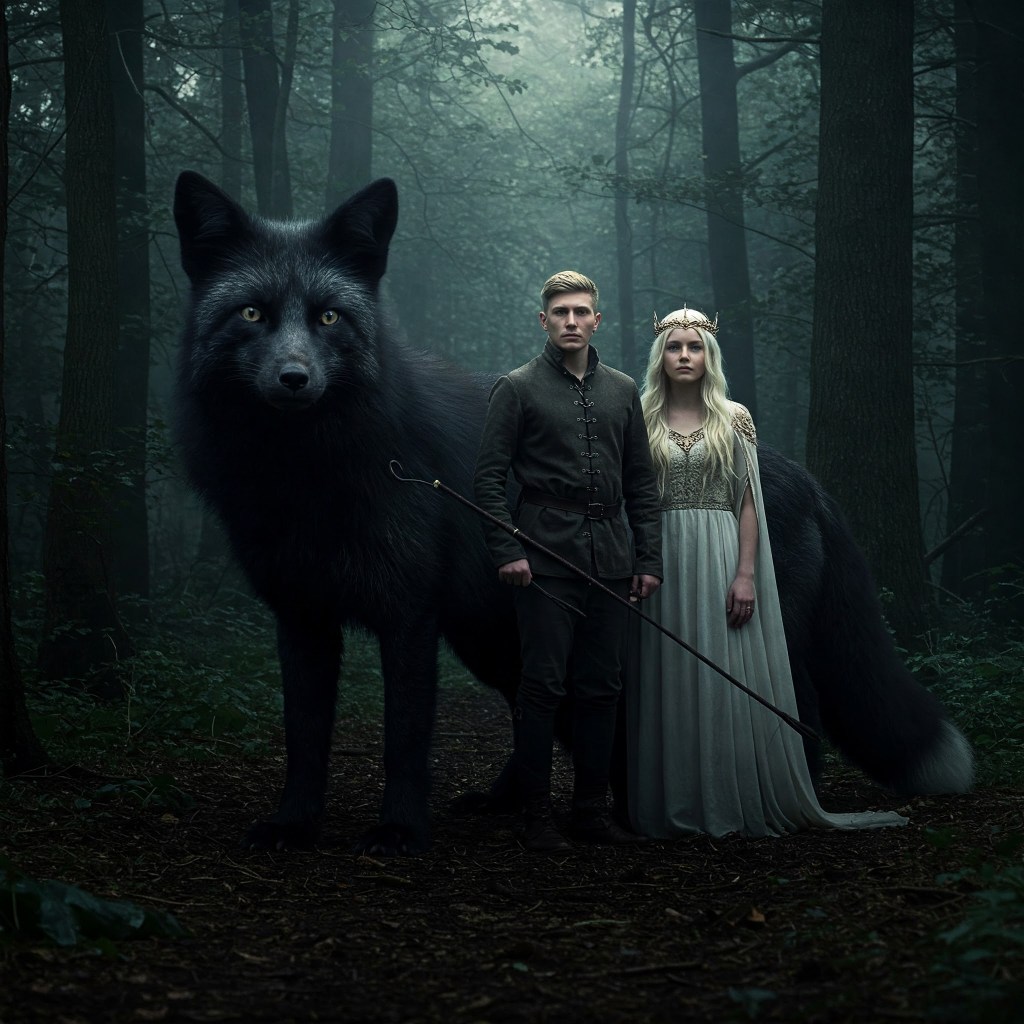
Image by Gemini

The silence stretched for long moments after Beldere’s revelation. There were some incredulous murmurs in the background but nothing distinct until the old man, face an inscrutable mask, finally asked. “Any other questions?”

Catwright the younger couldn’t imagine what his father must be thinking. After finally arriving home after two years on campaign, he gets his head bashed in by his son and then finds out a few hours later that his son is basically his father. Cat almost giggled like a little boy at the thought. He was in a good mood suddenly. With the revelation that the Everborn had a personal interest in him, and then receiving a soul-bound artifact enchanted with dimensional magic with a thousand gold pieces in it, his day had become much better. The letter and the gift were possibly more of a treat than watching his father collapse in the dirt this morning.

“There is something I have always wondered about,” Cat had a genuine smile on his face, which most in the mess hall had never seen. “Why did you have to continue the name of Catwright? Where did that come from, and how did it stick for three generations?” There was unrestrained laughter echoing through the chamber now. Even Beldere looked like his last sip of water almost came back out of his nose. Cat was grinning as well, but the truth was, he had always hated the name, and wondered if his descendants had been fixers of carts who lack a proper alphabetic education.

His father grimaced. “It was your mother’s idea. When she brought you here you were about six months old and she had already named you. You can ask her. You’ll find her, or rather she’ll find you, if only to tell you what an idiot you are for leaving the protection of the grove.” 

Cat was more than a little surprised the colonel answered the question, though it was not really an answer, only raised more questions And the rebuke at the end was so typically his father that Cat had to stifle a laugh. He knew that his grandfather had been an orphan who had embraced military service before he even came of age, but no one seemed to know much more. His mother would. The thought of his mother made him chuckle. Yes, he would find her, and he would have lots of questions. He reached down casually and touched his pack and kit sitting on the floor behind him, and they disappeared into his brooch. He enjoyed the startled gasps.

“You might want to be a little more careful with that particular secret.” The colonel looked thoughtful.

“Why?” Cat challenged, “It can’t be stolen; it’s soulbound.”

“Of course it can!” The old man looked genuinely surprised and disappointed. “They can just kill you and break the binding.”

It was Cat’s turn to be surprised and a little embarrassed, but his snark had not been stifled quite yet. “I will endeavor to prevent the loss then. I would not want to shame our family with a premature death and loss of a valuable artifact.”

His father just rolled his eyes and stood up. “Eat up boy, I assume you’ll want to put some miles on the road before dark. I’ll make sure the facet is ready to depart within the hour.”

It took Cat less than an hour to eat and walk to the west gate. There had been several interruptions and distractions by well-wishers or those who were just plain curious. He received their words with more tact and civility that he could usually muster because of his lingering good mood. He couldn’t remember the last time a simmering anger had not been lurking in the corner of his mind. His step was lighter for more than one reason. He was also physically unburdened thanks to his new amulet. It was strange to have this kind of freedom. He could call anything from his storage space directly to his hand; he didn’t even have to wear a sword belt. It felt unfair in a way, like he had found a way to cheat so many minor hardships with a single acquisition. It had briefly crossed his mind that this might make him weaker, somehow dependent on indestructible, weightless storage. The smile on his face revealed the truth though. It was worth the negligible cost to his pride for such a tremendous gain any way he looked at it.

Beldere and the soldiers were already assembled at the gate. He knew all of the old warriors of course. Crusty old Sergeant Lovine was at the head of a full facet of three swifts. The swifts were veterans as well, each with 2 heavy infantry, a mage, a dedicated healer, and a senior softie. He knew these softies had all cross trained as well; each one could perform as a sapper, an archer and a scout. The grizzled Corporal Remel, who went by the nickname ‘Spikey’, was also a druid. The squat broad man had an oversized crossbow strapped to his back, a thick grey and black beard with penetrating green eyes. “There’s the boy! If we’re goin to get planted, it might as well be while fighting them lizards!”

Cat knew the man had a grudge against the Ssythe, but didn’t know the details. He thought druids were like Beldere, supposedly peaceful and would preach against harming other sentient beings. Spikey was a soldier, though, so he apparently didn’t ascribe to all the non-violent tenants of the priesthood. “I’m not planning on starting any fights, Spikey.”

“Sure you’re not.” The softie shook his head doubtfully and probably had a knowing smile under his ridiculous beard. “It’s nice to get out of garrison duty just the same.” 

Only Beldere and the Sergeant had a horse, but Cat was still surprised by the escort. Most full cluster units did not have more than one or two fully complemented facets because mages and healers were relatively scarce. Most facets would have an extra infantry or bowman to replace a missing mage, and the healer would be a regular soldier with slightly more knowledge as a field medic. Knowing the skills of these men, Cat reckoned he had one of the most effective facets in all of Sapphire company. The mages were actual magi, with access to multiple veils, and the healers were specialists who could truly save lives. This was an escort that most royal houses would envy, and it was all for him. Were they ordered to do this? Did they really think this was a suicide mission?

The mercenaries arrived a few minutes later, each on their own personal steed. There were six of them, all travelling to Osenvale. Garreth rode an enormous warboar, its shoulder as tall as Cat’s head. They were apparently common in the Weltstone area, where the locals were constantly fending off hunters who braved the icy mountains for the valuable tusks. Olivia Peln and her brother Jarod, mages specializing in aquavae and  frigorum, the veils of water and cold, both rode giant black foxes called Shinnocmyr. Some people confused them with dire foxes, but these were more intelligent and magical. Cat was wary of them, because he had very little understanding of their capabilities. He knew they were dangerous, but had never fought them because they had no interest in being ‘stabbed for play’ as Olivia had translated. The rest — Gemma, Markus and Denton — all rode horses. Only Gemma’s was memorable because it was a silver-haired Felton mare. Mercenaries earned a lot more coin than regular soldiers and they tended to splurge on the exotic. One might think the soldiers were envious, but they would point out that most mercenaries don’t last a decade, and a large number don’t survive the first year. 

Risk and reward. Not for the first time Cat considered if he would enjoy the mercenary life. There were always adventures and excitement awaiting talented warriors for hire. Monsters, forces of nature, and creatures from beyond the veils appeared suddenly, and soldiers weren’t always around or equipped to deal with them. There were a lot of grey areas, however. Mercenaries could be hired to fill out armies on whichever side had the most gold. Any lord or merchant with enough coin could purchase their service to stomp out their competition. Cat wouldn’t feel right marching up to someone’s home and killing guards who were just doing their job. Such things did not occur often in Mecre, but there were plenty of nearby realms that were constantly at war with somebody. In these places, people with power and wealth made the rules. It was in those places that mercenaries earned their fame and fortune. It seemed that the best course, if he were to pursue such a career, would be to acquire his own mercenary company, so that he could decide where they went and who they worked for.

Before the group departed the colonel strode up with a group of officers. The soldiers came to an approximation of casual attention, respecting the unexpected appearance of their seniors, but veteran enough not to be intimidated or overly formal. Yet, it seemed the old man planned for some ceremony. The officers behind him came to stiff attention. Two flag bearers appeared with the Mecran flag and the Ironwatch flag and stood in back of the formation with standards held high. The colonel unfurled a scroll and held in front of himself, reading in a confident and projecting voice: 

“All within hearing and sight, behold and bear witness! I, Catwright Isubane the second, do bring to your attention a matter of familial concern. My son, Catwright Isubane the third, from this day forth is no longer a boy to be sheltered, but a man ready to forge his own path. Therefore, by the power vested in me by the King of Mecre, and as a Colonel in the Mecran Army, Commander of Ironwatch garrison and Lord of Ironwatch Grove, I hereby declare Catwright Isubane the third emancipated from my direct authority and guardianship. He is now free to pursue his own destiny, seek his fortune, and make his mark upon the world. Let it not be said that he leaves without my blessing. He carries with him my love, my pride and the pride of those who have instructed him all these long years. May he always remember the honor and values of our house, those of the lands of Mecre, as they and he are watched over by our Grand Gardener, the Watcher in the Wood, Neador lord of the Elderwoods.” His father rolled up the scroll with the practiced ease of an administrator and handed it off to an officer.

“Catwright Isubane the third,” Catwright the second shouted. “Step forward!” Cat was entranced with the show and almost missed his cue; however,  he had seen such rituals performed enough times to know his part. He stepped forward and knelt before his father.

“I bestow upon you the freedom of a man. May you wield it wisely and with courage. Go forth and make your own name, but know that you will always have a place within this keep and within my heart.” The old soldier held out a gold  signet ring. Cat sometimes forgot that they were technically nobility, as decreed by King Mecre on the day his grandfather had died. The titles and lands were deferred, however, until his father resigned his commission. It was likely a large part of the reason his father kept going. It was hard enough being a Colonel; who would want to be a Baron? “Rise, Catwright, not as my son, but as your own man.” Cat stood and accepted the ring, a plain gold band with an oval bezel. His initials were engraved in reverse with three ‘I’s” underneath indicating the ‘third’ portion of his name. He didn’t know what to say. All this affection, emancipation, a ring made just for him. Cat bit his lip. He would not cry! 

“Th..Thank you.” he managed.

A few more words were exchanged and there was some cheering and another round of well wishes. Cat’s mind was in a fog, he barely remembered anything after storing the signet ring and shaking his father’s hand. The old man had escaped with his entourage at some point and the flustered young man couldn’t wait to do the same.

Eventually, they made it through the gate and set a quick pace out of Ironwood village. The weather was crisp and dry, and they continued to make good time through the wide elderwood forest roads. The horses kept a steady trot while the soldiers and Catwright jogged alongside. He thought about offering to store the soldiers’ packs, but he felt like it might be insulting and they seemed to keep up well enough. Most of them had been doing this type of thing since before he was born after all.

The transition to the younger forest was not subtle. The road became a steep and more narrow descent that wound into switchbacks, and the ground vegetation abruptly thickened while relatively smaller and more varied trees grew closer together. As they curved around a particularly scenic outcropping, the deciduous greenery stretching for leagues in every direction, an explosion of birds startled the late afternoon peace. The entire party stopped and stared as thousands of small song birds, and hundreds of larger carrion eaters rose in a wide arc to the west and circled for a full minute with their flocks crossing through one another. The dark cloud of shrieks and screams sullied the sky until suddenly it stopped as the birds scattered in every direction.

“That didn’t seem natural.” a soldier remarked dryly.

“It wasn’t.” Spikey said, shaking his grizzled head.

The old soldier-druid wheezed slightly. “They’re common spies for shamans, druids, priests, and magi. Easy to control and hard to disable. I sensed at least a dozen lookers before I snuffed ‘em.”

“You broke a dozen links from thousands of feet away? That’s impressive.” Denton Blackfoot said, his fine chiseled features disturbed. “I didn’t notice the weaves on the birds or your casting.”

“Aye, Thera don’t like folks dominating her critters, and druids don’t need to part the veils to borrow her power. Besides I only stopped the weaker ones, there are plenty of casters out there who could weave a binding I can’t see.”

“I didn’t see any of them,” Beldere sounded confused.

Spikey looked at the young priest with some sympathy. “That’s why they waited outside the grove, boy; knew you’d be weaker away from the Watcher’s guardians.” 

Cat recognized the look Beldere got when he looked inward. The young man had rarely in his life been outside of a grove, and Cat wondered just how weak his leash had become. Too late to run away now, I’m already free. Yet it was good to know the acolyte might not be as omniscient as he seemed back in Ironwatch.

They travelled for another hour and camped in the partial shelter of an old fortification, a small and crumbling ruin from a long forgotten war. Cat set up his tent outside the walls, not entirely comfortable in the somewhat dark and dank surroundings. While others went about making a fire and cooking food, he spared lightly with the soldiers and mercenaries. Someone remarked that he didn’t need to train so relentlessly anymore, and Cat simply shrugged. It was all he really knew. The session was a game of simple first-touch wins; no one wanted to get hurt too badly, not knowing the extent of Beldere’s limited powers. There were healers among the soldiers, but they were magi with access to animyra and other eldritch veils. None of them were priests as far as he knew. Cat doubted they could heal anything like Beldere, even in his weakened state.

The first round was played one-on-one with just swordplay. It was an advantage for him and he did not disappoint, tagging each in just a few seconds after Sergeant Lovine, the judge, saying ‘go’. The next round, he let them prepare with spells and use any tricks; like non-lethal items they had available. The game became much more even. The veterans and mercenaries were giving as good as they got. Denton tagged him two out of three times with his magically enhanced speed and reflexes. Additionally, the enchantment he put on his sword helped him block and attack with unerring precision. 

On the third try, Spikey pulled out the stops and caused mist to shroud the training area. Cat didn’t mind that; he had experience fighting blind. He was taken to the ground in an instant, however, with a magic rope and then rapidly immobilized with growing vines. He felt the sword at his throat less than thirty seconds into the match. Cat had enhancements cast upon him by Beldere after that, partially to test the limits of the priest’s abilities and partially to up the challenge. He let everyone cast team spells on each other to see how their stacked abilities stood up against the stunted spells and lesser aura of Neador’s faithful servant. The magic was definitely in the favor of his opponents, but many of them were not used to moving faster or having a homing weapon. It was stifling to work against Beldere’s divine aura, but most of them had experience with the weakness and slowness it conferred. Cat was confounded by the combination of speed and Corporal Banid’s light whip enchantment on the blades of experienced warriors. The blades bent in impossible directions with the seeking spells attached, and the arc of the swings left ribbons of light in the air that still burned when touched. It was almost like turning normal swords into Elydrean mana blades.

As meal time approached, Cat’s rations were forgotten. The mercenaries had magical storage items and were happy to share. The smell of auroch steaks and fresh bread made his mouth water. Markus, the designated cook for the evening, had also prepared a spiced vegetable stir-fry, many of the ingredients for which Spikey and Beldere were able to grow fresh on the spot. The Pelns set out a large blanket and two great silver plates three feet in diameter. At first, Cat thought they were some kind of handleless shields until they placed great slabs of lightly warmed meat, the size of a man’s chest, upon them. The great magic foxes took to the feast with obvious delight.

After the evening meal, second and third swift divided up the watch duties, while first swift, having the night off, brought out a heavy metal flask and began passing it around. Swift leader Medane offered the flask to Catwright with a smile. “Drink up son; you might as well start the celebration now.”

Cat took the flask with some reservations; he had never been allowed alcohol within the garrison. For one, it was scarce, and two, his father had forbidden it, saying it could undermine his development. Cat took a swig, and it took considerable willpower not to spew it back up again. His whole mouth burned, then his nose stung, and his eyes started tearing up; it reminded him of the noxious magical clouds they used during gaseous warfare training. “You need to swallow it, Cat!” Gemma chortled from the other side of the fire. Swallowing caused the burn to continue all the way down his throat, but when it hit his stomach, warmth spread through him. Now he understood the quick sips and the grimace on the soldiers’ faces. He passed on the flask, noting with little surprise that Beldere declined. It was perhaps the most unpleasant drink he had ever tried, but he took another each time the flask came around, interested to see how the tinctures he had taken over the years would affect his tolerance compared to the others. Everyone in this group likely had at least some physical tempering, but his father had spent thousands of gold on Cat’s development, something most soldiers could not afford.

“This particular batch of Ironwatch whiskey has been enchanted with spirit mana by a master brewer,” Medane said casually, causing some of the mercenaries to look up sharply with concern. The old soldiers chuckled at the looks. “It won’t harm you none,” he waved his hand in a vague gesture. “It enhances the more enjoyable effects, like honesty and uh, relaxation, while reducing the less pleasant effects on the morrow.” Cat shrugged and took another sip; he felt his face start to heat up pleasantly. He was definitely relaxing. Muscles he hadn’t known were tight, were releasing their tension. The firelight, the friendly atmosphere, and the warm sensation in his face all seemed to lull him somehow.

“Why is it so hard to manifest mana while fighting?” Cat did not usually like addressing a group of people, but he felt more comfortable in this setting for some reason. His gaze fell on Denton as the most likely to have an answer.

“You’re looking at me, but you are one of the most gifted mana manipulators I’ve ever seen at your age.” Denton smiled wistfully, his dark eyes turned downward, almost sadly.

“Wh…what?” Cat responded, surprised.

“You naturally use lithos in your stance, which is why you’re nearly impossible to knock over. You are constantly switching among the other elements which makes you inhumanly fast and unpredictable. You even manifest animyra to see all around you and heal faster.”

“I don’t control that; it just happens.”

“Yet it is a manifestation of your will upon the veils and the elemental mana around you.”

“What about a physical manifestation like casting a spell?”

“Casting is a whole separate study, but you know that. What I do is mostly casting before a fight to prepare. I can manifest lithos and aether while fighting for strength and speed because I have cast the spells so many times; opening the veils is second nature. Like you, I don’t really need to think about it.”

Cat was still frustrated; he was at a loss to explain what he needed to know. The fog that clouded his mind was not helping. “When you speed up during a fight,” He paused to focus. “You know what is happening, you can feel the veil opening and control it.”

“Well, yes.”

“I don’t feel it happening; I don’t control the veils.”

“You do not have specialized training in that area, but you should still feel the veil opening inside you” The spellsword made a motion like opening tent flaps.

“I feel the world slow down around me when I speed up, and I gain a sort of surety at a certain point, a feeling for what’s coming next. The lithos make me feel rooted to the ground and it seems like I’ve always been able to do that, even when I was really little.” He remembered  a nursemaid trying to pick him up when he was about four. He had wanted to play with some small military figurines he had discovered and resisted her. When she couldn’t lift him, she cried for help, not understanding what was happening.

Denton nodded “The precognition is rare, but not unheard of in seasoned warriors. You may be pulling mana from the environment around you; it’s inefficient, but it makes sense since you don’t have a lot of formal mage training, and it explains why you don’t feel the veils.”

“You just keep practicing and focusing on improving, and eventually, the veils will help you out.” Corporal Banid jumped in, scratching his scraggly beard after a sip from the canteen. “It’s easier if you work on one thing until you get what you want. If you’re too ambitious though, it can take years.”

“Manifestation is associated with familiarity,” A cold breeze touched the fire as Olivia twirled her fingers in front of her. Cat could see frost on her fingertips, though she did not seem to be uncomfortable. Her dark eyes became lighter with a slight glow, and her short, cropped blonde hair started lifting upward. “The body does not naturally accept a veil opening within it, but with practice, you create channels, much like blood vessels, and manipulating the weaves becomes easier. Your body becomes closer to the veils. They open more easily and stay open longer, and the power can be addicting.” By the time she finished speaking several soldiers were pulling their cloaks tighter about them and hunching down for warmth. Cat smiled in appreciation, few people could merge beautiful and creepy like Olivia Peln.

“Manifesting is simply using the power of a veil without the need of words, gestures, runes, or a catalyst to prop it open.” Jarod put it.

“What about a focus?” Asked Somera, a stocky woman of middle years who served as first swift’s healer.

Jarod seemed surprised by the question and looked around at Olivia and Denton’s smiling faces as if in fear of being tricked. “Ah, the education of a soldier is much more practical than theoretical I suppose. He nodded respectfully to the older woman, his pale, sharp features embarrassed.  “The focus in common manifested spellcraft is you, or more specifically your soul.”

Somera was unperturbed. “So why do I need to use a wand or a staff to cast?” Her thick brows furrowed.

“That is a complex question.” Jarod sat back and stared for a moment at his black serpent-leather boots, likely more expensive than everything the soldier carried. There was a class difference here, not just in wealth, but in education as well. “Not everyone has the same gift with the veils. Some will never access a veil without some expensive assistance. Some just need a little extra help, he gestured to her polished oak staff. And still others just seem to have mana leaking from their pores.” He nodded pointedly at Catwright, and Cat was starting to understand his advantage. “The wooden foci you use are specifically potent for access to Salatosum, the veil of life. A spellsword, he gestured at Denton, might use steel to help access Bellicorum, the realm of conflict. The soul, however, is a conduit for all the known veils, and many we do not understand. Learning what it would take to unlock your potential would take too long to justify for Mecre’s standard two years of service. I studied and practiced for over a year before I could reliably cast my first spell.”

More questions and answers flowed around the fire, the soldiers more bold, and the mercenaries open with what they knew. Cat’s mind drifted off with the possibilities of higher training for career soldiers, or having an army of well-equipped and well-educated warriors. 

His dreams were strange and vivid that night. Something stalked him through a dark forest. He was not afraid but for some reason he could not be bothered to turn around and confront whatever it was. He was a passenger in another body; the instinct to run or fight was high, but however he tried, he could not act upon it. He awoke to a camp already in motion. Soldiers were emerging from the ruins, some of them already packed and ready to march. They ate a quick breakfast from the leftovers of the night before and made an early start upon the road. 

By early afternoon, they were among the farms which heralded the outskirts of Breckan’s Hold when Cat spotted an armored warrior on a giant black Mecran Destrier galloping towards them. The knight carried a long shaft of wood tipped with steel casually across his shoulder. Cat grinned and glanced at the scowling priest. “Bel, I think I’m going to need a lance.”
Minecraft, the Addiction is Real

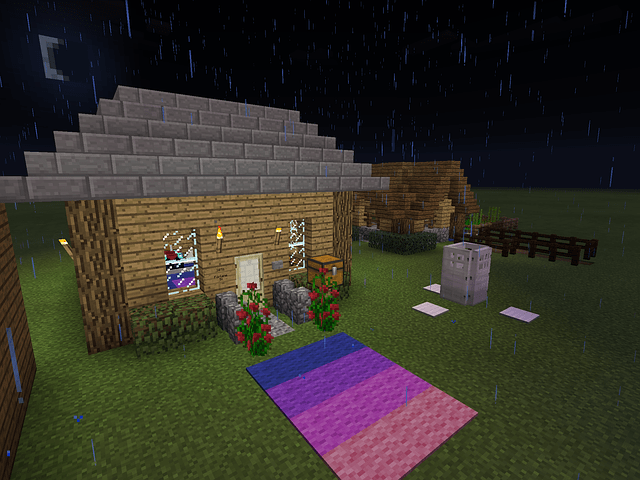
Image by SkyeWeste

Minecraft is the first game my son and I completed together. By completed I mean defeating the ender dragon in survival mode and seeing the credits scroll by. We had been playing for a while, dodging the endermen and waging a sort of primitive trench warfare against the dragon when my son said “Dad, if we just put on pumpkin heads the endermen will ignore us.” We put on our new carved helmets and the rest is history. He was five, and I was so proud as we watched the credits scrolling by, reminding me of the first time I beat Mario Brothers so long ago. Since then my Mom and one of my brothers have also started playing, joined occasionally by my wife. 

If you have gone this far with the game, you appreciate the time and effort involved, and you also probably won’t need to read the rest of this post. If you have not, you may well be missing out on the cross generational, cross dimensional, geologically magical adventure that is Minecraft.

Minecraft, since its official release in 2011, has captivated millions of players worldwide, becoming one of the best-selling video games of all time. Its simplistic graphics and seemingly straightforward gameplay might not initially suggest a recipe for addiction, yet it has a magnetic hold on its audience. So, what is it about Minecraft that makes it so addictive? I’ve tried to explain this to friends and family for years but it’s hard to articulate its nature properly, especially to adult gamers who look at minecraft as ‘just a kid’s game’.

Minecraft’s most compelling feature is its sandbox nature, which allows players to build and explore without predefined objectives. This open-ended creativity is a significant draw. Like life, exploring minecraft is quite like an infinite box of chocolates. In Minecraft, players are limited only by their imagination. Want to build a replica of the Eiffel Tower? Go ahead. Feel like constructing an underwater city? No problem. This freedom to create and modify the game world offers endless possibilities and keeps players coming back for more. 

I’ve had fellow gamers scoff and tell me that I should just play Ark, as if better graphics makes a better game. Although I do love taming armies of dinosaurs, you can’t really dig in Ark, it is not a true sandbox in my opinion. At some point I may need to make a separate blog post on what constitutes an actual sandbox. Some people think a true sandbox is basically a game development engine, but the game should have some set qualities otherwise very few people will invest the time to learn all the tools. Other people seem to think any game with an open world and questionable or non-existent storyline is a sandbox game. Yet none of the better graphics games seem to come close to the scope and versatility that is Minecraft. I would say that 7 Days to Die is the closest thing I’ve seen to an actual sandbox game with decent graphics. Please feel free to comment with your opinions.

Unlike many other games, Minecraft starts you off with a blank canvas. The absence of a rigid storyline allows players to forge their path, setting and achieving personal goals. This creative freedom is akin to playing with digital Lego blocks but on a much grander scale. The satisfaction derived from seeing a project come to life, block by block, is immensely rewarding and addictive. I should mention that Lego Fortnite is coming along nicely but still has a way to go to compete with Minecraft. ‘A’ for effort Epic!

Minecraft offers vast, procedurally generated worlds filled with diverse biomes, hidden treasures, and mysterious caves. The sense of discovery and adventure is a powerful motivator. Every new world is unique, providing fresh landscapes to explore and secrets to uncover. The game’s procedural generation ensures that no two worlds are the same. This randomness fuels  curiosity and encourages players to venture into the unknown. The excitement of what lies beyond the next hill or within a dark cave keeps players engaged and eager to explore further.

The survival mode in Minecraft introduces elements of danger and resource management. Players must gather resources, build shelters, and fend off hostile mobs like zombies and creepers. This survival aspect adds a layer of challenge and urgency that can be thrilling and addictive. Managing resources effectively is critical to survival. Players must mine for materials, hunt for food, and craft tools. The satisfaction of progressing from basic wooden tools to diamond-encrusted armor provides a strong sense of accomplishment and growth. Battling mobs and planning defenses adds a strategic element to the game. The adrenaline rush of surviving a night filled with zombie attacks or successfully navigating a perilous cave system enhances the game’s addictive nature.

Minecraft’s multiplayer mode allows players to join servers, collaborate on massive projects, or compete in mini-games. The social aspect of Minecraft fosters a sense of community and camaraderie.Working with friends or other players on large-scale projects can be incredibly fulfilling. The collaborative effort of building cities, amusement parks, or intricate redstone contraptions strengthens bonds and enhances the gaming experience. Minecraft has a vibrant online community with countless servers catering to different play styles, from creative building servers to competitive PvP (player vs. player) arenas. The ability to join and contribute to these communities adds another layer of engagement and addiction.

Minecraft’s educational potential is another factor contributing to its addictive nature. Many schools and educators use Minecraft as a tool for teaching various subjects, from math and science to history and art.The game encourages problem-solving and critical thinking. Players must figure out how to gather resources, build structures, and survive in a challenging environment. These problem-solving aspects are not only educational but also highly engaging. Minecraft promotes creativity and innovation, essential skills in today’s world. The game’s redstone mechanics, for instance, allow players to create complex machines and circuits, fostering an interest in engineering and technology. My son has a Minecraft world that simulates the periodic table of elements, allowing the combination of protons, neutrons and electrons to create any element, and then further facilitating the building of molecules with those elements.

Mojang, the developers of Minecraft, continually release updates that add new features, biomes, mobs, and mechanics. This constant evolution keeps the game fresh and exciting. The extensive modding community further extends the game’s lifespan. Mods can add new dimensions, gameplay mechanics, and even entirely new games within Minecraft. This endless stream of content ensures that players always have something new to explore and experience.

Despite its challenges, Minecraft can be incredibly relaxing. The simple act of mining, building, and exploring at your own pace can be therapeutic. The game’s repetitive actions, such as mining or farming, can induce a state of mindfulness and focus. Many players find solace in the game’s peaceful moments, where they can escape the stresses of the real world and immerse themselves in their virtual creations. After a stressful day of work it’s hard to beat zoning out with beer in hand just digging for diamonds.

Minecraft fosters a deep sense of personal investment and ownership. The time and effort players put into their creations generate a strong emotional attachment to their worlds and projects. Unlike many other games where progress can be reset or lost, Minecraft worlds can be preserved indefinitely. This sense of permanence adds value to players’ efforts and achievements, making the game more meaningful and addictive. I have a world that I’ve been enhancing over the course of 4 years. I call it my ‘trophy world’ not only because it stays in survival mode so I can earn in-game trophies, but because it is an evolving monument to my own creativity and diligence.

Minecraft’s addictive nature can be attributed to its blend of creativity, exploration, survival challenges, social interaction, educational value, continuous updates, therapeutic qualities, and personal investment. Each of these elements contributes to a deeply engaging and immersive experience that keeps players coming back, time and time again. For me and my family it offers a virtual environment where we can gather and work towards common goals while we catch up and spend quality time together even though we live on opposite sides of the country. Whether you’re a master builder, an intrepid explorer, or a survivalist at heart, Minecraft offers something for everyone, making it one of the most compelling and addictive games ever created.

World building part 2

Photo by Miquel Rosselló Calafell

In this second post on the topic of world building we’ll continue by building upon some of the ideas from the previous post and delving more into the mechanics of the game itself. As I write this, I’m debating if I want to add my own campaign world to this blog. Looking back through my notes and writing I realize that it is pretty disorganized and unbalanced. Maybe I can use my own advice and refine this world into something others might enjoy. I also have a story that is in its initial stages which relates to my campaign world and some of the prominent characters. Looking through the writing it’s obvious that some serious practice is required on my part to get back into the groove. This might be a good opportunity to get into some of that as well and maybe post some of these stories as a web serial. After reading the Wandering Inn I can’t help but be fascinated by the idea of doing nothing but writing a web novel full time in my retirement. For now, let’s jump back into the basics of world building.

Developing factions and organizations is a key strategy for enriching your world with complexity and tension. These entities, each with their own objectives, ideologies, and skills, can significantly enhance the political landscape of any setting. Identify the purpose each faction serves in your world, such as political entities, spiritual bodies, or different guilds—ranging from merchants and thieves to warriors and sorcerers. Consider their ambitions and core essence. Will they assist the players, or will they pose obstacles?

Delve into the backstory for each of your factions. Work their history into the world’s history. Highlight events that shaped the formation of your organization and describe how the repercussions of their past actions affect the players today. Include the past conflicts and political struggles and how it led to their current situation. Who are the notable members of this group? Are they a master crafter, a skilled tactician, or blessed with a silver tongue? Define the hierarchy of the group. How do they gain power or rank? What are the traditions and customs associated with the faction? Can the players become members? If so, how?

A strong faction will usually have influence over a geographical area or at least have a stronghold. Group ties will usually revolve around some sort of resource and compensation. How powerful is your group? How does the resource or area they control affect the economy and the local government? How does their combat power stack up against the local military or police force? There should be powerful stable actions to counter and balance forces that are prone to conquest and chaos. Detail the allies and enemies of the various parties and how they complement or undermine each other. Integrate quests involving the factions into game play and create drama. Players can spend half a game session discussing the ethical ramifications of helping one faction over another. It’s a great bonding experience.

If you are ambitious, have a reputation system that keeps track of the player’s standing in the various organizations. I’ve never really done this with a table top game, but I’ve seen it in a few video games. This reputation can help them gain access to new quest lines, new areas, unique items or even special abilities. If you have an artistic flare, design flags, colors, clothing and architecture that reflects the organization. Create distinction between groups by defining behavior, language differences, codes of honor, and customs.

Now that you are juggling all these factions you need to allow the players to influence them over the course of the story and be ready to accept the inevitable changes that should result. Again remember to keep good documentation for consistency and maintaining balance.

Once you have the basics of your factions outlined, enhance them with a diverse variety of characters. One of the most memorable parts of a gaming session are the interactions between the players and colorful NPCs. The game master should have a solid understanding of the backgrounds, and motivations of the supporting cast. The relationships you build between the supporting characters and players will bring more engagement with the narrative. I like to base my NPCs on people I have met before or an actor on tv, so that I have a picture in my head of what they look like, their mannerisms, clothing, ethnicity and voice. Naturally, I amplify the character, elevating them to a grander scale than what I’m familiar with, to ensure they stand out and entertain. Incorporating numerous details is beneficial, particularly with a vast array of characters, allowing for some similarities while maintaining distinct and unforgettable personas. Assign your NPCs weaknesses and drives, avoiding an excess of clichés. Detail their familial origins, socioeconomic standing, and political beliefs to add depth.

Next, we’ll delve into the mechanics of the game. This section might not resonate with those utilizing pre-existing systems, but for anyone aiming to craft something distinctively their own, there are several considerations to bear in mind. Our desire to infuse our unique touch into the world stems from our creative nature and the joy of gaming collectively. There’s a certain thrill in unleashing our imaginative chaos onto a mundane reality. However, when improvising, it’s important to be wary of potential pitfalls like disrupting the game’s balance or making commitments that are hard to fulfill.

We’ve all been there, in the middle of a cool battle when one of your players comes up with a cool idea with ambiguous rules. You don’t want to slow the flow of the game so you’re like “sure I’ll allow that.” The next thing you know it becomes an exploit that you “allowed before” and the players just bring the ceiling down on the dragon’s head instead of fighting the poor thing. The fact is, we can’t make a rule for everything, but I find that when I am directly involved in creating the mechanics, the numbers and intentions of the rules make more sense and are easier to apply in unique situations.

Developing a set of rules for a tabletop or video game can be a pain, and requires a lot of planning, work and testing. You need a framework to start with that defines what you will allow the players to do. I suggest starting with the basic Hero Quest actions like moving, attacking, and casting spells, then build out from there. Start with an objective for each action and define what the players are trying to achieve. For tabletop games, determine the sequence of actions and what players can accomplish in their turn. For MMOs you need to understand how the real time actions will be structured.

Develop a stat system for attributes that will affect gameplay, for example strength and intelligence. Create a skill system that allows balanced progression and improvement. Define the key resources such as health and mana and how they are used and replenished. Design a combat system with damage calculation, special abilities and defense resolution. Figure out how alternatives to straight combat are resolved when other skills are involved like diplomacy, stealth, and fear. There has to be dice! Decide how the deities of chance affect the gameplay.

The level progression system is the bread and butter of your mechanics. Players need to progress and get stronger in order to defeat tougher foes. Experience can be gained by defeating enemies, completing quests, or overcoming specialized challenges like disarming traps. I have been working on a class-less system for a while and it is rough. Perhaps in the future I will post some of what I have to the blog and ask for some feedback from some more mathematically inclined individuals.

Develop a (virtual) material reward system for overcoming objectives. Yes, I’m talking about that sweet loot. I have many fond memories as a high school nerd flipping to the back of the Dungeon Master’s Guide and rolling on those treasure tables. Gold and magic items, much like experience, should be balanced and earned. Your random number generation mechanism should make it very unlikely to find a plus five vorpal dancing longsword of godly might lying around in a room full of kobolds.

This marks the end of my guide to world-building, at least for the moment. My expertise predominantly resides in crafting stories and plots for tabletop games, with my experience in video game development being somewhat limited. I believe that starting with a well-developed, written world can simplify the process of creating the data structures needed in video game development. As I expand my knowledge, I’ll share more insights. I welcome your comments or suggestions, particularly from those who have experience or know someone who has successfully transitioned their tabletop game into a video game.

World Building Part 1

Photo by Konstantin Fichtner

One of the aspects of game development I have had some experience with through years of tabletop gaming is world-building. As any good dungeon master can tell you, coming up with engaging content is a lot of work, but it’s also very rewarding. It may be easier to take a module or scenario that someone else has written and adapt it to your campaign but it can feel clunky and leave you scrambling to answer the inevitable context related questions your players will come up with. I believe world-building is a crucial skill that is used in creating immersive environments in both tabletop games and video games. One of my goals is to someday take the experience I have from running hundreds of Dungeons and Dragons sessions and building my own world, and apply it while developing an MMO. Let me share with you some of the basics acquired from around the web and my own experiences and introduce the realm of world-building.

The first thing I like to start with is a map. There needs to be a physical world with some geography including mountains, forests, rivers, oceans and cities. The climate and ecosystems for each area should be considered. If it doesn’t make sense from a basic scientific perspective, for example rivers should run downhill from mountains to larger rivers and eventually to lakes and oceans, you will have to know why. If the basics like gravity and common sense are ignored, this can be ok, just be ready to explain the fantasy aspects in detail. Once you have the basics on a piece of paper or some mapping software, like Campaign Cartographer, you can pick a spot to start your adventures.

Before getting into your story, think about the theme and genre.Is this going to be a horror, sci-fi, fantasy or all of the above type of world? Consider the technology level. Are they only a bow and arrow society? Crossbows? Guns? As you write more of the story of your world consider the history and lore and the various societies and factions that affect the scenario. Historical myths and legends that directly affect the cultural evolution of the people of your realm create more engagement from your players. Remember that the players are paying attention to see if any of this is pertinent to how they complete their quests and get their loot, so include details that are interesting and relevant, but not too long winded. Create places of interest like dungeons, castles and ruins. Have unique back stories, cunning creatures and interesting characters (NPCs) related to each one.

Think about the different societies and factions that will affect your story and the relevant gameplay. What are their beliefs, motivations, customs and political structure? In my opinion it is easier to start in a small town and work your way out. You can work to flesh out each faction week to week as the characters are introduced to them instead of doing all the work up front. You may even decide to create certain specific groups and ideals based on the needs of your players or to incite more drama between players and NPCs. Ask yourself the questions a player might ask upon entering your world. Think about the economy of your starting area and the resources that are available. What do people do for a living and what do they eat? What kind of travel is available and who do they trade with? How do the people pay for stuff, standard copper silver and gold, or something more interesting like glowing mana-infused gems? 

Taking your story to a video game requires all of your aspects to be much more fleshed out. Your map will be more detailed, thought needs to go into how characters will navigate through different biomes. You will need to have actual building designs representing particular cultural architecture. All of the narratives and subplots must be complete and ready to go in quest format, pre-written NPC conversations and lorebooks that can be found within the game world. Having a well organized setting from years of tabletop gaming can help you avoid a lot of the pitfalls of an incoherent story and have the added benefit of ready-made quests and player engagement.

Let’s dive more into creating a culture for your world. Start with creating the prominent races and setting up their interactions. Each one should have at least a basic cultural description and history. The culture should organically develop from the setting and backstory and include languages, customs, social norms, religions and political system. Figure out who is in charge, how they got there and who opposes them. Is this a Kingdom with nobility? Maybe the government is controlled by merchants or guilds or there is a council that decides everything with competition for seats. What motivates the populace? How do they earn their income? What is the education level like? Is there a class system where the rich few have the power and peasants toil away for a few coppers a day? Culture also includes things like celebrations, holidays and traditional games or sports. Finally bring out the drama. Who are the political rivals? What neighboring countries are thinking about invading? What monsters lurk in the dark fringes of civilization?

A large part of where culture comes from is a society’s history and lore. A well developed backstory including all of the critical elements will greatly enhance the playability of a game, whether it is a tabletop or a video game. This backstory should provide context and depth to your world by detailing myths, legends, historical events and influential figures like heroes and villains. These items can provide the foundation for current conflicts and plotlines within the game.

Start with how the world was created,for example was it formed by gods, some cosmic event like the big bang, or was it constructed like the Death Star or Ringworld? What are the significant events or time periods in world history? Can it be broken down into ages or eras? Sections of time can be defined by conflict, renaissance, decline, the fall of empires, natural disasters or cataclysms. Maybe a new species invaded the planet from space or emerged from the depths and forever changed the course of civilization. Don’t be afraid to get into the details of the past with major civilizations, describe how they rose to power, or how they may have declined. Explain the major beliefs and traditions and customs and how and why they may have changed over time. Develop the legendary heroes and villains of the ages and why they are remembered and feared. Definitely highlight the major conflicts, including who was allied with or backstabbed by who. 

Myths and legends can define a culture. Make sure the subject of these tales are larger than life and exciting. The adventures of these legendary figures shook the world and became exaggerated over the centuries, immortalized in literature and song. For more depth and mystery continue to develop smaller tales and legends that vary from region to region. Think of the Loch ness monster, bigfoot or the Blair witch. Introduce this lore during gameplay and try to make it relevant to the current story or lead into upcoming stories. Add intrigue by leaving some of the mysteries unexplained. Leave some story arcs open ended for updates and expansions.

Always strive for internal consistency. Make sure your lore with respect to magic or technology is compatible with the existing game mechanics. Ensure historical accuracy within your story. You don’t want to have a treasure trove of full plate armor ten thousand years old when the bronze age was only three thousand years ago. Create a reference document for all of your world’s history, culture, and myths. Try to make common knowledge accessible. In tabletop games you can provide the players with guides for their use. In video games the lore tends to be  more spread out through conversation with NPCs and the reading of lorebooks, but you can certainly have online lore encyclopedias. 

For most fantasy storylines the systems of magic are the defining shape of the gameplay and major motivator of the narrative. Creating a consistent and logical form of magic should be a top priority for any fantasy world developer. Decide where the magic comes from and what form it takes. Is it a natural force? Is it based on faith? Is it internal or external? Also consider if magic should be something everyone can learn or just for an elite few. The magic needs to have limitations like taking time, willpower, mana and or physical resources.

Having dabbled in the development of magic systems I can attest that this is one of the more demanding aspects of world building. There are a huge number of variables to consider before you can even look at balance. How many schools of magic will you allow? Having just elemental magic is relatively easy, but what about necromancy, illusion, healing or summoning? Should the system be customizable or static? Consider how much number crunching you are willing to do in a tabletop game. In a video game timing is everything with casting time, cooldowns and good old resource management. Finally decide how magic will influence the balance of power and overall culture of your world.

If you decide to go with technology or a mix of technology and magic, many of the same considerations apply. You need to define the level of technology, how available it is and how it is used. Is this technology developed or found? What is the effect on the culture? What are the ethical and societal impacts? If you have both then rules will need to be in place for how they react together. Does magic hex technology, or is full on magitech available? Again make sure you have good records for consistency and narrative alignment. No matter which system is used, playtesting will be an integral part of the process to ensure a system that flows and is in balance. 

Define the basics of your economy by establishing currency for all of the different factions. Decide what kind of economy you have, for example is it a feudal gold based system or a modern digital (credit-based) economy. This can get complex very fast so I recommend starting very general and getting more detailed as needed. Identify the key resources of your world, including minerals, metals, food, magic and technology. Decide how scarce your resources are and where each particular one comes from. Have a basic idea of the trade system including routes and import/export dynamics. In an MMO trade will most likely involve an auction house or player to player trades.

Decide how much you want the players to influence the economy. Players can have an effect through quests and missions for different traders and merchants. They can also affect the economy through the gathering of resources and crafting. Integrating the economy through gameplay will promote player engagement, especially in MMOs. Remember to take into account how events like war, natural disasters or even a large festival can affect supply and demand. These scenarios can create easy story hooks to get the players involved, like the standard “stop the bandits from stealing our stuff” story starter hook.

So, I had thought that I could put all of this world building advice into one post, but the more I write, the more stuff I think of. We’ll call this a good first post and I will add more in the future. In the meantime, remember to always run quality assurance and control on your world. Make sure to maintain balance. Magic and the economy can get out of control really fast when players discover all the loopholes you missed or through monumental and unexpected effort they crash your economy or become invincible. The idea is that your game stays fun for everybody.