In a world drowning in data, we often focus on output: what we create, what we post, and what we achieve. But what about the input?
The sheer volume of information, entertainment, and distraction thrown at us every second is unprecedented. We are constantly consuming—from social media feeds and 24/7 news cycles to endless streaming options and notifications. This constant stream of digital input is the invisible force shaping our mental landscape, our energy levels, and even our sense of self-worth.
If we want clear thought, focus, and genuine self-improvement, we can no longer afford to treat our minds like a passive dumping ground for whatever the internet throws our way. It’s time to practice Input Hygiene.
What Is Input Hygiene?
Think of it this way: You wouldn’t eat junk food all day and expect to feel energized and healthy. The same principle applies to your mind. Input Hygiene is the conscious, deliberate process of curating what you allow into your attention. It’s about protecting your mental space from low-quality, toxic, or simply overwhelming information.
Why It Matters Now More Than Ever
Combating Digital Fatigue: That feeling of mental exhaustion isn’t just from work; it’s often from the relentless cognitive load of processing endless, uncurated information. Reducing noise frees up energy for things that actually matter.
Protecting Your Baseline Happiness: Constant exposure to curated “highlight reels” on social media or sensationalized news narratives can warp your sense of reality and hijack your mood. Filtering your input helps you maintain a healthy, balanced perspective.
Cultivating Deep Focus: Your brain is constantly being trained to handle tiny, rapid bursts of information (the scroll). Improving your Input Hygiene retrains your attention span, allowing you to engage in deeper work, reading, and thought.
Three Simple Steps to Better Input Hygiene
1. Audit Your Information Sources
Take a mental inventory of everything you consume on a typical day. Where is the majority of your input coming from?
Identify the “Junk Food”: What sources consistently leave you feeling anxious, jealous, or simply drained? Unfollow, mute, or block them. Your news feed is not a moral obligation.
Seek “Nutritious Food”: Actively seek out sources that inspire you, teach you a new skill, or provide balanced, well-researched perspectives. Think: books, long-form articles, thoughtful podcasts, or accounts that genuinely add value.
2. Implement “Digital Intermittence”
Just as intermittent fasting gives your body a break, digital intermittence gives your mind a break.
The First and Last Hour: Commit to making the first hour after waking up and the last hour before bed device-free. Don’t start your day reacting to the world’s demands or end it scrolling. Use this time for reflection, reading, or planning.
Scheduled Checks: Instead of checking email or social media whenever a notification pops up, schedule three specific times a day (e.g., 9 AM, 1 PM, 5 PM) to engage with them. In between, the apps are closed.
3. Control Your Defaults
We often fall into poor habits because they are the path of least resistance. Change the default setting of your devices and environment to support better choices.
Silence the Notifications: Turn off non-essential push notifications for everything except direct calls and texts.
Move the Apps: Remove distracting apps (like social media or games) from your home screen and put them in a folder buried on a third screen. The slight friction makes you think twice before opening them.
Make Knowledge Accessible: Put a physical book, a notebook, or a hobby project right next to your couch or bedside table. Make the healthy input the easier choice.
The Takeaway: Your mind is the engine of your life, and the quality of your output is entirely dependent on the quality of your fuel. Start treating your attention with the respect it deserves. Start practicing Input Hygiene today.
In a world of fleeting likes and curated online personas, is a book from 1936 still relevant? A book with a title so bold it sounds like a manual for manipulation: How to Win Friends and Influence People. You might see it on a shelf, its tan cover and classic font looking like a relic from a bygone era. Yet, tucked beneath the dust of time is a simple, profound truth: Dale Carnegie’s principles are not just relevant—they are more essential than ever.
When Carnegie wrote his book, the world was on the cusp of a great transition. Industries were growing, commerce was globalizing, and the skills of communication and human connection were becoming paramount. Today, we stand at a similar precipice, but the medium has changed. Our “friends” exist in social media feeds, and our “influence” is measured in clicks and shares. The fundamental human need for connection, however, has not changed one bit. Carnegie’s timeless principles offer a powerful antidote to the superficiality of modern interaction, providing a road map for building genuine relationships in an age of digital disconnection.
The Core: Beyond Manipulation to Authenticity
The most common misconception about How to Win Friends and Influence People is that it’s a guide to becoming a smooth-talking, manipulative salesperson. The title, unfortunately, gives this impression. But if you read the book, the opposite is true. Carnegie’s principles are not about coercion; they are about empathy, respect, and genuine interest in others. He teaches that to “win friends” and “influence people,” you must first understand them.
Consider the bedrock of his philosophy: The only way to get the best of an argument is to avoid it. In the age of Twitter flame wars and comment section battles, this principle is a revolutionary act. We are constantly conditioned to defend our points, to “win” the online debate. Carnegie suggests a different path—one of de-escalation and understanding. He argues that by avoiding conflict, we preserve the relationship, the very foundation of influence. This isn’t about giving up on your beliefs; it’s about recognizing that people are not swayed by being proven wrong. They are swayed by being heard.
Another cornerstone is a principle that seems almost too simple to be profound: Be a good listener. Encourage others to talk about themselves. In a world where everyone is a brand manager of their own life, constantly broadcasting their achievements and opinions, genuine listening is a superpower. When someone truly listens to you, without interruption or the urge to formulate a response, it’s a rare and powerful feeling. Carnegie knew that human beings crave validation and the feeling of being understood. By giving people your full attention, you build trust and rapport in a way that no clever retort or social media post ever could.
Our modern communication tools—email, text, social media—are incredibly efficient, but they often strip away the very humanity of our interactions. The nuance of a tone of voice, the sincerity in a person’s eyes, the warmth of a handshake—these are all lost. As a result, misunderstandings are rampant, and genuine connection can feel scarce. Carnegie’s principles are a call to return to the basics. They remind us that before we “like” a post or send a quick text, we must remember the person on the other end. He encourages us to think about what is important to them, to find common ground, and to express genuine admiration. This isn’t just about professional networking; it’s about enriching our personal lives and building a community that feels less like a performance and more like a shared experience.
The Introvert’s Secret Weapon
Carnegie’s wisdom is a secret weapon for those who are naturally introverted, offering a powerful, low-energy approach to building meaningful relationships. Introverts often thrive in one-on-one interactions and feel drained by large group settings. They are natural listeners and observers. Carnegie’s principles don’t require you to become a loud, bubbly conversationalist; they empower you to lean into your natural strengths and use them to your advantage.
Carnegie’s most repeated advice—Be a good listener. Encourage others to talk about themselves—is tailor-made for the introvert. Extroverts may dominate a conversation with their own stories and ideas, but the introvert’s power lies in their ability to make others feel truly heard. For an introvert, a social gathering can be a daunting landscape. Instead of trying to “work the room,” an introvert can use Carnegie’s method to find one or two individuals and engage them in a deep, meaningful conversation. By asking thoughtful questions and giving their full, undivided attention, they are not only making a powerful impression but also conserving their social energy. The focus shifts from the pressure to “perform” to the simple act of genuine curiosity.
This principle is even more relevant in the digital age. In a virtual meeting, an introvert might struggle to speak up, but in a follow-up email or a private message, they can use their listening skills to their advantage. A simple, “I really appreciated your point about the Q3 projections. Could you elaborate on how you see that affecting our team?” shows that you were paying attention, values their input, and is a non-threatening way to build a connection.
Carnegie also taught the power of asking questions instead of making direct, confrontational statements. This is a subtle but profound tool for introverts. This method avoids conflict, shows respect, and saves energy. It puts the conversational ball in the other person’s court, allowing you to listen and think. For the introvert, this is a path to influence that doesn’t rely on being the loudest voice in the room. It’s about being the most thoughtful.
Perhaps the greatest lesson for introverts is that Carnegie’s methods only work when they are sincere. Introverts have a built-in advantage here; their interactions are often more deliberate and less performative. When an introvert gives a genuine compliment or shows sincere interest, it carries more weight. In our digital world, where authenticity is a buzzword but often feels in short supply, a person who truly listens and asks thoughtful questions will stand out.
The Blueprint for Professional Success
Let’s now bring this timeless advice into the boardroom and the digital office. The modern professional landscape—defined by virtual meetings, remote teams, and platforms like LinkedIn—might seem miles away from Carnegie’s 1930s world, but his wisdom is, in fact, the blueprint for success in this new era of business.
LinkedIn is a professional networking platform, but it’s also a digital stage where Carnegie’s principles can shine.
Don’t Criticize, Condemn, or Complain: Posts that criticize or complain do not build your reputation; they diminish it. A true professional uses a positive, constructive tone. Sharing success stories and highlighting the achievements of others builds a much more valuable personal brand than negativity ever could.
Become Genuinely Interested in Other People: Instead of seeing LinkedIn as a place to broadcast your own accomplishments, see it as a research tool. Before a virtual meeting, spend a few minutes on the other person’s profile. When you start the conversation with, “I saw your recent article on AI in marketing, and I found it incredibly insightful,” you’re showing genuine interest, instantly moving the interaction from a transactional exchange to a personal, meaningful conversation.
Give Honest and Sincere Appreciation: The “like” button on LinkedIn is too shallow. When you appreciate a colleague’s work, express it in a comment or a direct message. A simple, specific note like, “That was an excellent point you made in the meeting today…” is far more powerful than a “thumbs up.” This kind of sincere appreciation not only makes the other person feel important but also solidifies your professional relationships.
The principles are also vital for navigating the new reality of virtual meetings. A simple, genuine smile can be seen by everyone and instantly creates a positive, open atmosphere. Similarly, use their name when you’re talking to someone: “That’s a great idea, Sarah,” or “Thanks for clarifying that, Mark,” makes the person feel seen and valued in a setting where they could easily become just another participant.
The Paradox of Humility
Carnegie’s most counterintuitive and powerful piece of advice is: If you are wrong, admit it quickly and emphatically. In a world that often rewards projecting an image of perfection, this principle feels like an act of vulnerability. But Carnegie argues the exact opposite. He suggests that admitting you are wrong is not an act of surrender but a demonstration of strength, integrity, and humility.
Carnegie understood a fundamental truth of human psychology: people are more willing to listen to you and trust you when they know you are not afraid to be human. When you make a mistake and own it, you disarm potential conflict and earn respect. The person who admits their mistakes is seen as trustworthy and credible. The person who constantly defends their errors, no matter how small, is seen as insecure and dishonest.
This principle is even more crucial in the workplace. When a project goes wrong or a deadline is missed, the temptation to assign blame is immense. However, a true leader follows Carnegie’s path. Admitting, “I take full responsibility for the miscommunication on this project,” doesn’t make you look weak. It shows that you are a person who owns the outcome and can be trusted to fix a problem. Furthermore, it creates a safe environment for others. When a leader openly admits their own blunders, it gives permission to the rest of the team to do the same.
A Timeless Invitation
Throughout this series, we’ve deconstructed the timeless wisdom of Dale Carnegie, proving that his principles are not outdated relics but essential tools for our modern, digital world. We’ve seen how they move beyond manipulation to build authenticity, empower introverts to find their voice, and serve as a blueprint for success in professional life. Let’s now bring all these threads together to understand how to integrate this philosophy into our everyday lives, making these powerful habits a natural part of who we are.
The genius of Carnegie’s work is that his principles are not a series of one-off actions. They are a mindset. They are a philosophy of life rooted in one core idea: the desire to feel important is one of the deepest urges in human nature. Every principle he taught—from remembering a person’s name to giving sincere appreciation—is designed to fulfill that fundamental need in others.
The key to making these principles work is sincerity. It’s easy to read the book and think of it as a checklist, but if these actions are not rooted in a genuine interest in the other person, they will feel hollow and transactional. The true power of Carnegie’s method lies in the internal shift you must make. Start with curiosity. This shift from a self-focused mindset to an other-focused one is the most transformative part of the process.
In our hyper-connected but often disconnected world, the people who stand out are those who build a legacy of trust. This isn’t a one-time event; it’s the cumulative result of a thousand small interactions. These are the people we gravitate toward, the people we trust, and the people we want to work with. They are the living embodiment of Carnegie’s teachings. They have mastered the art of making others feel important and, in doing so, have built a network of loyalty that is unbreakable.So, is How to Win Friends and Influence People still relevant? The answer is a resounding yes. Its principles are not about manipulating others but about understanding and connecting with them on a deeply human level. They are a timeless invitation to be a better person—a more empathetic listener, a more humble leader, and a more sincere friend. In a world that often celebrates ego, Dale Carnegie’s work reminds us that true influence is not about asserting power but about building relationships. It’s a road map for creating a life filled with purpose, connection, and success. The digital age has simply given us new and more powerful platforms to apply this enduring wisdom. The tools may change, but human nature does not. The true art of winning friends and influencing people remains the same, and it begins with you.
Consistency is a cornerstone of success, a force that transcends the mundane and elevates the ordinary to the extraordinary. In a world that glorifies instant gratification and celebrates overnight sensations, the quiet power of consistency often goes unnoticed, yet it is arguably the most potent factor in achieving long-term goals. This is true not only in personal endeavors like health and productivity but also in the cutthroat world of business. The journey to mastery, whether in a craft, a career, or a habit, is not a single leap but a series of small, intentional steps taken repeatedly over time. It is the unwavering commitment to a process, even when the results are not immediately visible, that separates the successful from the stagnant.
The principle of consistency is simple: small actions, performed consistently, lead to massive results. It’s the difference between trying to climb a mountain in one bound and steadily walking up a winding path. Each step, no matter how small, brings you closer to the summit. Without consistency, effort is fragmented and fleeting. A burst of intense work followed by a week of inaction is far less effective than a steady, moderate pace. This is the law of compounding in action. Just as a small investment grows exponentially over time, consistent effort in any area of life accumulates, building momentum and creating a force that is nearly unstoppable.
The Business of Consistency: Lessons from Global Giants
In the world of business, consistency is a non-negotiable component of a winning strategy. It’s what builds brand loyalty, fosters trust, and ensures a predictable customer experience. Two of the most powerful examples of this are McDonald’s and Starbucks.
McDonald’s: The Unchanging Burger
McDonald’s didn’t become a global powerhouse by inventing the most gourmet hamburger. In fact, their success is built on the very opposite: a relentless focus on uniformity. No matter where you are in the world—New York, Tokyo, or Cairo—you know exactly what to expect when you order a Big Mac. The taste, the texture, the presentation, and even the speed of service are remarkably consistent. This predictability is a form of value for the customer. In a world of infinite choices and variables, McDonald’s offers a reliable, safe, and familiar experience.
Their consistency extends beyond the product itself to their operational systems. The famous “Speedee Service System” developed by the McDonald brothers and later perfected by Ray Kroc was a blueprint for an assembly-line kitchen. This system ensured that every hamburger was made the same way, every time, reducing errors and increasing speed. This operational consistency allowed them to scale their business globally without sacrificing the quality or predictability that their customers had come to expect.
Starbucks: The Consistent Cup of Coffee
Similarly, Starbucks didn’t dominate the coffee market with the world’s best-tasting coffee. They did it by creating a consistent and comforting “third place” —a space between home and work. Their success is rooted in the consistent delivery of a specific experience. You can walk into any Starbucks anywhere in the world and know that you will find a similar layout, a familiar menu, a predictable Wi-Fi connection, and a specific ambiance.
This consistency allows Starbucks to charge a premium for their products. Customers aren’t just paying for the coffee; they are paying for the reliable experience. The friendly barista, the familiar scent of roasting beans, the low hum of conversation—these are all part of a carefully crafted, consistent brand experience. When a new competitor opens up, they might offer a better cup of coffee, but they can’t immediately replicate the deep-seated trust and familiarity that Starbucks has built over decades of consistent operation. This consistency becomes a powerful competitive advantage that is difficult, if not impossible, to copy.
The Battle Against Inconsistency: Overcoming Challenges
While the benefits of consistency are clear, so are the challenges. Our lives are often chaotic, filled with unpredictable variables that threaten to derail our best-laid plans. Issues like shift work, a demanding family life, and unexpected events can make maintaining a routine feel like a Sisyphean task. However, overcoming these challenges is not about having a rigid schedule but about developing a resilient and flexible system of habits.
The Demands of Shift Work
Shift work, by its nature, disrupts the natural rhythm of life. It can make a traditional 9-to-5 routine impossible, affecting sleep patterns, social life, and even physical health. For a shift worker, consistency cannot be about doing the same thing at the same time every day. Instead, it must be about a flexible, responsive approach.
Mini-Habits: Instead of a long, daily workout, a shift worker might focus on “mini-habits.” This could be doing a five-minute stretching routine upon waking, or a 10-minute walk during a break. The goal is to make the habit so small that it is impossible to fail.
Trigger-Based Routines: Rather than a time-based schedule, a shift worker can create a trigger-based one. For example, “after my last cup of coffee, I will review my to-do list for 10 minutes.” This links a new habit to an existing one, making it easier to remember and stick to, regardless of what time of day it is.
Flexible Planning: Using a weekly or bi-weekly plan rather than a daily one can be more effective. A shift worker can map out their exercise and meal-prep days based on their schedule for the upcoming week, ensuring that they prioritize their goals even when the day-to-day routine is in flux.
The Demands of Family Life
A demanding family can feel like the ultimate barrier to personal consistency. Children’s needs, a partner’s schedule, and the unpredictable nature of home life can leave little room for personal habits. The key here is not to fight against the chaos but to integrate your habits into the existing family structure.
Involve the Family: A consistent habit like exercise doesn’t have to be a solo activity. You can go for a family walk, play a sport with your kids, or turn a chore into a game. This not only keeps you consistent but also models healthy behavior for your children.
Create “Pocket” Time: Even with a demanding family, there are small pockets of time that can be used for consistent habits. This might be 15 minutes before the kids wake up, 10 minutes while they’re doing homework, or a brief period after they’ve gone to bed. These small pockets, used consistently, add up to significant progress over time.
Communicate and Negotiate: Talk to your partner about your goals and how you can work together to achieve them. Perhaps you can trade off responsibilities so that you both have dedicated time for your personal habits. This creates a system of mutual support, reinforcing your commitment to consistency.
The Rewards of Consistency
The true power of consistency is revealed in its transformative effects on our lives. From our health to our professional lives, the ripple effects are profound.
Consistency in Diet and Exercise
The world of health and fitness is a perfect case study for the power of consistency. A single gym session will not transform your body. A week of healthy eating will not make you healthy for life. True, lasting health is the result of thousands of small, consistent choices. It’s the decision to choose a piece of fruit over a cookie, to go for a 20-minute walk when you don’t feel like it, and to get enough sleep night after night.
Consistency in diet and exercise leads to physiological adaptations that a sporadic routine simply cannot. It conditions your muscles, strengthens your cardiovascular system, and improves your metabolism. It’s not about intensity; it’s about persistence. The person who consistently exercises three times a week and eats a balanced diet will achieve far better results than the one who works out intensely for a week and then quits. The body, like a well-oiled machine, thrives on a predictable and consistent routine.
Consistency in Habits and Productivity
Beyond diet and exercise, consistency is the key to unlocking productivity and mastering new skills. A writer who consistently writes 500 words a day will have a finished novel at the end of a year. A musician who consistently practices for 30 minutes a day will, over time, develop a level of skill that is indistinguishable from natural talent.
Consistent habits build momentum and create a sense of identity. When you consistently practice a skill, you begin to see yourself as someone who is good at that skill. This shift in identity is one of the most powerful motivators for continued action. It’s no longer about forcing yourself to do something; it’s about living up to the person you believe yourself to be.
The consistency of habit also reduces the mental friction of starting a task. When a habit is ingrained, you no longer have to debate with yourself about whether or not to do it. The decision has already been made, and the action becomes almost automatic. This frees up mental energy that can be used for more creative or complex tasks.
Conclusion: The Quiet Power of the Compound Effect
In a world that is obsessed with instant results and dramatic transformations, it’s easy to overlook the quiet, steady power of consistency. But it is this very power that builds empires, masters skills, and transforms lives. It’s the unglamorous, day-to-day grind that, over time, creates something magnificent.
Whether you’re a business owner striving for brand loyalty, a parent trying to fit in a workout, or a writer working on your magnum opus, the principle is the same. Don’t fight for perfection; fight for consistency. Start small, be flexible, and create a system that works for your life, not against it. Because in the long run, it won’t be the moments of brilliance that define your success. It will be the unwavering commitment to the small, consistent actions you took along the way.
In the vast and ever-evolving landscape of self-help and personal development, few books have achieved the enduring resonance of Napoleon Hill’s Think and Grow Rich. Published in 1937, amidst the Great Depression, it emerged not as a fleeting fad, but as a meticulously researched compendium of principles distilled from interviews with some of the most successful individuals of Hill’s time – Andrew Carnegie, Henry Ford, Thomas Edison, and many others. For over eight decades, its pages have been turned by millions seeking to unlock their potential, achieve their dreams, and, as the title boldly suggests, think their way to prosperity.
Yet, in a world transformed by technology, globalization, and a pace of change unimaginable in Hill’s era, a pertinent question arises: Is Think and Grow Rich still relevant? Has its wisdom, born from a different time, become obsolete in the face of new challenges and opportunities? The unequivocal answer is a resounding yes. Far from being a relic of the past, Hill’s masterpiece offers a timeless framework for success, applicable to both personal growth and professional achievement in the 21st century. This post will delve into the core tenets of Think and Grow Rich, illuminating how its principles continue to empower individuals and shape the trajectories of businesses in our modern world.
The Enduring Power of Thought: More Than Just a Title
At the very heart of Think and Grow Rich lies the fundamental premise that our thoughts are powerful, formative forces. Hill dedicates significant attention to the concept of “Definiteness of Purpose,” urging readers to cultivate a burning desire for their goals and to translate that desire into concrete plans. This isn’t merely about positive thinking; it’s about the deliberate and persistent focus of one’s mental energy.
In today’s hyper-connected and often chaotic world, the ability to cultivate clarity of thought and maintain focus is more crucial than ever. We are constantly bombarded with information, distractions, and competing priorities. Social media, endless notifications, and the “always-on” culture can fragment our attention and dilute our intentions. Hill’s emphasis on “Definiteness of Purpose” serves as a powerful antidote to this modern malaise. It reminds us that without a clear vision of what we want, and a relentless pursuit of that vision, we risk drifting aimlessly.
Personal Relevance: For individuals navigating career choices, personal relationships, or health goals, the principle of Definiteness of Purpose provides an anchor. Instead of succumbing to the pressures of conformity or fleeting trends, individuals can leverage this principle to define their unique path, set meaningful goals, and systematically work towards them. The clarity that comes from a definite purpose allows for effective decision-making, resilience in the face of setbacks, and the unwavering commitment required to achieve ambitious targets.
Business Relevance: In the business world, “Definiteness of Purpose” translates directly into a clear vision, mission, and strategic objectives. Companies that thrive in today’s competitive landscape are those with a laser focus on their core competencies, their target audience, and their value proposition. Startups, in particular, often succeed or fail based on their ability to articulate a clear purpose and execute on it with unwavering conviction. Even established corporations, to remain agile and innovative, must constantly revisit and reaffirm their purpose, ensuring their efforts are aligned and their resources are optimally deployed. The ability to filter out noise and concentrate on strategic imperatives is a hallmark of successful leadership, directly echoing Hill’s foundational principle.
Faith and Autosuggestion: Programming the Subconscious for Success
Hill dedicates an entire chapter to “Faith,” not in a purely religious sense, but as a state of mind that empowers belief in the attainment of one’s desires. He argues that faith, coupled with persistent positive emotion, can influence the subconscious mind, which then works to manifest those beliefs into reality. This is intricately linked to the principle of “Autosuggestion,” where individuals consciously feed their minds with positive and constructive thoughts, affirmations, and mental images of their desired outcomes.
The concept of programming the subconscious mind through repeated thought and emotion has found increasing validation in modern psychology and neuroscience. The power of visualization, affirmations, and self-talk is widely recognized in peak performance coaching, sports psychology, and cognitive behavioral therapy.
Personal Relevance: In an age where mental health awareness is paramount, the principles of Faith and Autosuggestion offer practical tools for cultivating a positive mindset. Combatting self-doubt, overcoming limiting beliefs, and building resilience are crucial for personal well-being and achievement. By consciously choosing to focus on positive outcomes and internalizing belief in one’s capabilities, individuals can overcome anxiety, improve self-esteem, and break free from patterns of negative thinking that hinder progress. The consistent practice of autosuggestion can literally rewire neural pathways, fostering a more optimistic and proactive approach to life’s challenges.
Business Relevance: For entrepreneurs and business leaders, maintaining faith in their vision, even in the face of adversity, is often the differentiator between success and failure. Building a successful enterprise is fraught with risks, setbacks, and moments of profound doubt. Hill’s principles provide a mental framework for navigating these challenges. Leaders who embody “Faith” inspire confidence in their teams, investors, and customers. Furthermore, the application of autosuggestion can extend to organizational culture. By consistently articulating a positive vision, reinforcing core values, and celebrating successes, leaders can cultivate an environment of belief and optimism within their company, fostering innovation, collaboration, and a shared commitment to excellence. Marketing and branding, too, are powerful forms of autosuggestion, aiming to instill belief and desire in the minds of consumers.
Specialized Knowledge and Imagination: The Fuel for Innovation
Hill emphasizes the distinction between “general knowledge” and “specialized knowledge.” While general knowledge is abundant, it is specialized knowledge, combined with an active imagination, that leads to significant breakthroughs and wealth creation. He posits that imagination is the workshop of the mind, where plans are formulated and ideas are given form.
In the 21st century, where information is readily available but differentiation is key, this principle is more pertinent than ever. The “information age” has given way to the “knowledge economy,” where the ability to acquire, synthesize, and apply specialized knowledge is a competitive advantage. Furthermore, the rapid pace of technological advancement demands constant innovation, making imagination an indispensable asset.
Personal Relevance: The modern workforce demands continuous learning and upskilling. Individuals who thrive are those who commit to acquiring specialized knowledge in their chosen field, staying abreast of industry trends, and anticipating future demands. This might involve pursuing advanced degrees, certifications, or engaging in continuous self-study. Moreover, the ability to think creatively, to connect disparate ideas, and to envision novel solutions is highly valued in every profession, from engineering to artistic endeavors. Personal growth in this context means cultivating curiosity and actively seeking out opportunities to expand one’s specialized knowledge and imaginative capacity.
Business Relevance: Companies that consistently innovate and maintain market leadership are those that prioritize the development and application of specialized knowledge within their teams. Investment in research and development, employee training programs, and fostering a culture of continuous learning are direct manifestations of this principle. Beyond simply acquiring knowledge, however, businesses must cultivate an environment where imagination can flourish. Brainstorming sessions, cross-functional collaboration, and encouraging risk-taking are all ways to harness the collective imagination of an organization. Disruptive technologies and business models are born from imaginative leaps, not merely incremental improvements. The ability to envision a future that doesn’t yet exist, and then to leverage specialized knowledge to bring that vision to fruition, is the hallmark of truly transformative businesses.
Organized Planning and Decision: The Bridge Between Desire and Reality
Desire, faith, and knowledge are potent, but without a concrete plan of action and decisive implementation, they remain dormant. Hill stresses the importance of “Organized Planning,” breaking down goals into actionable steps, and the critical role of “Decision,” emphasizing the need to make swift and firm choices. He warns against procrastination and indecision, recognizing them as major obstacles to success.
In today’s fast-paced business environment, agility and rapid decision-making are paramount. Market conditions shift quickly, competitors emerge unexpectedly, and opportunities can be fleeting. The ability to formulate a clear strategy and execute it with precision is what separates successful ventures from those that stagnate.
Personal Relevance: Procrastination is a perennial human challenge, and in a world of endless distractions, it can be amplified. Hill’s emphasis on organized planning provides a practical antidote. Whether managing personal finances, pursuing a new skill, or planning a major life event, breaking down complex tasks into smaller, manageable steps is essential. Furthermore, the ability to make timely and informed decisions, even in the face of uncertainty, is a vital life skill. Indecision can lead to missed opportunities and paralysis by analysis. By cultivating a habit of decisive action, individuals can maintain momentum and achieve their objectives more efficiently.
Business Relevance: Strategic planning, project management, and operational efficiency are all direct applications of Hill’s principle of Organized Planning. Businesses that excel are those with well-defined processes, clear timelines, and accountability structures. Furthermore, in an era of rapid change, the ability of leaders to make swift and accurate decisions is crucial. Delays in decision-making can result in lost market share, diminished competitive advantage, or missed investment opportunities. Companies that empower their employees to make decisions at appropriate levels and foster a culture of decisive action are more adaptable and resilient in a dynamic marketplace.
Persistence: The Unbreakable Spirit
Perhaps one of the most universally acclaimed principles in Think and Grow Rich is “Persistence.” Hill asserts that without persistence, all other principles are rendered ineffective. He describes it as the sustained effort required to overcome obstacles, setbacks, and temporary defeat. It is the unwavering determination to continue, even when success seems elusive.
In the modern world, where narratives of overnight success often dominate, the gritty reality of persistence can be overlooked. However, every truly significant achievement, whether in business, science, or art, is a testament to persistent effort over time.
Personal Relevance: Life is replete with challenges. Whether it’s a difficult academic course, a demanding fitness goal, or navigating personal loss, persistence is the engine that drives us forward. In an age of instant gratification, the ability to delay rewards and maintain focus on long-term goals is a powerful differentiator. Think and Grow Rich provides a powerful reminder that setbacks are not failures, but opportunities for learning and recalibration. Cultivating mental toughness and an unyielding commitment to one’s vision is crucial for navigating the inevitable ups and downs of life.
Business Relevance: Entrepreneurship is often described as a rollercoaster, and persistence is the seatbelt. Building a successful business requires navigating market fluctuations, competition, funding challenges, and internal hurdles. Many promising ventures fail not due to a lack of good ideas, but a lack of persistence in the face of adversity. Leaders who embody persistence inspire their teams to push through difficult periods. Companies that demonstrate resilience and an unwavering commitment to their long-term vision are better positioned to weather economic downturns, adapt to market shifts, and ultimately achieve sustainable growth. The stories of iconic companies like Apple, Amazon, and Microsoft are all testaments to periods of intense struggle and the ultimate triumph of persistence.
The Master Mind Principle: Collective Intelligence in Action
One of Hill’s most unique and powerful concepts is the “Master Mind” principle. He defines it as “the coordination of knowledge and effort, in a spirit of harmony, between two or more people, for the attainment of a definite purpose.” Hill believed that when individuals with diverse skills and perspectives come together with a common goal, their collective intelligence and creative power far exceed the sum of their individual contributions.
In the 21st century, the Master Mind principle finds myriad expressions in collaborative work environments, strategic alliances, and the burgeoning “gig economy.” The increasing complexity of challenges, both personal and professional, often demands interdisciplinary approaches and collective problem-solving.
Personal Relevance: The concept of a personal “Master Mind” group is invaluable. This could be a group of trusted mentors, peers, or friends who offer support, accountability, and diverse perspectives on personal goals. Whether seeking career advice, navigating a personal challenge, or pursuing a creative endeavor, the insights and encouragement from a well-chosen Master Mind group can accelerate progress and provide invaluable emotional support. The rise of coaching circles, mastermind groups, and online communities dedicated to specific interests are all modern reflections of this principle.
Business Relevance: The Master Mind principle is the bedrock of effective teamwork, strategic partnerships, and corporate alliances. In today’s interconnected global economy, no single individual or company possesses all the knowledge and resources required for sustained success. Collaborative innovation, joint ventures, and outsourcing are all manifestations of businesses leveraging the Master Mind principle. Cross-functional teams are designed to harness diverse expertise to solve complex problems. Agile methodologies, prevalent in software development and beyond, emphasize collaborative problem-solving and rapid iteration, aligning perfectly with the spirit of the Master Mind. The most successful organizations understand that their collective intelligence is their greatest asset, and they actively foster environments that encourage synergistic collaboration.
The Sixth Sense and the Universal Mind: Intuition and Beyond
While perhaps the most abstract of Hill’s principles, “The Sixth Sense” speaks to the power of intuition, inspiration, and tapping into a universal reservoir of intelligence. Hill suggests that through the diligent application of the other principles, one can open themselves to insights and guidance that transcend ordinary thought.
While “Sixth Sense” might sound mystical, modern discussions around intuition, creative flow states, and even artificial intelligence’s ability to “learn” and “predict” suggest a deeper understanding of how information is processed and insights are generated. Neuroscience is increasingly exploring the subconscious processes that lead to flashes of insight and “gut feelings.”
Personal Relevance: In a world saturated with data, the ability to trust one’s intuition, to listen to that “inner voice,” can be a powerful guide. Many successful individuals across various fields speak of moments of inspired thought or sudden clarity that propelled their work forward. Cultivating mindfulness, reflection, and even creative pursuits can help individuals tap into this intuitive capacity, leading to more innovative solutions and better personal decisions. It’s about developing a deeper connection with one’s inner wisdom, beyond pure logical deduction.
Business Relevance: While businesses rely heavily on data and analytics, the role of intuition in strategic decision-making cannot be underestimated. Visionary leaders often speak of a “gut feeling” or an inexplicable sense of direction that guides their most significant choices. In complex and uncertain environments, where data alone may not provide all the answers, the ability to synthesize information with an intuitive understanding of market dynamics or human behavior can be a significant advantage. Furthermore, fostering a culture that allows for creative breakthroughs and “aha!” moments, recognizing that innovation often springs from unexpected insights, aligns with the spirit of the Sixth Sense.
Conclusion: A Blueprint for All Generations
Napoleon Hill’s Think and Grow Rich is not a magic formula or a simplistic “wish fulfillment” guide. It is a profound exploration of the psychological and philosophical underpinnings of success, meticulously laid out in a systematic framework. Its enduring relevance lies in its focus on universal principles of human endeavor, principles that transcend specific eras or technological advancements.
In the 21st century, with its unprecedented access to information, global interconnectedness, and rapid change, the wisdom contained within Think and Grow Rich is arguably more critical than ever. It provides a timeless blueprint for:
Personal Development: Cultivating a powerful mindset, fostering unwavering persistence, embracing continuous learning, and building supportive relationships.
Business Success: Establishing clear vision, fostering innovation, making decisive choices, building high-performing teams, and demonstrating resilient leadership.
The book’s appeal is not in offering quick fixes, but in providing a foundational understanding of how success is cultivated from within – through the power of thought, the strength of belief, the discipline of planning, and the unwavering spirit of persistence. As long as human beings aspire to achieve, to grow, and to create, the principles articulated by Napoleon Hill will continue to serve as a beacon, guiding individuals and organizations toward their fullest potential. Think and Grow Rich is not just a book to be read; it is a philosophy to be lived, and its echoes will continue to resonate for generations to come.
Walking cleared the mind. Cat wished the walk stretched another twenty miles, but he had barely one to sort through his jumbled thoughts before reaching the encampment of Beornen’s Barbarians. His friends remained silent; Beldere simply stared forlornly at the ground, his tears gone. The soldiers’ jokes, an attempt to drain adrenaline and emotional overload, carried to him. The air hung thick with stunted empathy; Cat still smelled the blood, saw the vacant eyes of what were, moments ago, living, breathing fathers, sons, daughters, and mothers. Guilt and sadness wrestled for dominance, drowning the relief of being alive and unscathed, and the hollow pride of victory.
“It’s a good thing old Catwright isn’t trying to cause trouble; I don’t know if the city could handle it if he truly applied himself. Told you all this would be an exciting assignment!” Spikey’s voice, Cat knew, carried intentionally, fishing for an emotion, a reaction. Anything.
Cat turned, bringing the soldiers to a staggering halt. “Yes, Spikey, things are about to get very exciting,” he said, his voice calm but hard. “I wasn’t making a real effort before, but now I feel I have good reason. There will be a great deal of trouble in our future,” he paused dramatically, “if you choose to stay. I have plans that may not align with your job descriptions. I want you to think long and hard about where your true loyalties lie, because the Duke and his druid council might dislike what I do next. If family and loved ones depend on you, you may want to seek a new assignment, because being around me will soon become far more dangerous.” He resumed walking, leaving the now-silent soldiers exchanging trepidatious glances.
“That goes for the three of you as well; this was just the first battle in a war. I wasn’t raised to lose wars.”
“I will stand with you, my lord.” Chatwick’s unusually sober voice declared, his hand on the hilt of his new sword. The stark sincerity of his proclamation made Cat smile.
“Thank you, my friend,” Cat said, “and please, just call me Cat.”
“I’m here, for as long as my mother lets me stay,” Seleger said wryly. Cat was surprised she hadn’t already arrived, tucking her boy into a security box and dragging him back to Breckan’s Hold.
“Let me in,” Beldere urged.
“Yes, you’re right.” Cat sighed. “I’m ready to let you link with me. I think you should link with all of us. I’ve been stubborn and foolish. If we’d been linked, that encounter could have gone very differently. I ignored the advantages of our working together for my selfish pride, and for that, I apologize.” It had been difficult to admit the truth to himself, but speaking the words, finally surrendering, felt good. Cat already sensed the initial probe of Beldere’s awareness, and with a small, mutual effort, the mental barriers formed a small aperture.
I’m here. The touch of Beldere’s mind felt soft and reassuring. Cat had linked with battlemages, battle priests, and druids before, but this felt more personal, warmer, yet at the same time, he focused his will to avoid panicking and pulling away from the intrusion.
Can you see my plans?
Some of them.
I want you to train as well, wear armor, learn to defend yourself.
Very well.
Linking, or “creating thought webs” as some soldiers called them, facilitated instant, efficient communication. It demanded discipline and practice to learn, but it significantly increased any fighting force’s effectiveness.
Heees inmyhead in my head my ohohohohooooooh, I hope we can we can stop to pee soon needtopeeneed to pee… hungry smell sausages oh mmm pork sausage, Watcher’s britches look at… breasts breasts big beautiful bouncing bosomes, so soft so smooth and… The stream of thought cut off abruptly.
Beldere sighed aloud. “It may be some time before Chatwick can join with us fully.” Seleger laughed so hard he nearly fell over.
“I think I see a public latrine up on the left,” Cat said.
Moments later, the humor faded as a palpable tension demanded caution. Rounding the last corner, they saw the Barbarians’ encampment: a newly raised rock berm guarding the front, and three dozen mercenaries armed with projectile weapons behind its defenses.
A towering man stood before them, wearing a gleaming breastplate over well-worn leathers, a variety of weapons strapped all over him. He stood relaxed, yet ready. Beornen’s voice boomed. “Greetings, Lord Isubane and friends, please forgive our wariness. I heard you just destroyed a much larger mercenary company. If you’ve come for trouble, you’ll find us no easy meat.” Cat believed him; he knew from his conversations with Garreth that the Barbarians hired for quality, not numbers. Their leader emanated a power unlike anything the young warrior had experienced. It was an aura of lithos, and something more.
“We’re not looking for trouble. You invited me here.” He wanted to say much more, but it had already been a long day, and Cat felt he’d exhausted his week’s supply of speeches.
The Barbarians in front and the soldiers behind both relaxed. “Come then and enjoy our hospitality; we have drink and more drink, and some food. Killing makes you thirsty.” Cat wished he could say he hadn’t personally killed anyone, but he knew it would sound hollow.
“Gunther and many of his lieutenants were friends of mine,” Beornen began once they were all seated and served a large draught of dark beer. “They weren’t great friends or smart friends, but they were decent people considering their line of work.” The tone felt challenging but not overly harsh. This was a man who understood some of the situation but wanted a better explanation.
Cat would not apologize, nor would he avoid responsibility. “I know greater powers are at work here, yet I didn’t take the threat seriously until today. For selfish reasons, I overprepared for something I didn’t think would happen. My enemy convinced others to do its work, through gold or magic or both, I’m not sure. Either way, it’s gained, and we’ve lost.” Catwright took a long swallow of the smooth, dark drink. Beornen considered him for a long moment.
“What would you have done if you knew for sure they were coming?”
“I would have confronted them immediately.”
Beornen laughed. “Just like that, eh? Well, that might have worked. What will you do now?”
“I have a lot of confronting to do.”
Beornen steered the conversation toward more pleasant matters. They discussed martial training and the logistics of running a mercenary group. Cat listened with great interest, and Beornen happily talked about his barbarians. The mercenary leader was not truly a barbarian, but he had been raised among some of the more civilized tribes of the northern plains. They practiced a martial form called Stoakchau, which complimented the forms of lithos very well. Cat had heard of the fighting style but wasn’t proficient. He had learned dozens of forms from most of the known realms, but his instructors considered the nomadic tribal styles too undeveloped to bother with. Beornen was a master of lithos and had taught what he could to his company, making them an excellent group for fortification defense.
“Garreth wanted me to offer you a job, but I don’t think you’d take it. Also, I’m not sure I want your enemies.”
Catwright smiled. “No, I don’t think you can afford me. I was actually going to offer you a job.”
Beornen laughed along with several of his lieutenants, including Garreth. “A good mercenary company avoids work that gets them killed. I have a feeling I know what you want.”
“There’s this creature called the ‘unseen’ that wants to capture me and use me in some sort of ritual. How much to go and kill it for me?”
Beornen’s smile turned grim. “You should seek out the king of Mecre with that request; that seems a proper quest for the Everborn himself. I’ve heard of this creature, but I know only myth and legend, and that it’s far too dangerous to take lightly. Such figures exist in many cultures: the Ssythe, the Grulken, the Etyrack, and the Liephen, to name a few. My people call these beings ‘Old Ones’; they are great powers among their species, evolved beyond mortals but not quite gods, though they hunger to take that next step. You might compare them to dragons, or elder druids, or the Mecran elemental knights, but not nearly so benevolent. If this thing moves so boldly, it must believe it’s close to ascension. Do not underestimate what it will do to achieve its goals. I’d warn you to proceed with caution, but I see that’s not your way.”
“Where should I start, and who would help?”
“Educate yourself; start with the libraries and scholars of this great city. For the rest, you’ll need subterfuge. The Red Hand is a good group for this; most of their people are in the city. I believe a few members of Echo Company and the Shifting Sands are also in the area, but some of them are almost as vile as the slavers. As for allies, people with grudges are bound to be looking for ways to strike back. Just don’t pour more ale than your cup can hold.”
“I appreciate your suggestions. Garreth speaks highly of you, and I consider him a good judge of character.”
“He speaks well of you also,” Beornen stood abruptly. “He also says you can fight.” Catwright had to smile; he had known it was coming but felt excited nonetheless. Despite all the carnage less than two hours ago, it was barely a warm-up compared to what he was used to.
For the first time in almost two years, Catwright found himself completely outmatched. Beornen wielded an active lithos aura which slowed the younger warrior considerably. The mercenary commander complimented the boy on simply standing under the intense gravity magic. Cat had trained under similar spells’ effects and knew the trick was to shift his stance, focusing on his own lithos movements and mana, to guide the opposing mana around him and negate the crushing effect. Yet Beornen could actively move and alter the aura, unexpectedly shifting it to throw Catwright off at opportune moments. The larger man could also manipulate metal, increasing his axe’s speed or changing its direction without regard for momentum. This effect even extended to Catwright’s weapon and armor to some degree, though it obviously took greater effort. Still Cat almost dropped his sword twice. Beornen casually admitted that with enough time he could weaken normal metal enough that a sword would break and steel plate crack like glass. He heated up the boy’s armor a bit to prove his point, and if not for the leather padding, Cat’s skin would have burned badly. It grew uncomfortable enough that Cat dismissed his armor for a bit to cool off. At one point, Cat tried grappling with the barbarian, managing an effective chokehold, but before he could apply any real pressure, he began to feel nauseous and weak. He struggled to breathe, and his vision darkened. “Stop!” The word, imbued with the power of a divine order, froze Beornen, a look of surprise crossing his face, and Cat immediately felt better. Beldere was angry, the most intense Cat had ever seen him.
Beornen, still locked in place, managed to form words. “I wouldn’t have caused him any permanent harm, priest.”
“You were seconds away from a point of no return,” Beldere’s voice quavered. “I don’t think I could have brought him back from that.”
“I was aware; I only wanted him to loosen his hold a bit.” Beornen moved again, stretching his limbs. “There are metals and minerals inside the body, and when I make contact with the skin, I can manipulate those as well. I simply wanted to show that wrestling someone like me isn’t a good idea.”
“Point taken.” Cat remained lightheaded, and his muscles responded slowly; he had to focus just to stay standing. Beornen still looked at Beldere.
“You are powerful for one so young. I am an empowered disciple of Toram the Harbinger, yet you held me in place, helpless, with but a word. Toram is no fledgling god like your Watcher of the Wood, so your faith must be strong indeed.”
“You’re a priest?” Cat asked, finally able to move his mouth. “Is that how you manipulate your aura?”
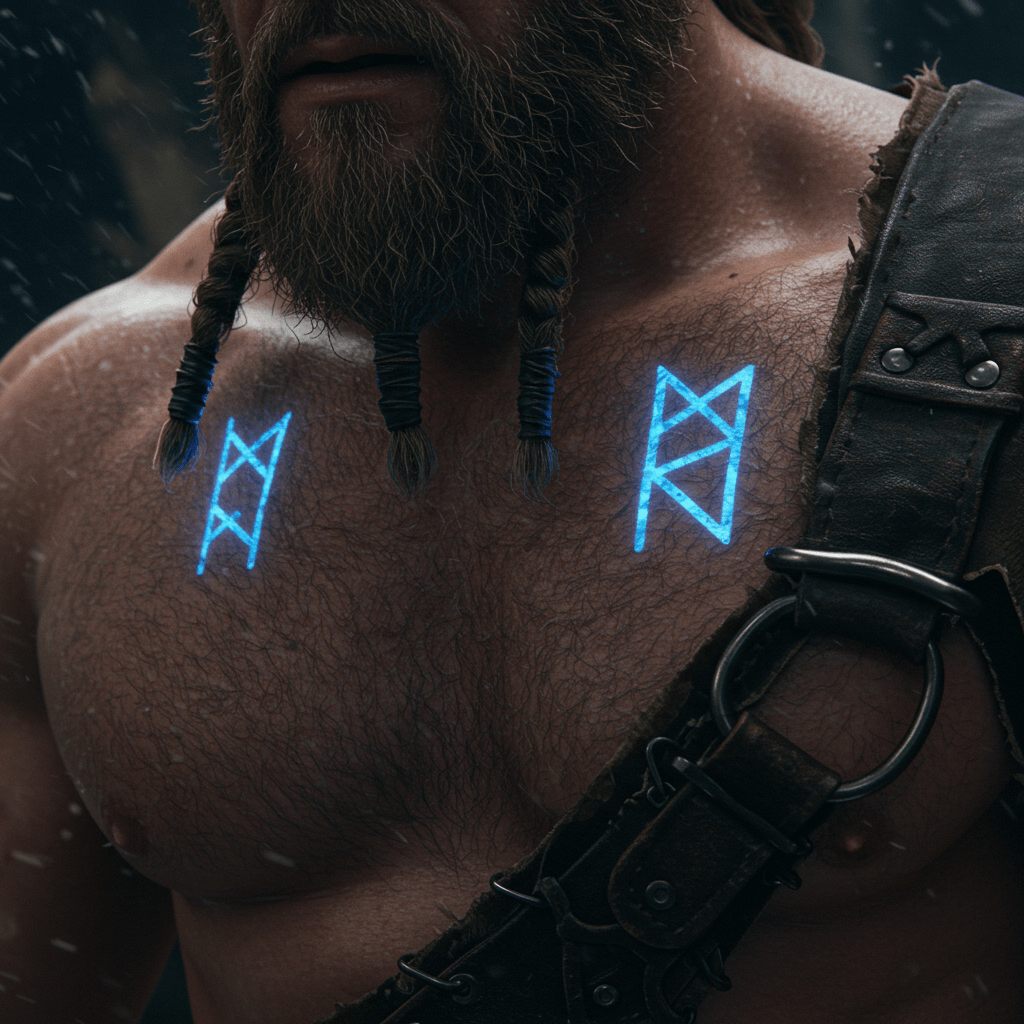
“I am a Herald of Toram, though my blessings come in the form of empowerment for myself and the warriors around me. I have a great affinity for what you call lithos, as do many of my people, but the aura is aided by runecraft.” He removed his breastplate by using his aura to flip some quick-release latches and gently lower it to the ground. He then peeled back his leather shirt to reveal two symbols, both a little larger than an inch square, glowing with a sapphire hue, engraved onto his chest.
“Dwalven runes?” Seleger spoke up with interest. “On your skin? I always thought they had to be on metal.”
“The Dwalven craft them onto their armor and weapons because their items are virtually indestructible by our standards. They also know the secrets of crafting and so can carve as many as they like and also repair them properly. Doing the same for mundane arms would be quite expensive.”
“Can’t your runes be ruined by being cut or disfigured, like slave runes?” Cat asked.
“No, this is a much more elaborate binding than a simple slave brand. It’s also soulbound, so as long as I survive, they will regenerate.”
“Wow,” Seleger whistled. “That must have cost…”
“About twenty-five thousand gold each, yes.” He watched the boys’ eyes widen and simply smiled. “Worth every copper? No?” Cat could only nod in agreement. The lithos aura had completely flummoxed him, and he had trained specifically to counter such magic. On a battlefield, very few people would adapt in time to survive a second attempt.Beornen, with his singular, awe-inspiring power, was merely a man – a formidable warrior, yes, but still a man. Yet, this man spoke of ‘Old Ones’ with a deference that chilled Catwright to the bone. What ancient, unimaginable powers did those beings wield, if even Beornen and his company of fierce barbarians felt such dread? Cat needed to learn, to grow stronger, for the true war, he knew with chilling certainty, had only just begun.
The morning dawned cool and overcast, with a light drizzle. Even so, and despite the early hour, Cat had drawn a small audience—about forty men and women of all ages gathered to watch his elemental forms. He grumbled internally about all the eyes on him, wondering how they’d even known to show up, but figured it was good focus training since they were mostly quiet. An unusually high number of young noblewomen were there, whispering amongst themselves and drawing titters from their coterie. Cat strongly suspected Seleger was behind it.
Seleger and Chatwick thankfully came to the rescue as he finished, resulting in not having to awkwardly force himself through the crowd and socialize. Seleger handled everything for him.
“Excuse us, everyone, we must be going! Sorry, important meeting to attend. Make way! Good morning!” The onlookers parted to let them through, and Cat heard some of the comments: “How’d he do that backflip?” “Is Aether always first? I thought Lithos was first!” “What was that last form? It seemed to combine everything and go beyond.” “I’ve never seen that—has anyone seen that?” Cat would have thought that seeing the elemental forms in a big city would be a lot more common. He had put together the animyra forms on his own through reading and extrapolating from what his instructors could show him, yet he had never met anyone who could actually do the full set of movements all together. He hoped he would find someone who could verify his movements were correct.
“Is this how my mornings will be now? Do I have you to thank?”
“I’m sure this is just the beginning of your fame and notoriety, my dear friend,” Seleger evaded without missing a step. “Imagine if you chose to shave your faint stubble every morning, wear stylish clothes, or gods forbid, bathe more than twice a week!” Chatwick let out a full laugh he’d been trying to suppress. It was ironic since the boy’s habits of cleanliness had been far worse than Catwright’s before meeting Seleger. “Yes, my dear ward, take note! Proper hygiene and dress are paramount to achieving a life worth living. Otherwise, we are doomed to die elderly, alone, and unbedded.”
Cat was spared having to think of a response by arriving at their destination. They entered a relatively cozy meeting room occupied by four facet leaders, including Sergeant Lovine. Cat and Seleger had discussed the night before how they might squeeze out a bit more freedom from their plethora of sitters, and Cat had suggested a classic Ventus trap. Cadmus Ventus, a famous general from the War of the Dead, had become known for baiting traps with a relatively weak-looking force or other tasty target, then maneuvering his forces to surround the victims who fell for the ruse. The problem, of course, was that the bait needed to be either a sacrifice or extremely powerful because they were in a poor position when the fighting started.
Seleger sold the plan to the dubious soldiers with his customary zeal: “And so, if we could have a perimeter of, say, five hundred yards…” There was a great deal of back and forth, but they had already tacitly agreed to blend in and have a perimeter that was out of sight.
“Two hundred yards!” One of the Sergeants was adamant that they needed to be close enough for their facet mage to have life sense on the party.
“Oh come now,” Seleger countered, “we’ll have a priest of Neador with us who can contact all of you if needed!” He didn’t mention that they had no intention of telling Beldere the plan, or any more than necessary. They just didn’t want soldiers hovering over everything they did. Eventually, they settled on a three-hundred-yard perimeter, with the soldiers in plain clothes, magically stored shields and crossbows, and four close coordinators within fifty yards. With the logistics settled, they met up with Beldere for a quick breakfast and headed off to the festival grounds soon after.
The boys, including Chatwick, all signed up for the youth competition, but after seeing the other contestants practicing and the overall lack of real skill, Cat and Seleger decided to sign up for the adult single combat competition as well. There was a knight-level competition Cat was looking forward to seeing, and after some thought, he went to ask if he could join that list too. It turned out that one needed to be a certified knight or sponsored directly by a priest.
“Absolutely not!” was Beldere’s predictable reply. “I’ll not condone you fighting so far above your ability. One small mistake and you could be crushed to paste or beheaded, and there would be nothing I could do!” The priest’s eyes were watery and his voice almost broke.
“Why not?” The refusal, though expected, irked away any sympathy he might have had. Cat wasn’t sure if he was more disappointed that Beldere had so little faith in him or that the priest couldn’t heal him from a beheading.
“I just told you why not! I don’t want you to get killed…”
“No, I mean why can’t you heal a decapitation, I mean, if you’re right there already.”
“It doesn’t work like that,” Beldere sighed and shook his head. “Only the greatest healers in history could heal death, and even they could not do it every time.”
“Aren’t you one of the greatest healers?” Cat teased.
Beldere just gave him a disgusted look. “The high priestess of this city, High Weaver Aerwyn, could shatter a building with a word or heal an entire quad within seconds, but even she cannot bring back the dead.” Cat wanted to ask how he knew that but decided to drop the subject since it was causing such obvious distress for the pious young man.
“You don’t have to worry, Cat!” Seleger cut in loudly. “All you have to do is win the adult competition and you’ll be granted an honorary knighthood from the Duke himself!” Seleger was trying to make a joke, but Cat perked up and smiled. Seleger saw the look. “That’s going to be a lot of running back and forth, Cat. Some of those bouts are scheduled at the same time.” Seleger thought for a moment. “That could be over forty rounds in two days.” But Cat was not deterred in the slightest.
They spent the rest of the morning signing up for the various competitions, which involved waiting in lines, answering questions, a magical verification of age and identity, and of course, a basic test of competence. The verifications, combined with the various testing, attracted some interesting characters. Several old former soldiers wanted to shake his hand, claiming they had known or at least been acquainted with his grandfather. One old fellow in particular seemed exceptionally emotional. The sharp-eyed man wore the grizzled visage of someone in their eighth decade, but he spoke as if seeing something play out before him in a scrying pool, reflecting a past as clear as yesterday’s sunrise.
“I helped recruit and train him, as part of Onyx Company, back when they mostly just did garrison duty around Mecre City. One of the best natural swordsmen I ever saw. I was there at the Battle of Mecre, when he dropped out of the castle like a falling star. Armor so bright it hurt to look at. He flew across the front lines, rallying the soldiers. I watched him die, pierced by all them teeth, this long” he held out his hands a little over a foot apart “in that monster’s jaws. The poison pumped into him so much…” the man’s voice started to break “…it leaked out…” he sobbed. “But his sword was lodged into that thing’s brain, tip sticking up out the top of its head like some unicorn lizard.” He barked a strained laugh. “And he kept wriggling the blade around, trying to do more damage, until he stopped.” He looked at his enraptured audience now, obvious pride in his bright gray eyes. “He took that bastard with him!”
Beldere looked absolutely horrified, on the verge of tears himself. Chatwick’s mouth hung open, eyes round, looking from the old man to Catwright and back. Seleger gave Cat a wary, sidelong look as if expecting him to do something crazy. Cat just sighed and reached out a hand and put it awkwardly on the old man’s shoulder. “Thank you,” he said simply. He had heard this all before from veterans, minstrels, and historians. Everyone had a slightly different version, but this man’s tale was pretty consistent with most of the stories Cat had heard. The old soldier just wanted some acknowledgment, some catharsis, which Cat felt duty-bound to help provide for some reason.
“Wait, wait,” Chatwick exclaimed. “All of that stuff really happened?” Everyone, including Beldere, just looked at the young squire incredulously. Cat chuckled.
“Thousands of Mecrans perished that day!” Beldere seemed scandalized.
“Did they stop teaching history in Breckan’s Hold? I may have to speak to someone about that,” Seleger began.
“I never really paid much attention,” Chatwick admitted sheepishly. “I just heard the stories, at festivals and such.”
Having told his story, the old man moved on, but word must have spread because Catwright was accosted several more times during the day by men and women of that generation who had been there and seen the battle. By the time they reached the sign-up tents for the adult lists, after stopping for some lunch and to browse the markets, the judges and trainers greeted them respectfully by name and expedited their entry process. Cat had expected some snide comments about children signing up for the grown-up games, but it seemed he and Seleger were both being taken seriously.
Too many conversations and about sixty gold pieces each in entry fees later, it was late afternoon and time to meet with Beornen’s Barbarians. The walk to the mercenaries’ encampment was a bit over a mile, and Cat looked around for some of their shadows. He had spotted a couple of their close-in escorts during the day, but overall, they had done a great job of staying inconspicuous.
Leaving the main fairground, they found a less-traveled thoroughfare toward their destination. Though still crowded, the path at least offered some breathing room, sparing them the constant need to avoid collisions. Here, the noise level dropped a notch, allowing Cat to clearly make out the conversation between Chatwick and Beldere a few steps behind.
“If he’s like his grandpa, why can’t he fly around and glow like the sun, like in the stories?”
“In the actual battle,” Beldere was using his lecture voice, “Captain Catwright wore the Armor of Areleas, an artifact from the Age of Power which granted a variety of abilities, including flight…”
Cat tuned out the rest of the conversation as his hackles rose. The crowd thinned out suddenly, and about twenty feet ahead of them stood several mercenaries in black painted half-plate armor. The Obsidian Tears, Cat thought with resignation. Is this really happening? They stood relaxed, holding their helmets as if they had just come to parley.
In a clear, confident voice that carried over the crowd, the leader delivered what Cat felt was the most cliché kidnapping demand imaginable. “Just come quietly and no one needs to get hurt.” He was a tallish man, in his early thirties, just over six feet, with penetrating blue eyes and the kind of charisma Cat supposed women might be impress.ed with.
Several people in the crowd watched, curious. Beldere and Chatwick stopped and looked up, confused. Seleger bellowed into the strange new silence with a voice that created a shock like lightning. Many onlookers, including some of the mercenaries, stumbled back and clutched their ears.
“Hark! Citizens of Mecre and the great city of Osenvale! Here we have scoundrels in our peaceful streets attempting to abscond with our sacred nobility. They would take us captive even as we are ordained and accompanied by a priest of Neador, in the light of day, at the request of an evil slaver’s guild!” Cat had never been so appreciative of Seleger’s singular ability to create a distraction and gain the attention they needed at the same time. Part of Cat still believed they could come to a peaceful resolution until he spotted the dark-haired mercenary to the left of the leader and their barely moving lips and twitching fingers.
The mercenary leader looked annoyed by Seleger’s interruption and tried to speak again, but Seleger just boomed right over him. “To arms! Citizens of Mecre! As a Lord of this land, in the name of my father Dain Sulwood and the Everborn King Mecre, I declare this guild to be criminals under Mecran law!”
Oh shit! Cat thought. No more negotiation. Cat made a quick gesture with his right hand: mage! Seleger just glanced his way and gave a curt nod in response.
Cat felt the veils opening: Bellicorum, Aether,andSomnivel. The mage wove them together with obvious skill and released with a power built up through the duration of Seleger’s speech. Several things happened at once. As the spell crashed down, Cat knew what to expect. He bit down hard, aiming for his cheek, but ended up biting through his tongue. The spell was strong; he felt it swim through his head like a dense fog, but the pain and the timing had been enough for him to come through awake and still able to move. It had been centered behind him, on Beldere. Smart. Beldere, Chatwick, and a few dozen Mecrans collapsed like puppets with their strings cut.
Cat was already moving. Before the sleep spell fully manifested, his hand axe was already in his hand. Before the sleeping crowd hit the ground, the axe punched through the breastplate and into the chest of the mage. He didn’t even have any barrier spells up! What an idiot! The mage was still alive, but out of the fight with a hole in his lung. Cat didn’t want to kill anyone; he was still going for non-lethal blows. The axe could have very easily found the spellcaster’s head.
Cat and Seleger sprinted forward. Instincts and years of training helped them pick out dozens of other mercenaries surrounding them, many with bows. There was only one choice: close the distance or become a pincushion. The leader glanced in shock to see his fallen comrade and reached for the battle-axe at his side. Cat’s hand crossbow appeared, and he released a shot that hit the leader’s exposed hand. Jerking his hand away in disbelief, the man had time only for one horrified gasp before Cat was on him. Cat felt the bowstrings go back and frowned with consternation. Were they going to shoot their own people?
Cat put a dagger into the man’s armpit, trying not to hit anything vital. He was aware of the aether shifting as the arrows released. Using the dagger like a lever, he turned the larger man, positioning that bulky black armor between himself and most of the arrows. The poor man’s body jerked and bucked as the arrows hit; some of the tips went clean through the armor, one emerging an inch from Cat’s neck. He noted the glossy black, obviously enchanted, tear-shaped arrowhead and couldn’t help a little appreciation. That’s why they’re called the Obsidian Tears.
They had killed their own leader. The man was having his last spasms as Cat summoned his armor and sword. I really need to invest in a shield. He glanced over to see that Seleger was still alright, having employed a similar tactic. His friend was already fully armored and dropped the mercenary he was holding to summon an enormous tower shield. Gods be damned, if I get shot, he’s never going to let me live it down! The Tears were rushing in from all directions, having given up on the ranged approach. Seleger gave Cat a bloody grin, and then the veils started to open all around them. Uh oh.
Of course, Spikey and several others had noticed when Beldere and Chatwick had gone down, and the whole city probably took notice when Seleger raised his voice. Cat was surprised it had only been a few seconds since the sleep spell landed. He started counting the seconds as he and Seleger fended off the mercenaries. The Tears were angry and disorganized; they had not expected things to go so poorly so quickly. Cat took down four in the first five seconds with crippling, non-lethal wounds—at least he hoped so. They were tripping over their own fallen trying to get to him, doing more damage than he was. Cat was calm and relaxed. In the back of his mind somewhere, he understood that these people were no longer just trying to capture him; they wanted him dead. Yet he was focused with the composure of thousands of hours of training.
“How long did they have before the soldiers showed up? Thirty seconds? A minute?” Cat’s mind raced, understanding what was about to happen, his focus almost wavering. These were Mecran soldiers, defending Mecrans on Mecran soil. There would be no negotiating when they arrived. Seleger must have realized the same thing as he shouted at the enemy: “Put down your weapons! You cannot win this!” The volume caused several to hesitate, but it must have seemed pathetic coming from two cornered sixteen-year-olds surrounded by hundreds of warriors.
Five seconds:mass haste, battlefield awareness. Cat knew the spells being cast, the speed at which doom approached, the precision with which justice would be doled out. Ten seconds:harden skin, enhanced perception. Cat felt himself speed up and become more aware as battlefield awareness allowed the casters to pick them out from the enemy and add them to the quad enhancements. Fifteen seconds:precision shot, rapid reload, explosive shot. Cat took a couple of shallow hits, denting his armor, not even touching his hardened skin. He saw movement on elevated positions, on rooftops and in windows, not soldiers or mercenaries. One thing many foreigners did not know about Mecre was that every Mecran did some time in the military, and every Mecran could use a crossbow. Cat noted dozens of citizens pulling out crossbows and taking aim. Twenty seconds:company barrier, penetrating shot, acid shot. Mecran soldiers worked together as a unit, linking spells and combining mana pools, moving in perfect coordination. The mercenaries by contrast, fought independently, just a mob now that their original plan was foiled. Barriers came up around Catwright and Seleger, and Cat knew it was already over. A sadness tried to invade his focus, but he stomped it down, his practiced mental defenses slamming into place like a bulwark for his sanity. He didn’t ask for this. Twenty-five seconds:mass paralysis shot, multiply shot. Cat and Seleger moved back to back and tried to remain relatively still as the doomed Obsidian Tears hammered on the glowing elemental barriers. Thirty seconds: There was a rumbling sound as dozens of lithos-enhanced tower shields hit the ground, and Cat envisioned over a hundred crossbows lifted toward the enemy. Some of the Tears turned to face the new threat; others finally understood and tried to run away.
A moment of surreal silence hung in the air just before the bolts were launched, multiplied by a factor of ten, expanding and thrumming like a giant swarm of bees in a raging storm of death. A thousand missiles unerringly penetrated their targets, exploding in a spray of acid, blood, and viscera. The paralysis was overkill because there was nothing left standing to paralyze. These volleys were meant to bring down huge magically regenerating Grulken warriors.
As Cat’s hearing returned, he heard the screaming first. Apparently, not all of the Tears were dead; in fact, quite a few on the outskirts had survived. Those who had failed to flee threw down their weapons, shock and despair in their eyes. Beldere was awake, running around trying to save whoever he could. Hundreds had already passed beyond the veils. The human part of Catwright clawed at the walls of the bastion in his mind, claiming this was his fault. If he had kept a close guard, no one would have attacked. No one would have died. He had set up and executed a perfect Ventus trap without really wanting to. He had not taken the threat seriously, and this blood was on his hands.
The cold, trained soldier and tactician kept the analytical side in control. This was not the time for useless emotions clouding his thoughts. He floated as an observer above the carnage, taking it in and deconstructing the events before someone inevitably intruded. There were those who would call this a victory, but Cat was not an idiot; he understood war, and this was undisputedly war. His enemy, this mysterious ‘Unseen’ who could manipulate and control from afar, whose minions could execute complex plans up close, had won a great victory here today. It did not care about humanity. A sacrifice of potential enemies to forward one’s goals was no loss; it was masterful.
Chatwick wandered toward him, eyes wide in shock at the gore. As a pig farmer he had probably already seen his share, but not like this. The boy was covered in it but otherwise unharmed, somehow the quad had protected friendlies from the acid, but not the blood. Cat and Seleger were relatively clean since the Mercenaries hadn’t managed to break the shields before the bolts struck them down. Chatwick lifted a blade from the ground. It was a mid-length, double-edged saber, a deep blue in color that seemed to drink in the light while subtle patterns shifted on its surface. An air and water mana enchantment, Cat thought, with some embedded ice spells. The sword was probably worth thousands of gold; it was unblemished, while the piles of torn flesh around it were unrecognizable as human.
“This sure is a nice blade,” Chatwick said wistfully. “I hope someday I can have one like this.” He spoke as if in a dream. Cat recognized some of the signs of ‘deferred trauma,’ as Beldere would call it. Cat was fighting a new emotion now: Anger. All of this, for what? So that some creature could take him as a plaything, as some component in a ritual? Other thoughts skittered through the gaps. Beldere, Chatwick, and Seleger all could have died if this mercenary group had used different, more ruthless tactics. He also realized this would not end here; he would still be hunted as long as this beast existed. The anger was consuming the guilt and sorrow like fire would dry leaves. He forced himself to take a deep, calming breath before the seething rage overcame him. It didn’t work. Something was building inside him, heating his skin. It felt like he would explode outward with the pressure. What’s happening? It almost felt like when he was gathering mana during his morning katas, except more. Letting out his breath, he focused on releasing the energy. There was a whooshing impact on the street around him like a ten-thousand-pound mattress had been dropped from the sky. A strange orange aura, like a sunset on the wind, raced outward, causing those close by to stagger or fall over; even people a hundred feet away flinched when it touched them. More than a few people were staring at him in wonder. Cat suddenly felt much more relaxed for some reason.
Cat felt around in his mouth with his tongue, testing, and found it mostly healed. “Keep it,” he said, just a little slurred.
“Huh?”
“Keep the sword,” Catwright repeated. “In fact, let’s take all their stuff. They don’t need it anymore.” Cat had become much more proficient with his talisman’s storage space. Reaching out with his mind, he sought to create tendrils of awareness connecting to all the metal, wood, and cloth within a forty-foot radius, then with a thought, it all vanished. Seleger gave him an incredulous look, obviously still in shock as well, as demonstrated by his distinct lack of bluster. Cat just started walking around in a wide circle, repeating his looting trick, idly wondering just how much he could hold.
Sergeant Lovine approached him minutes later. He was pale, but his voice was composed and all business. “The area is secure, my Lord.” My Lord, when had the Sergeant started calling him that? “We captured a hundred and forty-six survivors and estimate a little more than fifty escaped, and at least three hundred members of the company were not present during the attack.”
Cat just nodded. “How many dead?”
The Sergeant grimaced as he inspected the charnel covering the street. “We estimate a bit over three hundred, my Lord.”
“Was this all necessary?” Cat wondered aloud.
“I believe so, sir. There were casters in their back lines enhancing their fighters who were preparing nets and ropes. They would have had you eventually, sir.” That was not what Cat had meant at all, but he let it go.
“What now?” It was Seleger, having finally recovered his voice. Cat realized that this whole battle and aftermath had only taken a few minutes. Mecran efficiency. His mind was still trying to pull him in twenty directions, and he was slowly sorting the jumbled chaos locked safely behind his mental barriers. The soldier in him had somewhere to be.
“Well, we still have a meeting with Beornen’s Barbarians.” And he started walking, his dumbstruck friends falling in behind, Chatwick with a fancy new sword he was trying to fit into the old scabbard, Beldere still sobbing at the meaningless loss of life, Seleger with his best stoic expression, silent for once. Most of the Quad followed closely behind, keeping the crowds at bay, while two swifts stayed behind to organize and conduct clean-up. No one noticed the silent watching figures vanishing into the twilight shadows.
It was difficult to believe they had managed to break every window on the first floor of the tavern. Cat didn’t remember throwing so many people out of windows, though he did recall aiming for the unbroken ones at one point. There was actually a hole in the wall near one window where he had missed. To be fair, the walls were pretty thin, and the soldier hadn’t even gone all the way through. The night’s conflict could have been so much simpler if the soldiers hadn’t joined in.
Seleger hadn’t gone down with just one punch, and the ensuing scuffle caused one of the Sulwood guards to try and pry them apart. Cat had picked the guard up with one arm and slammed him through one of the tables. At that point, all of the Sulwood soldiers joined the fray, and the night really started to get out of hand. Sergeant Lovine wisely moved the Ironwood contingent out of the way into an unoccupied corner, content to let the Sulwoods beat Catwright into submission. Unfortunately, from the perspective of many of the patrons, Catwright looked like someone being persecuted, with his wild yells and righteous fury keeping him swinging far longer than anyone thought possible. Before long, half the tavern had joined the fight on Catwright’s side. Then, the rest of the crowd joined in a savage free-for-all of destruction. Mecrans did tend to enjoy a good fight, especially after a few drinks.
Thankfully, no one had died. No one really even needed a healer. It took less than ten minutes for Beldere and Natalia to arrive, yet the damage was already done. The building was still standing, but all the windows on the first floor were at least cracked; most of them were completely shattered. In one case, the wooden frame had broken outward with the spiderwebbed glass mostly intact. No one had unveiled any destructive magic, so the structure was still sound; however, almost all the tables, chairs, and the bar itself were smashed to kindling. The tavern keeper was screaming into Seleger’s face until Natalia’s gold mollified him. Cat could tell that a hundred gold pieces was a lot, even for her, and she was not happy about it. The druid had sharp words for Seleger, Catwright, and her soldiers. She told the boys that she would find a way for them to repay her in a tone that made the hairs on Cat’s neck stand up.
Cat and Seleger spent most of the morning bickering while they helped clean up the mess.
“If you had just kept your lips latched…” Cat began.
“My lips? You could have had a lovely evening with several lovely-lipped ladies if you hadn’t thrown a tantrum!” Seleger countered, and Cat knew he could not win a war of words with the other boy. It was with some satisfaction that Cat saw there were still some unhealed bruises on his friend’s face. Beldere had walked away in disgust once he saw none of the wounds were serious, refusing to pray for any of them.
It was around mid-morning that Dain caught up with them. There was a whoosh of air, creating a stirring of dust and debris, and suddenly Seleger’s father was there atop Feingar, scaring the feces out of the locals and looking with amusement at the tavern repairs in progress. A dark look from Natalia quickly turned his face wryly serious. She was radiantly furious in a light green riding dress, her hair had a reddish hue to it this morning which set off the rubies in her ears. “Should I even ask?” was all he said.
“I’m sure you can surmise all that you need from a look, husband. I shall fill you in on the details later. For now, we have more urgent matters to discuss, and I must speak to the magistrate to see that these reckless rapscallions are not locked up or conscripted for labor.” She leaped lightly up behind her husband, and Feingar shuffled off in the direction of the plea hall.
“If something were to happen to your father,” Cat whispered solemnly to Seleger, “I might let your mother take my virginity.” Seleger’s elbow to his ribs was swift and brutal. Cat accepted it with a quiet grunt and a smile.
They lost a day assisting with repairs and in negotiations with the local officials. Natalia’s influence and coins kept everyone out of trouble, and Dain took the opportunity to inform the party about the nature of the meeting of lords. The news was not entirely surprising for anyone. King Mecre had been warning of the rising Ssythe threat for years; it was just strange to absorb the reality. Dain would need to send a few soldiers but would not be going himself, being more of an administrator now than a soldier. Half of Ironwood garrison, however, including Cat’s father, would be mobilizing and heading south after barely a three-week break.
They arrived in Osenvale in the afternoon of the eleventh day of travel from Breckan’s Hold. The city glowed with the fine white stone from which its walls were carved. It was said that an enchantment could be activated that would blind incoming enemies, though it had not been used in living memory. Cat supposed that at certain times of day, the wall would be blinding without the need for magic, if one assumed, of course, that the sun was somehow not magical.
Soaring spires erupted from the center of the city. Some of the buildings were over two hundred feet high. There was a sky dock which would supposedly accommodate everything from small personal flying craft, such as a rich merchant might own, to great void craft which could journey to the moons or even other suns. There were two lumbering airships ponderously floating over the skyline as they approached the city. Cat had heard that they were impractical craft, expensive to maintain, and only used occasionally for observation or novelty. He could see their use as a security measure, or perhaps to oversee a battlefield, if only they weren’t so slow and fragile.
Cat hoped to see some of the magic beasts which the sky knights rode, perhaps even a dragon, then he remembered that they usually traveled invisibly or by teleportation to avoid attention. His eyes did widen, however, as they entered the eastern gate to the cacophony of noise and chaos of colors and activity. It had been nearly a decade since he had been here for his father’s promotion ceremony, and his memories did not do justice to the variety that assaulted his senses. Shops lined both sides of the cobbled streets, with people shouting to each other and passersby. Clothing colors from dark black to sparkling green to bright white dazzled the eye. He did not recall all the different varieties of skin color humans could have, from pale shades of ivory to dark obsidian.
A cool ocean breeze brought scents of salt, fish, spices, and perfume. Some made his mouth water, some made his stomach churn, most he could not name. The variety of other races also astounded him. There were smallfolk, including Lomeli and Mosslings, and various fey, including the Elydrean, tall beautiful humanoids with unnatural grace. He saw a few beastkin, including Taurians, huge bestial folk with bovine heads. For some reason, it was the Dwalvin that caught his eye. He had never seen the dour, normally reclusive mountain dwellers before, and if he had not seen pictures, he might have thought them to be a group of abnormally tall and stout humans. The six males averaged about six and a half feet tall, like the Elydrean, but where the Ely were slim with fine, angled features, the Dwalvin had flat, blunt features, with thick dark beards and likely all weighed over three hundred pounds. They were not fat, however; their bare, thickly muscled arms were covered with tattoos and runes. They looked upon everyone and everything with suspicion and disdain, which was not uncommon from the elder races. Cat was distracted from this novelty by a not-so-subtle hand signal from Seleger. “Four Ssythe, front left.”
Cat tried not to stare, but his glance to the left made him pause. This was another race he had not seen in the flesh, and though the war with them ended over forty years ago, it was almost unheard of to see them in a Mecran city. The four lizard folk towered above the humans in the marketplace, who gave them a wide berth. Their long, flat snouts filled with jagged, protruding teeth were intimidating to behold, and their high-set yellow eyes were focused on his own. All four gazed with a predatory intensity they didn’t try to hide, and Cat stared right back. Ssythe were fast, ferocious warriors with powerful legs, a strong, nimble tail, and sharp claws and teeth. And while they were a lethal threat to any dozen normal humans, they were not a threat to their party. A Mecran soldier could generally go toe-to-toe with one of the creatures and come out on top, and when the soldiers worked together, their strength was only multiplied, whereas Ssythe fought with little organization and tended to get in each other’s way, sometimes snapping at each other in their blood lust. The soldiers about them took notice, however, and tightened up their formation around the caravan.
“Are you trying to provoke them?” Seleger hissed. “They’re probably just tourists,” he continued unconvincingly.
“They’re staring at me.”
“That’s what they do; they stare! It’s not about you. They were probably just curious about the caravan and the giant bear, but now you’ve singled yourself out by locking eyes.” Cat remembered learning about that somewhere now that he thought about it. He looked away immediately, yet he could still feel their eyes on him as they crossed the marketplace.
Reaching the top of a rise on the way to the high citadel, the city spread out before them, nestled against the Endless Sea. Two great harbors flanked the western wall, one to the north filled with a variety of fishing vessels and the southern wharves dedicated to great naval warships. They traveled south along a wide ridge line with the festival and competition grounds on a massive two-hundred-acre, man-made plateau to their right, between them and the military harbor. Cat could see and hear that the harvest celebration was already in full swing with music, choreographed dancing, and livestock shows. The bright colors of the various banners and tents were an assault on his eyes. The jousting, archery, and single combat arenas were mostly empty since the elimination rounds didn’t start for another two days.
The citadel dominated the landscape to the south, a layered structure on the tallest hill overlooking the city just southeast of the naval harbor. Multiple semi-circular walls surrounded a towering, gleaming white structure that could accommodate most of the city if needed. Giant ballistae lined the battlements; the weapons, vaguely shaped like crossbows and twenty feet wide, could punch a hole in a hull two miles away. The enchanted munitions could shatter most warships with a direct hit. Cat had trained with them briefly, still he barely understood how the complex network of pulleys and levers worked, but their effectiveness made storming a fortification like this unthinkable.
The gates of the fortification yielded with the briefest of acknowledgments, the arriving company being expected and bearing the banners of House Sulwood. And none could mistake the sight of Feingar, a mount such as few soldiers, officers, or even the highborn could claim. The Duke and Duchess offered a formal greeting in the sun-dappled courtyard, beneath the venerable shade of four towering elderwood trees, as was the custom of Mecre. The rulers of Osenvale, both in their middle years of their sixth decade, yet healthy and strong of bearing, stood ready. Duke Castor Jemelyn, a veteran of the Ssythe wars following the invasion of Mecre, was lauded for his valor, though his ducal seat had descended to him by ancient right. Duchess Evanna Jemelyn of the ancient House Tarymthold traced her lineage to the times before the War of the Dead, her kin whispered to possess blood that ran long and true, often past the span of a hundred years, lending credence to tales of fey ancestry. The Jemelyn kin were numerous, and many were gathered, a sprawling assembly of nobility gathered to behold the newcomers from a town whose name likely many of them had never heard.
Cat then noticed Seleger’s smile, a look like a hungry falcon spotting a plump flock of pigeons in a courtyard. Following that gaze revealed the grandchildren and cousins, mostly between the marriageable ages of fifteen and twenty-five, with the fairer sex outnumbering the lads by a good measure. Many of them fixed the two young men with gazes that held a certain sharp intent, like sleek hunting cats assessing a new prize to adorn their chambers. Cat had to admit they held a certain allure; he was a youth barely out of boyhood, and here was a gathering of comely and well-favored ladies regarding him with acquisitive eyes. Yet, the very notion of marriage and binding vows, of settling in one place, filled him with a dread akin to the idea of being sold into service. He had too many roads to travel, too many wonders to behold. He could see the wisdom in cultivating a philosophy like Seleger’s: to taste the fruit but not be bound to the orchard.
After what seemed like hours of formality, they were finally shown to their rooms. He was given a tour of a lavish apartment, with a separate bedroom, enclosed bathroom, full kitchen, and entry sitting area. The place even had magical plumbing. He tried to act nonchalant, as if he was used to such opulence, but when they indicated it was his room alone, his jaw nearly hit the floor. The whole facet could sleep in this place, he thought. He explored the amenities for a few minutes and then wasted no time finding the practice grounds, his armor appearing on his body as he walked. After practicing for hours with a set of light plate mail borrowed from the Sulwoods, he ultimately was able to achieve the feat of equipping the entire set from his pendant’s spatial storage. It wasn’t a matter of equipping everything at once; he had to focus on one piece at a time and make sure everything was already buckled and adjusted perfectly. It had been painstaking at first, but now he could be fully armored in seconds.
Thirty minutes and fifteen opponents later, Seleger pulled him aside. “Somehow, I knew I would find you here. A couple of your old friends arrived. They have a message for you but didn’t want to pass it on; they wanted to tell you in person.”
“Who?”
“Two of those mercenaries, Garreth of the Hairy Face and the pretty lady with all the daggers. Looks like she’d stab you if you tried for a kiss.”
“Gemma, and yes, she probably would stab you.”
“Might be worth it. I’ll think it over.” He actually looked like he was doing just that. Seleger led Cat through the wide courtyard, up several flights of stairs, and down a long hallway to a well-furnished study. Cat saw nine guards for the three exits, and already seated in the room were Duke Jemelyn next to another man in his sixties with a slimmer frame and a harder, more dour demeanor. Also present were Natalia, Dain, Garreth, Gemma, Sergeant Lovine, Beldere, and three guard captains Cat didn’t recognize. They all straightened and regarded the two boys as they entered. The atmosphere looked tense and uncomfortable.
“No need to stand, everyone; it’s just us!” Seleger boomed into the awkward silence. Natalia grimaced, Dain sighed, the Duke smiled, and the tension was broken. Cat still felt under dressed; he was in his simple travel uniform, which was rumpled and sweat-stained from his thirty-minute workout with the armor on top of it.
Gemma gave him one of her sardonic smiles. “I just don’t see what they want to pay all that gold for.” Then the discussion started in earnest. Cat learned that there was a bounty on him from the slaver’s guild for ten thousand gold. This didn’t surprise him greatly since his father claimed to have been offered five times as much, yet this was from the slavers, not the Ssythe directly. What was more disturbing were the rumors and information provided by the two mercenaries that pointed to the Gavanti, the shadowy organization behind the slavers, and the agents of the Ssythe working together. Garreth believed they were inciting some of the larger mercenary companies with more impulsive leadership to take up the bounty. Gemma’s informants believed the Ssythe were donating heavily to the Gavanti coffers for their help in pulling this off, their intent being to purchase Catwright from the slavers for use in some arcane ritual to benefit one of their high-ranking leaders. Duke Jemelyn seemed dismissive of the idea that one of the mercenary companies, or even all of them together, could make off with a slave bounty in Osenvale.
“Where would they go?” he reasoned. “They would need a local teleportation portal set up or someone with the power to pull it off on their own, and we could track them. Someone that powerful would not go unnoticed here. If they tried to escape by mundane means, our soldiers would catch them before they made it out of the gates.”
“What about a ship?” Natalia asked.
“Too slow,” one of the guard captains answered. “There’s nothing in the harbor that could outrun our galleons. There are also dozens of druids and priests within the city, including yourself, my lady, who could halt any ship on the water within line of sight.”
“An airship?” Seleger asked.
The Duke hesitated a moment, then shook his head. “If something of military class came inbound, we could investigate, but the vessels in the city now are slower merchant vessels. We also have at least three sky knights within our walls, any of whom are more than a match for one of those ballooned cargo ships.” He looked at his guests, particularly Seleger and Natalia, pausing briefly. “We will increase the patrols throughout the city to ward off any mischief, but I honestly doubt anyone would try something. We are not Praxallis or Arksellum,” he said with pride. He gestured to the man sitting beside him as he stood, prompting everyone else in the room to stand as well. “I have other matters to attend to, but my Steward, Lord Kagin, is quite capable and will be at your disposal.” Without further ado, the duke left the room along with all nine guards, and everyone looked to Lord Kagin.
“To those of you I haven’t met, my name is Daker Kagin, and among other things, I am responsible for the security and welfare of all the guests who stay within the citadel or any of the local estates owned or managed by the duchy.” He had remained standing but now motioned for everyone to sit, and did so himself. “I would like to begin by having us share any information we might have on the local instigators of this bounty and anyone in the area who might have the means to actually attempt it.” His voice was smooth and cultured, and he seemed to meet the gaze of everyone in the room at once. “I apologize that our own intelligence on the matter is rather limited; our enemies generally don’t blend in well, but I understand that is changing. The Ssythe and the Gavanti both have places of worship within the city, and many have made this city their home. It seems strange considering our past conflicts, but concessions have been made on both sides. The church wants peace and intermingling of the factions, while the military wants more soldiers and better equipment. The council of druids preach tolerance, while the king wants war. Certain organizations are taking advantage of citizen conflict to incite violence. We believe powerful mentalists or masters of learvadol, the veil of deceit, or perhaps both are involved and directly manipulating susceptible members of the population. We have captured ringleaders who had no idea what they had done or why, and others who had sudden flare-ups of rage which were out of character and unexplained. Any other information you could add may be useful.”
What followed was an eye-opening conversation for the young warriors who had been relatively isolated in their small communities. Apparently, there were several known criminal institutions that owned property, bought and sold goods, and normally operated legally within many Mecran cities. Natalia was a surprisingly rich source of information. She believed that these merchants were not just there for the profit of buying and selling Mecran goods but also to ensure they had the opportunity to plant spies and operatives in key locations. She knew of at least three factions who had people at the gates and reported to their superiors when the company from Breckan’s Hold entered the city.
Gemma’s mercenary company, the Red Blades, had also looked into the creature offering the bounty at the information brokers’ guild. It turned out that the aberration was called Trellix and was a highly respected Ssythe operative with powerful psychic abilities working directly for someone called the Unseen. Dain and Natalia looked at each other with concern, and Kastin grew even more intent. Gemma just looked at Kastin with a slightly coy smile, which Cat knew meant she was up to something.
“I’m impressed by your resourcefulness, young lady. I assume you have more to offer, for a price?”
“You are correct, Lord Kastin. I am authorized and would be happy to negotiate on behalf of the Red Blades. My company is quite specialized and experienced in the field of information.” Gemma was suddenly all business; it was like she transformed into a different person. Her back straightened, and her eyes focused. The discussion that followed was educational in more ways than one. Even Dain and Natalia seemed impressed. Cat had known that knowledge was valuable in any form of conflict, but he hadn’t realized just how much a city lord would pay for such a service.
Everyone had at least some form of input, with Garreth admitting that his guild wanted to stay out of any potential conflict within Osenvale and that he was here on his own, not representing Beornen’s Barbarians. The guard captains had relatively little to offer, considering it was their city. Apparently, very little crime was committed out in the open. For the most part, they knew only what the more friendly druids chose to tell them. The ability to see and listen through the eyes and ears of nearby animals was very useful for information gathering. Natalia pointed out that whoever they were up against was wise to the tricks of druids, as some of her critters had been lost when getting too close to certain areas, and no, she was not willing to risk more innocent animals to map out these dens in greater detail.
Gemma earned every coin by providing a list of locations and individuals to watch and the names of three of the major mercenary companies that had been approached by the Ssythe’s agents directly.
“Most of the shady deals are happening on the north side of the city near the commercial harbor, in that lane of taverns and brothels you call the Brineway. Mercenaries and other thugs are talking to that creepy broker, Trellix, and his cronies.” She glanced at some notes she had unfolded from her pocket. “The Obsidian Tears went into Wendel’s Wench tavern with their leader and three lieutenants and were talking about the gold like it was already theirs to spend when they left. My sources say they were not interested in the bounty three days ago. The Aether Drifters and the Taurgonaughts also seem to be interested. The Drifters are good at keeping secrets because we don’t have anything else on them other than they usually only take on small jobs. The Taurgonaughts,” she laughed, “well, they’re all Taurians, renowned for taking on idiotic assignments, being susceptible to mental influence, and being too arrogant to care. The Drifters and the Taurians are relatively small groups, less than forty members each. The Tears are more of a problem, being close to a thousand strong with some serious heavy hitters and a lot of other connections in the guilds and other companies. They came all the way from Merekar, and most have never been on Mecran lands before, which might make them stupid enough to try something.” She paused dramatically. “There’s another group moving in the shadows. We’ve spotted them a couple of times on rooftops or tailing our people. Whoever they are, they are very skilled at stealth, including avoiding all forms of magical tracking. We don’t know whose side they’re on.” She looked to the Steward and shrugged.
“I assume your soldiers have ways to keep track of you all?” Kagin looked pointedly at Lovine.
“We have a druid who can link everyone and has bonded everyone, including Lord and Lady Sulwood, their son, and his ward.” He was referring to Spikey, of course. Druids could create natural bonds with all living things just by being around them, though Cat’s understanding was that the connections formed naturally; one just had to know how to look for them.
“I can also sense everyone in our party,” Beldere put in. Priests generally had a slightly harder time bonding than druids, and they generally could not link with someone against their will.
“That’s good to know. I will make arrangements for escorts for you all while in the city. Please submit your itineraries this evening.” So much for having some freedom, Cat thought.
It was a lot to take in. They adjourned shortly after, with Gemma promising to deliver daily reports to Kagin. Natalia was coordinating to increase what, in Cat’s opinion, was an already ridiculous guard to an even larger number of soldiers. Dain was giving Seleger pointers on what to look out for. Garreth approached Catwright while the others were talking.
“My company commander would like to meet you if you have some time, Cat.”
“A recruiting pitch?” Cat smiled. He had heard more than a few people commenting that his talents wouldn’t go unnoticed by the gathered companies in Osenvale and speculating on how much he could get as a starting wage.
“Something like that, more of an evaluation. You’ll probably like him; he likes to challenge everyone who looks tough, just like you.”
Cat just nodded. “I’m sure Beldere can find you. Maybe tomorrow? Early evening?”
“Sounds good, Cat,” he gave a sly smile. “Good idea to have Beldere along; you’ll probably need him.” With that one comment, the large, hairy man couldn’t have baited the hook any better. Cat just smiled.
Disclaimer: The views and opinions expressed in this blog are my own and do not represent the official policies, positions, or opinions of the Federal Aviation Administration (FAA) or any other governmental agency. I do not speak on behalf of the FAA, and any information provided is based on my personal experience and knowledge.
I’ve been reading a lot of articles about why air traffic control is short-staffed, and since I have some experience in the area, I thought I’d take a crack at it. I have about twenty-five years of experience in the industry, and I’ve trained more than 30 controllers. Only one of them did not make it due to ability, and there were some definite psychological issues there as well. I believe that the agency is short-staffed because of the antiquated philosophy that an air traffic controller somehow has to be smarter and more capable than the average human. Are some people more gifted than others? Of course. If we try to staff our facilities with only the prodigies, however, we will fail unless other fundamental changes are made.
First, let me debunk or confirm a few rumors out there for anyone interested in the job. No, you do not have to have 20/20 vision, as long as you can wear glasses or contacts that correct to 20/20. The pay is good. My wife has a college degree, I do not, and I made twice what she did last year. Let me throw in some caveats. I have been in basically the same position for almost twenty years, so I’ve received a few raises. A new controller starts out making less than I did as a pizza delivery driver in 2003 until they get fully certified, which can take years. My wife gets to work from home, and her health benefits are better than mine. She has relatively little traumatizing pressure on a daily basis. I will talk about chronic stress later. I also worked well over 100 hours of overtime last year, and she didn’t work any overtime. She could make as much as me if she wanted, but she likes to work from home and not be in charge of too many people. The best benefit air traffic has over her job is the retirement pension, which her job does not have. Since so many air traffic controllers die before retirement or soon after, I’m not sure that perk is as great as it sounds.
So here is why we are short-staffed, in my opinion. A crucial part of the reason we are short-staffed is because we are short-staffed. Controllers, in general, already have this idea that they are somehow special and that not everyone is cut out for their job. Now, stack this with the fact that many of them have been doing the job of two or more controllers for so long they’ve forgotten what it was like having an extra person to help out, or maybe they have never experienced full staffing. That controller may be a prodigy who was hired and certified because they have a gift, and the tasks came relatively easily to them. Now they have to train some kid off the street who knows nothing about what they do. I’ll come back to the indoctrination training later. So, since this air traffic controller probably hasn’t had to train anyone in over a decade, and they are used to working with other prodigies, they have no idea how to deal with someone new. So, this new developmental controller endures six to eighteen months of chronic traumatic stress and being told they are just not good enough until they are kicked to the curb.
Chronic traumatic stress, in my opinion, is when you are regularly exposed to intense situations that cause fight-or-flight responses to kick in. This is when your focus narrows, maybe you actually have darkness around the edge of your vision, your heart rate increases, and you have a cold sweat that breaks out all over your body. No, you don’t hyperventilate and pass out; people who have panic attacks can’t be air traffic controllers, sorry. Your body has to process that stress, and it is exhausting and probably shortens our lives. You may have experienced this for short periods of time when skydiving or snowboarding and suddenly the mountain disappears underneath you for a dozen feet, during a medical crisis, or during combat. Many air traffic controllers experience this daily, sometimes for hours on end. After a year or so, your body somehow naturally suppresses the worst side effects, and you learn to deal with it one way or another. I drank a lot of alcohol as a young controller. Some controllers quit during initial training or just mentally give up until the agency forces them out.
Hazing is not as common anymore; there are a lot of rules preventing it, but it still happens in a much more subtle way. There is a constant critique of everything you do, starting with the daily list of faults from your trainer and little comments like “why aren’t you getting this yet?” There are comments from the peanut gallery constantly, and little to no positive reinforcement. Can you imagine how the newer “everybody gets a star” generation clashes with the older “you suck until you can prove otherwise” mentality?
So, we are short-staffed. The certified controllers are trying to certify people who can do their jobs, preferably as well as they can, in about 150 hours. Training times vary greatly and are not remotely consistent. There are facilities that are very basic with one runway and one taxiway, and the operating procedures book is only about fifty pages long, and a trainee gets about 400 hours to get through the facility. There are radar facility sectors that are dozens of times more complex with hundreds of pages of operating procedures, and a trainee only gets 150 hours to get certified. I get that the agency doesn’t want to justify training everyone for five years straight, but maybe they could experiment with other options instead of trying the same thing that hasn’t been working for thirty years. For example, start by doubling all the training hours and see how that affects the metrics. How much more money are you going to waste than you are already wasting by getting rid of people after a year or two of training?
The indoctrination process needs a change. The basic school in Oklahoma City, if you’re a civilian, is pretty much useless. It is a way to weed out candidates that have poor study habits or don’t play well with others. I feel that this can just as easily be accomplished in-house through on-the-job training and/or electronic learning. I spent three months in Pensacola, where Marines and Navy have basic ATC training, memorizing a ton of information, half of which I forgot before I actually started training, and only about ten percent was really applicable to where I ended up working. It is a three-month-long shit test, kind of like boot camp to weed out those that someone with a 1950’s mentality would perceive as weak. I have spent months in Oklahoma City over the years, and maybe five percent of what I learned there was actually applicable to my job. I spent two months learning how to work a final approach and then started out on a sector with no final. After eighteen months of training, I still had not seen a final approach in live training. Was I supposed to remember what I learned in Oklahoma over a year before? Oh, wait, it wouldn’t have mattered because the next sector does not have a final either! I know most people don’t know what I’m talking about, but if there is a pilot or controller among the six people who read this, at least they might get it. Part of the problem is that there are so few people who get it, and even fewer people who get it and who are in a position to do something about it. And why would they? Changing anything in the agency requires the equivalent of an act of Congress, and who wants to beat their head against that wall?
Physical school houses should be going the way of the last millennium, especially for a money conscious entity. I own a pair of VR goggles, I have played around with free development software like Unreal Engine. I think many of our training issues could be solved for pennies on the dollar. Take all those brilliant, experienced people in Oklahoma and have them start producing VR training content instead of wasting their talents teaching general knowledge to a bunch of hungover kids.
Let’s talk about on-the-job training. I read an article recently where they suggested the agency should outsource more on-the-job training to contractors. I had to laugh. Unless that contractor has been certified at that particular facility and is only teaching on positions where they have been certified, it’s a waste of time and money. Just put the controller directly into on-the-job training instead and give them some extra hours. If I wanted to fly a plane, why would I want to learn the basics from somebody who has only piloted a submarine? You laugh, but there is that much variety between positions and facilities. That’s why having a basic school where everyone learns the same thing is so crazy.
Contractors could be a solution, however, if used differently. Give them a ‘supervisor’ certification on live traffic. This basically means they are not expected to work when traffic is crazy busy; they just have to be relatively safe under general supervision. Give them a raise for every position they certify on, and then let them specialize in simulation training on those positions. When they are not training, use them for staffing as a handoff, an assist, or any control position when traffic is slow. Like a supervisor.
I have mentioned in previous posts that controllers have a lot of ego, and some of them like to complain. That controller who complains that the controller next to them is not as good as they are is the same controller who will complain when there is not enough staffing. I believe that 99 percent of the people who can pass through the basic hoops to get into the FAA are capable of being an asset to the agency with patience and the correct training. Too many egos, however, are still saying that if you can’t get certified in a certain number of hours, you can’t do the job. My theory is that everybody is wired a little differently in the brain. Some people have lived a different lifestyle or have little genetic quirks. I think that eventually all of these people can develop the same neural pathways and have their synapses firing in the same general direction, so to speak.
I can think of at least three examples off the top of my head of controllers that would not be in the agency if they had had a less patient and ‘savvy’ training team. I can think of at least two other controllers who would not be in the agency if their training team hadn’t made mistakes and the agency hadn’t been legally obligated to give them more hours. Think about that, because some trainers did not properly document certain items, trainees were given a hundred or so extra hours and became certified controllers. I’m not going to get into all the loopholes, but let’s just say that for a savvy training team working together, there are a lot of ways to get a trainee more hours. What if the trainers didn’t have to be ‘savvy’? What if trainees just had more time? How many more controllers would we have?
So, there is a class for on-the-job training instructors which the FAA provides, and I recently had the privilege of attending for the fourth time. I was disappointed but not surprised to find that the class has not meaningfully changed since the first time I had it back in 1999. I’m not going to detail all the issues with the class, but one of the things that struck me was the emphasis on protecting your facility so that the developmental can’t get more hours when they are done. Document correctly, don’t haze them, be nice, not because it’s the right thing to do, but because you don’t want to create a reason that person can stay longer and ‘bog down the system’—the ‘system’ which sees trainees kicked to the curb even though the facility might not have another one for months or years, the ‘system’ which has been slapped with cheap, ineffective bandaids for years but never actually overhauled. What are you bogging down? Your ability to have proper staffing?
So that’s my two cents as far as training goes. I mean, I have a lot more to say, but I’m trying to keep this relatively tactful and concise. It’s nice to see that people are starting to pay attention and try to make some changes to get more staffing. These knee-jerk reactions are typical for a government agency, however, and in my opinion, at least two decades too late. They are supposedly offering an extra twenty percent of our base pay for people like me to stay in longer. After taxes, that’s not enough money to pay for my car payment, much less the gas it takes to get to work. There are just so many other options. Honestly, I’m sick of driving; some days it’s almost as stressful as work, and I’m ready to work from home like my wife. A much more dramatic restructuring and shift in mentality is required for a truly effective fix, and that would still take years. It will be interesting to see how things play out, but hopefully, I will be retired well before we see the results or consequences.
Gemma Reedly had never really thought of herself as a good person. She had a certain code of conduct, a set of very loose principles, but mostly she looked out for herself. If there was one thing she had learned growing up on the streets of Arksellum, it was that caring too much about other people was hazardous to your health. That was why, as soon as she entered the glowing white quartzite walls of Osenvale, she went straight to the information brokers. She figured information about the kid would be worth some coins, and she was correct. She liked the boy well enough, but money was money, and people were going to find out anyway. She told them everything she knew, under a truth compliance spell, of course. She told them she was pretty sure he was somehow the reincarnation of his grandfather, and she told them about the special artifact he had received from Mecre himself. Mostly, the brokers wanted to know about his combat prowess and who his companions were. She felt a pang of guilt telling everything she knew about Beldere, the Sulwoods, and the facet of Mecran soldiers, but she was not overly worried. Someone would have to be a lunatic to go after that crowd in a Mecran city.
“Why are people so interested in this?” she asked. The broker looked at her with surprise, and for a moment, she thought he would try to charge her for the information, which she could tell from his expression, everyone already knew. It wasn’t her fault she’d been living out in the middle of nowhere for the last two years.
“I suppose it’s common knowledge now,” he sighed. “It’s the bounty for his capture. Talk to that broker over there if you want to know more.” He pointed to a greasy-looking hybrid humanoid who looked like a creepy cross between a snake and a human. It was hairless, earless except for holes in the side of its head, with slimy grey skin, slitted eyes and nose, a mouth that was too wide, and arms too long. It stood a little over six feet tall, even though it was stooped. Some evil fecking Ssythe experiment, she guessed.
“Hey! What’s the bounty on Isubane?” she called out. The creature actually flinched at her words but answered in a calm, sibilant voice.
“Ten thousand Mecran gold marks.”
“Who’s paying?” she walked right up to him—at least she assumed it was a him; she didn’t see any obvious lady parts, and the voice was relatively deep. He made her wary for some reason, but she wasn’t going to let him know that.
“The consortium of labor procurement,” he tilted his head, “are you interested in participating?” She ignored the question.
“The slavers’ guild can post bounties like that in Mecre?” She was more than a little taken aback. The idea that the consortium could just pay to kidnap someone in a kingdom where slavery was forbidden was scary. And ten thousand gold? The kid might make for a great gladiator in the coliseum of her home city, but no one would pay that much for a fighter who likely wouldn’t last a month.
“The guild of brokers only asks that the coin amount is valid and available,” the emotionless thing replied. “We are only providing information. The legality of the capture or where and when the target is acquired is the prerogative of the hunter.” Gemma just shook her head and barked a laugh. She tried to calculate the number in her head of what she would need if she were stupid enough to try. It would be more than the bounty was worth. And in Osenvale of all places? There must be over ten thousand soldiers here, not to mention priests and druids and at least a dozen mercenary companies, all mostly loyal to Mecre. Even if they managed to grab him, they’d never get away without some serious veil manipulation.
“Well, best of luck to any idiot who tries a fool’s snatch like that. They’d best bring an army! Sounds like a good way to get planted early.” She was laughing aloud as she walked off. The broker’s unsettling smile followed her out the door.
Gareth
Gareth had heard about the bounty as well, but from a different source. His mercenary company was already aware of the reward and the officers confronted the wayward mercenary about it soon after his return. They weren’t interested in the job; there were too many risks, and the client was one they did not care for. They were also not desperate for coin, like many companies. However, they were curious about the boy and what made him so special. Gareth told the officers what he knew and some of what he suspected, but none of them were well-versed in the arcane or Mecre’s legends and lore, and so had little idea what it meant. They understood that Catwright might be the rebirth of some great hero who had died almost fifty years ago, and accepted it without question. They had certainly encountered stranger cases in their line of work.
“A bounty like that on a kid who’s barely left home,” Beornen of Lacrath shook his great head. The commander of the mercenary company known as Beornen’s Barbarians was a towering man, almost seven feet tall and over three hundred pounds of muscle. He resembled a member of one of the greater magical lithos races, something more than human, and he kept that veil of earth mana open almost constantly, which added to the impression. “What do you personally think of him, Gareth?”
Gareth was finding himself enjoying the attention despite himself. He idolized his commander, even though Beornen was a few years younger; he truly was the stuff of legends. “I like him. He is stubborn beyond all reason, socially awkward, but good-hearted. He is strong-willed and determined to improve in a way I’ve never seen.”
“Sounds like you and I are in agreement then, that we should stay far away from this slaver nonsense.” Beornen sighed, his face thoughtful. “There are shadows at play here we don’t understand, and I have a fear that our stance and your relationship with the boy might create a conflict with some of the other companies. I know you’ve thought about it. What would you have us do?” The commander was far more canny than most gave him credit for and had likely already seen several levels of complications beyond anything Gareth would have considered.
“Recruit him,” Gareth replied without hesitation. “He would be an asset to our company.”
“You mentioned earlier that he could fight; just how good is he?”
“Two years ago, I had skills I could teach him; I could surprise him, but it was still a tough match. Now, he could probably fight a half dozen men like me and emerge victorious.” The commander’s eyes widened at this; Gareth was no weakling. “I mentioned this before, and I’m not sure any of you truly believed me: he has mastered all five of the elemental forms. He does them every morning as a warm-up, and it is an impressive sight.”
Beornen just grunted. No one in his five hundred strong company had mastered all the forms. There was quite a difference, however, between knowing an entertaining dance and using it effectively in combat. “That I would like to see. Do you think he could best me?” The giant grinned and puffed out his chest a bit. Gareth paused and took the question seriously.
“You have certain advantages that he might not be ready for, so I would favor you for the first few matches.” Then Gareth grinned. “But should you beat him, he will haunt you like a spectre until he learns all he can from you.”
Beornen bellowed a laugh at that. “I will consider what you’ve said Gareth. Recruiting may indeed add to our infamy, but I’m not sure I want to fight the other mercenary companies and the slaver’s guild for him.”
Gareth appreciated that the big man always put the good of the company first, and considered all the angles. “Surely you don’t think someone would be reckless enough to try and grab him in Osenvale?”
“I do think someone will try, and I agree it makes no sense, but some of the other companies have already been talking about it. I feel like someone has been goading them to action. We’ve been in this city for a couple of weeks and there’s a lot of unusual movement in the underground. As I said, shadows at play, puppets of the Ssythe and the slavers working together. That alone seems unusual, and the fact that they are operating at all in a Mecran city is even more so.”
“What will the company do?”
“We will watch and wait. Whatever plays out should be entertaining at least and unlikely to involve us directly. Have a care Gerath, it is not unusual for slavers to use someone perceived as a friend of the target, as a means to get close to them.”
Gareth had a lot to think about. Despite the commander’s warnings he would seek out Catwright when he entered the city. If he wasn’t aware of the danger, he needed to be warned. Also, Gareth still felt that one of the best moves for the kid and the company would be to recruit him to their ranks. He also wanted to dig deeper into whatever plots were afoot in the city. Espionage was not his strength, but it seemed like the company had their nose to the ground, so he would start there.
Luarca
Minions swarmed around the hulking abomination like ants in a frenzy, desperate to please the creature. Willing or not, they served, their small minds had no real ability to resist. This is what the Gnarr-Ssythe had been built for; war and conquest, domination of the weaker races by raking claws and crushing teeth. Standing at over seven feet tall, with crocodilian features, hard grey-green scales and at least four arms, what they lacked in intelligence they made up for with raw ferocity. Luarca had wasted little time upon reaching the surface, putting plans into motion. The Ssythe had been breeding for decades on these islands. They had been left alone by the softer races, thought to be defeated. Now the Ssythe would strike, not just for conquest, but for a foothold and access to more power. These changed creatures who worshipped the Lord of the Unseen were still pathetic, but they were improved tools and with time would become even more so.
The help of the Gavanti had been procured much more easily than anticipated. They wanted wealth and slaves for some great excavation project they had in the far north. Wealth was simple, and the Ssythe were very good at providing slaves. The ancient cult had been ecstatically celebrating the return of their god or some such nonsense. Luarca had casually investigated and found some moderate divine magic in their midst, but it was not a familiar signature. It was probably some new rising power grabbing any desperate devotees they could manage. Agavantor, the lord of darkness and magic, had been before Luarca’s time, an ancient enemy of the pesky druid god and supposedly well and truly dead. Hopefully, that was still the case. The legends told of an evil the likes of which even the Crawler in the Deep did not wish to encounter.
Power emanated from the writhing ritual circle in the courtyard of his new aboveground abode. The dwelling was unnecessary; after sleeping for years, it would be decades before rest was needed again. If the goals of the ritual were accomplished, the idea of rest would be obsolete. Having any indoor area for living seemed a waste; none of the elements could cause this form any serious discomfort. There was food aplenty all about. A ravenous hunger had taken over upon reaching the surface, and the titanic horror had gorged itself on human slaves and the slower Ssythe for hours. The feast had revitalized and empowered its atrophied body and refreshed its mental faculties. Now the monstrosity wielded an arcane knowledge of the veils, long forgotten by lesser beings. It modified the older techniques of mana amplification, creating more useful rituals fueled by lesser implements stitched together by mystic weaves. Five humans formed the sides of the pentagonal ritual. Their taut, tied, naked bodies twitched in agony. Their skin was ravaged, and their raw throats were useless after hours of screaming. Yet still they lived. Humans did have a certain resilience, which made them an excellent resource for soul-powered magic.
There were a variety of Ssythe and Gavanti agents in the city called Osenvale, but Luarca preferred to keep the conflict between humans as much as possible. With the aid of the augmented circle of enhancement, plenty of weak-minded individuals could be directly influenced, even from over a thousand miles away. Simply bending its will toward the pentagon showed Luarca hundreds of thousands of glowing souls and soft human minds. The master psion had tried to directly influence the Isubane child, but whether it was the distance or some inherent resistance, the most it had accomplished were some minor nightmares. The boy hadn’t even woken up or reacted to them in any noticeable way.
The ritual also opened up communication to all of the agents within the city, and some of them were strong enough to influence other potential pawns. They were already stirring some of the mercenaries into action. If this plan failed, another group of specialized contractors within the city could accomplish what was needed with minimal fuss. This shadowy syndicate owed favors and a great deal of their livelihood to the Ssythe, whether they were aware of it or not. It might be time to call in some of those favors. And of course, there were contingencies upon contingencies. Luarca had not lived for almost a thousand years by being complacent. Now that his full awareness was bent upon the surface of Primythera, there would be change.
Dain
There were several things most people did not know about the great grey bears of the Lelldarlyn Mountains. It had to do with their magical nature and how they were able to exist in the first place. A normal bear the size of Feingar would be encumbered by its own weight, actually making it slower than its smaller cousins. Yet, the grey bear’s bones were lighter and much stronger than normal bones. Their muscles were also far more powerful in proportion to their mass. Druids and scholars all recognized that such a creature did not evolve naturally, and theories abound as to their origin. Their uncanny intelligence and physical prowess make them a dominant predator on the peninsula of Lendre.
Feingar also had the unique advantage of having a very powerful magical saddle, a gift from Duke Kerold Oboggin of Konig after the unexpectedly brutal Konig River campaign. The fine-looking leather saddle was studded along the outer seams with small sapphires. It magically improved the mount’s speed, reduced their fatigue, and provided sustenance. It was specifically crafted for long-distance rapid travel on a warbear. This was how Dain Sulwood was able to make the normally three to four day trip to Braunwood Town and the castle of Count Eckheart of Vessalia in less than five hours.
The Count was a large man in his late sixties with a head of sparse grey hair and a prodigious paunch. Though he styled himself a military man, with ornamental armor and a jeweled sword, Lord Eckheart had left the military after his mandatory two years for more mercantile pursuits. Rumor was that he was at the battle of the twin gods, when Isulas, Isuna and their army stormed the gates of Mecre City. After seeing many of his friends slaughtered trying to hold the line, he’d lost his taste for violence.
Dain counted some forty nobles occupying the great hall in attendance of the Count and his advisors. There were six Barons, including Baron Galunte of Lockdale, who was Dain’s direct senior in the hierarchy. Looking around at all the various military-style uniforms, Dain reflected on the differences between this government and the feudal societies of old. Mecre’s governors were generally selected on merit by the council of druids in Mecre City, and they conducted themselves much like a military chain of command. There was less formality and ceremony and more practical decisiveness. If a Duke were a general under the king, then a Count might be a Colonel, and the Barons act as Captains and so on. Everyone also knew that they could be fired and replaced without regard to their genealogy.
The social atmosphere was relatively casual as food and drink were served. Pleasantries and platitudes were exchanged in equal measure, there was a friendly and familiar air about the chamber. Many were discussing military matters such as training and equipment, while others made minor trade deals and inquired about friends and relatives. Meetings such as this were very rarely held for economic reasons, however, as Mecre did not have any serious issues in that area. One of the benefits of having a druid council and a druid patron god was an abundance of food. Many farms could produce four or five normal yields a year, and selling the surplus to neighboring realms made an easy profit. No, a gathering such as this meant one thing: war.
In the center of the great hall, a large, exquisitely detailed stone war table depicted the southern half of the peninsula of Lendre, including all the surrounding islands. This was no game, however; this was a map of Mecre’s actual military forces and known enemy armies. In just a few days, the Ssythe armies had spread out from the islands of Memath and Chelan and taken over the entire multi-island nation of Coramar. The small kingdom was sparsely populated and had very little military to speak of, yet it was still hundreds of thousands of people who were now likely slaves or meat for Ssythe bellies. Mecre was organizing a defense of its coastal population since the King believed that would be where the lizardfolk would strike next. He also wanted to organize a counteroffensive to liberate the Cormarians, but most of the druid council was opposed to the idea, citing neutrality and possible threats from the north.
Druids generally would not go to war unless it came to their doorstep, and Mecre the kingdom had thrived under this philosophy for over a thousand years. Mecre the king believed that the time to flex and train their military strength was now, and that war was inevitable; he wouldn’t be here if it wasn’t. There were a great many Mecrans who saw their returned everborn king as a warmonger, an omen of doom, and someone to be feared, but there was no doubt that he knew battle. It was said that whenever the king arrived in person to a conflict, the outcome was all but predetermined, no matter the odds. He could not be stopped on the battlefield. The Ssythe, however, had their own undefeated champions.
The group of men and women at this gathering, already burdened by the weight of leadership, had become used to war over the past few decades, but those battles had been mere skirmishes compared to what was coming. Reports had the Ssythe warriors numbering close to a million. It would drain all of Mecre’s garrisons to field a human army a fraction of that size. Thankfully, Mecre was not asking for such a commitment just yet. A defensive war could be waged with far fewer soldiers, especially with the aid of the druids. The council nobles agreed that a levy of twenty percent of their standing troops would be adequate.
There would be no squabbling or politics over who should go or who should stay. All was balanced in the land of druids; it was the way of Neador and had been for over a millennium. As for the soldiers, there would likely be volunteers in excess of twenty percent anyhow, as Mecre was a patriotic kingdom that did not suffer invasion lightly. The meeting was conducted and concluded in the space of one long meal. Within four hours of arriving, Dain was on the way back to Breckan’s Hold with new orders and a grim purpose. He would assign his own portion of the required levy and then leave for Osenvale to assist Duke Jamelyn in negotiating with the mercenaries gathered there. There he would also unite with his wife in the effort to keep his impetuous youngest son from joining the war effort.
The fumes from the back porch of Giblin’s tavern were more potent than the alcohol in his drink. They stung his eyes and made his nose itch, but slowly he felt himself relaxing into a state he had never felt before. Everything around him took on a dreamlike quality, and his worries faded into the background. At first, he had been worried about offending Seleger’s friends, but after a while, the apprehension stopped, and he tried to focus on saying things that did not elicit gales of laughter from everyone listening. He vaguely remembered Gemma coming by with what seemed to be a sympathetic tone, telling him that he’d figure out how to talk someday. Cat wasn’t sure what she meant, but she also said the mercenaries would all be leaving for Osenvale in the morning and that he should look them up when he got there. Some time after that, Seleger suggested they all relocate to somewhere more private.
Catwright, not being a complete idiot, had some idea of what was happening and did not have any interest. It was not that the girls were unattractive; they just made him uncomfortable. He didn’t like the smell of the herbs, and he didn’t like the sense of complacency in their conversation. They complained about their circumstances but offered no solutions and exhibited no desire to make the necessary effort to change their situation. He told them that he was not feeling well and that he felt some extra rest would do him good. This was true enough, but he also knew that once he made his way to the fresh air, his metabolism would deal with whatever toxins he had imbibed and inhaled, and he would quickly feel better.
Beldere was waiting for him outside. The priest was dozing in a chair in front of the tavern but came awake as Catwright approached.
“You know that I can feel you poisoning yourself.” The priest spoke slowly and carefully, as if he were under the influence of the herbs himself.
“Can’t you cut the thread or something, like mages do?”
“Not really, the thread is not normal magic, it is soul based and would be there whether or not either of us were aware of it, just based on our time in proximity and knowledge of each other. I don’t know how. I’ve been connected to you for so long, your… condition is always in my head. I think there is a way to mute it, but I’ve never really tried to”
The walk back to the manor was mostly quiet, but Cat could tell Beldere was struggling with something. “Go ahead and say it, Bel.”
“I would never change your thoughts, Catwright.” It was not what Cat was expecting the priest to say, but Cat nodded in encouragement, interested in where this was going. “I mean, I don’t think I could anyway, but I wouldn’t try because it goes against my calling to ever harm what you are. I know you’re afraid of it since you saw what I did to Dernus Bailer.”
“So what am I?” Cat was curious why the priest had phrased it that way. He knew about the priest’s calling, of course, and though Cat had his doubts about the authenticity of its origin, he could definitely respect Beldere’s conviction.
“You are a chosen of Primythera, a force of nature to help guide Mecre’s people through the coming darkness.”
“Just Mecre’s people? Oh well, I guess that shouldn’t be too bad.” Cat was simultaneously needling and deflecting. It was an old sarcastic argument about how the lesser gods like Neador only seemed to be concerned with their small part of the world. Cat was also mocking the idea that the planet spirit herself would be directly interested in him. He was no Everborn or druid disciple to have such a responsibility. Just the idea of such a weight made him uncomfortable.
“I know you don’t really believe. It is difficult, even for me. I have a feeling, however, that the next couple of years will be telling.”
They made the rest of the walk to the manor in the silence of dark thoughts. That night Catwright dreamed of slogging through a hot, damp jungle with unseen eyes upon him. Beldere dreamed he was tethered to a wagon the size of a barn and had to pull it up a steep, narrow, rocky trail by himself.
The next week went by in a flurry of activity as the hold bent around the task of safely conveying Natalia Sulwood to the city of Osenvale. Carriages were inspected and upgraded, competitions were held for those who would have the honor of providing her escort, and outfits were commissioned for those who would be part of her entourage. Catwright, along with Chatwick and Beldere, found to their chagrin that they would be included in that illustrious group.
“Catwright Isubane the Third! Your father should be ashamed! It’s been too long since I spoke to that old bastard; he obviously needs a hard dose of womanly sense! You are for all purposes landed and titled nobility, and you come here with only two sets of dirty old military rags for clothing? Unacceptable!” Natalia paced in front of him in dignified righteous fury. “I shall commission a full set of appropriate attire, including a fine set of parade armor. I will have a note of account for the cost, including a strongly worded message from myself sent by courier on the morrow!” Cat almost grinned, thinking about how his father would react to such a letter. “And you, Beldere of Ironwood, how is it that a priest of Neador only has two sets of robes that you obviously grew out of years ago? Is this also the fault of that miserly, loafing dullard Catwright calls his sire?”
“I’m sure Colonel Isubane or one of his subordinates would have provided additional garments had I…” Beldere began.
“So you didn’t even request appropriate outerwear?” Natalia pressed. Catwright and Seleger smiled. Chatwick looked like he was trying to disappear into the background. Beldere opened his mouth, probably about to spout some nonsense about how he was just a humble priest who did not require such largess, but Lady Sulwood just rolled over him. “You represent the Lord Watcher of the Wood, Neador of Lendre. Have some respect for your station! The common folk should look upon you and see something to aspire to, not be appalled by your obvious lack of means. No, no more need to speak of it, I shall have this travesty remedied before the sun sets.” Her grim face changed abruptly to a sweet yet predatory smile as she turned to Chatwick. “And you, my dear.” Catwright swore he saw the boy flinch. “Your newly acquired attire is acceptable, but we will have a more formal set made with perhaps a bit of room for growth. I predict you will gain a bit of weight before we are presented before the Duke.” All their eyes widened a bit at this. Apparently, Natalia meant to stay at the castle in Osenvale. Now that he thought about it, Cat realized that it made sense that she wouldn’t settle for a relatively unprotected inn when suites were available for nobles and their entourage within the fortified walls. Cat found that he was disappointed that they would not be experiencing the more entertaining and less formal options for accommodation. He was also not looking forward to having to present himself formally before Duke and Duchess Jamelyn and residing under their thumb, but he was still excited about going to the festival and participating in the competition.
The fittings went as expected, and within two days they all had new attire. Catwright would wear the livery of House Sulwood since he did not have official colors of his own yet. The silver and dark green looked good on all the boys, though Cat couldn’t remember wearing anything so stiff and restricting that was not armor. The dress armor was a refurbished one of Seleger’s old extra sets; it really did not have to be adjusted very much to fit him. The green and white feathered plume on top of the helmet was a little much, and the pauldrons were far too large and ostentatious for his liking. They were basically shoulder decorations more for intimidation than anything else, blocking peripheral vision and making certain sword maneuvers very difficult. Overall, Catwright liked the simple polished steel design with relatively few embellishments on the rest of the armor. It was light yet sturdy, not a full encasement, but enough to protect the essentials. Seleger’s set had far more ornamentation, including at least one thumb-sized emerald on each piece, which Cat was sure held some kind of linked enchantment.
“You should have worn that when you rode out for a joust, you probably would have done better,” Cat teased.
“What? And get this magnificent set all dinged and dirty? Mother would have thrown a fit!” Seleger laughed. Cat’s guess about the enchantments was proven correct a moment later when they strode from the armory and Seleger’s armor disappeared from one step to the next, leaving him in a slightly rumpled set of loose casual linens.
“Wow!” Cat said, seriously impressed. He had only a basic education in magic theory, but he knew serious magical ingenuity when he saw it.
“Oh yes!” Seleger beamed, “and watch this, well, hopefully, it works.” A slightly worried expression crossed his friend’s face moments before the full set of armor appeared around him, already tightened and buckled. Cat couldn’t pick his mouth up off the floor to make a comment. That was masterwork smithing, engineering, and magical linking. “Oh, thank the Watcher!” Seleger laughed, “the last time I tried that, I was nearly castrated! The uh, codpiece was just a smidge too small, you know.”
“I’m sure that was the issue,” Cat retorted with no small amount of sarcasm. They ribbed each other good-naturedly on the way back to the manor as Catwright concentrated on his own set of armor. It was not as smooth, but over the course of a few steps, the cuirass and the helmet disappeared, then a few seconds later, the pauldrons and the greaves, followed just moments later by the rest of the armor relocating to the soulbound amulet’s dimensional space.
“What? I didn’t know it could do that!” Seleger exclaimed. They had discussed the potential uses for the artifact, but Cat was discovering that some of their perceived limitations could be overcome with concentration and practice. He had discovered that when he focused on the item when holding it in his hand, he had an awareness of inanimate objects in his vicinity, and if he concentrated hard enough, he could bring them into his inventory without making physical contact. He then discovered that the more he practiced, the more he could move at once. “Now, put it back on!” Seleger encouraged. Cat gave him an incredulous look but stopped walking and concentrated hard.
The clatter of metal showering onto the cobblestones was loud enough to cause a dozen people to stop what they were doing to look and see what happened. The bellowing laughter that followed was no less resounding, though it came from a single human. How is he so loud? Cat thought. Is he channeling air mana?
By the time Seleger caught his breath, Cat had managed to store all the armor again. “By the Watcher’s brown hairy balls, Cat, that was an absolutely delightful epic failure! You might want to practice that trick a bit more!” Cat wanted to punch Seleger’s smiling face. He knew his own face was bright red, and he had a bruise on his head and shoulder from the falling metal. Seleger, however, was actually crying from trying to hold in his laughter.
“It’s not that funny,” Cat deadpanned, trying to steal a bit of the mirth. Seleger just started laughing again, mercifully less raucously than before.
“Oh gods! Ellie’s perky little tits, I think I cracked a rib!”
“Don’t let your mother hear you talk like that; she’ll crack more than a rib!” Cat chided.
“You’re probably right; Ellitra’s certainly her favorite of the Watcher’s disciples. Speaking of my mother, you’d best set about repolishing that suit before she sees it!” He was right, Cat realized. That armor had gleamed with perfection, and now it had been dropped on the stones. Not only would there be dirt, but dings and scratches as well. It would be a long night.
Two days later, they were finally on the road to Osenvale. Dain and Natalia parted ways with some ceremony and a tasteful display of affection. Dain apparently needed to attend a meeting of local lords to the south but promised he would catch them before they reached the city. He wished them all good speed as the caravan rolled out of Breckan’s Hold. The three wagons in the procession, however, slowed them considerably. Even with the druidic magic and other various travel enchantments available, the three hundred mile trip would take a full ten days.
Rolling hills gave way to more level fields and meadows. The lush farmlands surrounding the small townships made for some fascinating culinary experiences. Natalia was not one who settled for travel rations when she could pause in each village and purchase a sample of the local fare. Catwright had never been excited about fruits and vegetables until he tried some amazing salad dishes with a dozen ingredients from leafy to savory and various dressings made from oil and vinegar and spices. They shared plates of spiced meats with a variety of cheeses, some of which somehow smelled questionable but tasted wonderful.
Their passing was met with celebration and cheers wherever they went. Natalia was apparently well-loved by her peers and their subjects as well as her own. They did not stay in any one place more than a night, but they always dined on the finest each place had to offer and stayed in warm, cozy accommodations where everyone, even the guards and soldiers, had their own rooms. Catwright reflected that every accommodation he had enjoyed since arriving in Breckan’s Hold was larger and far more comfortable than the room in Ironwood Keep where he had grown up.
Natalia took time to speak with other nobles or town leaders, and Seleger took the time to shamelessly flirt with every entity in a skirt. One town even had a community of Lowenti. These small folk were rarely taller than a man’s waist, but that only caused the randy young lord to rise to the challenge. His exchange with one miniature woman was turning Cat’s face red. The Lowenti girl was well-proportioned with lightly tanned skin and bright green hair. She was dressed scandalously by human standards in what amounted to a pull-over shift that stopped at her upper thigh, but she was less than three feet tall and probably weighed less than twenty pounds.
“I know an alchemist who can brew a potion of growth that will last almost two hours,” Seleger claimed with a smile.
“Only two hours? Oh, we’d barely get started in that amount of time. You’d better bring two potions, or better yet, I know a wiley old mystic who can shrink you down permanently!” Her grin was wicked.
Cat had to laugh at his friend’s speechlessness and the dumbfounded expression on his face. Later that night, after a few drinks at the local tavern, Cat finally had to ask: “Why do you do it?”
“Do what?” Seleger was scanning the tavern crowd, likely for more targets of his affection.
“Try to seduce every woman you see.”
“Well, it’s not every one, is it? Only the younger and more attractive…”
“You know what I mean.”
“I do love the ladies, Cat, their shape, their smell, the way they move, and they seem to like me well enough. Who am I to deny them what may be the defining experience of their life?” Cat wasn’t sure how to respond to such a pretentious deflection. After a moment, he sighed and continued.
“You don’t want to court all of them? Do you?”
“Court them! By the gods, no!” Seleger seemed disturbed by the idea. “That would be far too much work and commitment for a busy young lord such as myself. I’m just looking for enjoyment, a meaningful overnight distraction.”
“And they don’t get upset or jealous?” Cat was confused; most of the stories seemed to glorify love and monogamy at first sight.
“Well, some do, yes, but you just need to let them know from the beginning that you are after a momentary encounter. Unfortunately, my methods are subtle enough that some of the duller lasses don’t catch on, or forget whilst in the throes of passion.” Seleger was looking at Catwright now with open suspicion. “Surely when you tumbled some of those Ironwood girls, you didn’t go fawning after them the next day like some love-sick loon.” Cat’s open mouth and silence were all Seleger needed, and it should be noted that enough drink had been consumed to betray all subtlety. He bellowed loud enough for the entire building and people in the street outside to hear. “You did pine over the first buxom damsel to service your shaft!” Cat’s face was red now, and he stuttered a response.
“No, I uh, never…”
“You’ve never explored the wonders of a woman.” Seleger’s voice was suddenly soft, his eyes were gleaming with predatory mischief eerily similar to his mother Natalia. Having had a bit to drink himself, Catwright did not see the trap.
“Uh, no…”
“By the gods and the veils, Catwright, I did not know, but now that I do, it is my duty as your friend to help you through this.” Cat had a sinking feeling. “Attention, fellow patrons, and particularly all of you lovely young maidens!” Seleger’s voice was suddenly like a physical force of nature. “My friend here,” he gestured at Catwright, “has never known the pleasures of a woman! Ten gold for the first young lady to relieve him of his sad innocence and introduce his manhood to her nether sheath!” Some people laughed, some looked concerned, but many a young and not-so-young woman actually turned to look with interest. Ten gold was more than two months’ wage for most of these folk.
Catwright was moving beyond embarrassment into another emotion. This was not him. This was not how he wanted to do this. Seleger was going too far. As women actually started to approach the loud young lordling for an explanation of the exact terms, Cat’s face heated with rage, and he clenched his fists. Seleger was going on and on with his monologue, slurring his words slightly, though he was still loud enough to be heard within a hundred yards.
“Come and provide comfort to this strong, handsome young warrior! He who has never truly known a feminine touch.” Seleger was transitioning into a dramatic and melancholic story. He exaggerated and made bawdy metaphors. His audience was rapt, and like an overburdened dam, something in Catwright broke.
“…his childhood, bereft of affection, for his mother left him when he was just a babe! How could this affect…?” was the last Seleger managed to get out before Catwright’s fist crashed into his jaw.