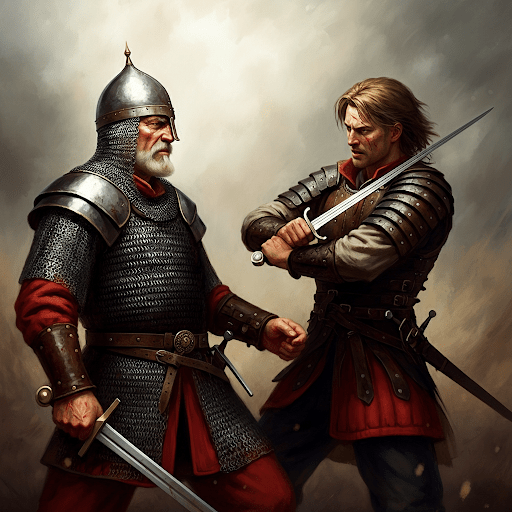
Isubane’s Echo, Chapter 4: Breckan’s Hold

Image by Gemini

“Hah! There’s nothing like two lads trying to impale each other to bring back memories of old times. Don’t you worry Beldere, I’ll get the lad a lance touched by Thera herself!”  Spikey had a huge grin on his face, and a sly gleam in his eye, as he picked up a random stick from the side of the road and fed the power of Primythera, the planet spirit, directly into the long dead branch. It grew rapidly, straightening and hardening as several soldiers couldn’t help but trade bawdy jests as to the phallic nature of the druid’s creation. Spikey took it in stride, confiding to his swiftmates in a whisper that carried to everyone: “That’s Sully’s little boy over there. Who wants to see Cat thrown from a saddle? Wagers?”  

“You’ll need a horse, Catwright, unless you plan on running at him,” Sergeant Lovine dismounted and handed off the reins. Cat eyed the Sergeant and the Corporals with a sour, resigned expression as they started discussing odds while breaking out snacks and using their packs for chairs. Very few believed he would win the joust, but most thought he would win a sword fight if he wasn’t too incapacitated.

 “Catwright Isubane the Third,” the armored horseman bellowed across the distance, “I challenge you to a duel to the dirt; first one knocked down three times loses! Agreed?” 

“Agreed!” Cat shouted back as he mounted the much smaller rouncey. 

“Take a shield!” Beldere scolded. “You aren’t even wearing any armor. You are putting far too much faith in my ability to put you back together.”

 One of the soldiers handed Cat a full-sized tower shield; it must have weighed over thirty pounds. Even holding it sideways, Cat had to angle it down so he could see over the top. Cat started laughing. “You’re always saying I need to have more faith, Bel.” 

“Ha!” his challenger called over. “That shield is older than my grandfather!” 

“Still not as old as that antique set you’re wearing!” Cat shouted right back. 

“Ha ha! Weight advantage to me! We’ll see how smug you are when I put this lance through that pathetic wooden door and your unprotected ribs.” Beldere raised his head at this, then narrowed his eyes and waved a hand. The steel tip on the lance fell off and bounced off the warhorse’s barding once before unceremoniously thumping to the ground. You could practically see the distraught look through the young Sulwood’s visor. “Watcher’s hairy green balls, Bel, you always have to ruin the fun!” The lance came off his shoulder in one fluid motion, and the enormous destrier surged forward.  

Cat was just taking his lance from Spikey, somewhat distracted by the graphic metaphors being tossed around, and half of the soldiers rolling on the ground in laughter, when he noticed Seleger coming for him. He spurred forward, using every bit of horsemanship he could muster just to get his frightened mount galloping in the right direction. He was basically riding blind as he maneuvered the 12-foot lance into position around the massive shield, almost dropping the weapon in the process. He flattened the shield slightly to see and had to raise it back up a half-second before impact. He felt and heard the shattering of wood. His freshly made lance flexed in his grip as it hit the lower corner of Seleger’s shield and bent instead of shattering for just a split moment. In the next fraction of a second, he was forced sideways and then backward as his lance snapped, his right shoulder popped out of its socket, and the remainder of his opponent’s lance struck him in his left pectoral. Then there was intense pain and a feeling of weightlessness as he flew backward through the air, and landed in a backward roll which brought him smoothly to his feet.  

Cat dropped the remains of the tower shield and reached over to pull his shoulder back into place with an audible crunch. The pain was intense but helped him focus. He didn’t go into shock or pass out as easily now as he did a few years ago. Unfortunately, his right arm would be useless for a while, so he drew his sword left-handed and set his stance as Seleger turned the massive stallion around. Seleger was picking up speed like he intended to just run him down; Cat just set his feet and smiled. At the last moment, the other boy broke off and vaulted from the saddle. 

“I could have taken the easy win, but I don’t want you to hurt my horse.” 

“I wouldn’t hurt your horse.” 

“Yes, you would; you just wouldn’t kill it because you believe all broken bones and stab wounds can be healed.” 

“They can.” 

“You’re too used to having a personal priest to fix all your problems.” Seleger was goading him, trying to get him angry enough to make a stupid mistake. Cat just smiled. 

“Are you going to talk all day, or can we finish this?” 

“Did you see how easily I took you out of the saddle?” Seleger boasted, raising his voice for all to hear. Cat refused to mention that Seleger had started charging before he was even seated. “I’m not even right-handed.” Seleger looked pointedly at Cat’s uselessly dangling right arm. “But you are.” Seleger was very good at getting into his opponent’s head, but that wouldn’t work on him. Cat started striding toward the other boy. 

Seleger was so busy hurling taunts that he barely got his sword up in time to block Cat’s first swing. Seleger was good at swordplay, and he was fully armored, but Cat was relentless. Seleger tired quickly with all the extra weight, and before long, the armor was ringing with the rapid hits from the faster, more nimble fighter. In less than two minutes, Seleger was disarmed and face-first in the dirt. Farmers and other travelers had gathered in a circle with the whooping soldiers to watch the display. Cat noticed the soldiers already shamelessly exchanging coins while Seleger struggled to a sitting position and removed his battered helmet. The ruddy-faced boy grinned up at Catwright as the victor offered his friend, Seleger Sulwood, a hand up. 

“You are still a ruthless bastard” Seleger grunted at Catwright as Beldere healed the shallow wounds and Cat’s dislocated shoulder.

“I seem to remember someone telling me a couple years ago, that I was too soft on the competition”

“Yeah, I meant for you to go harder on them, not me!” Seleger laughed. “It’s good to see you Cat, I haven’t taken a good whooping in a while.

“That armor must be five hundred years old,” Cat said matter-of-factly. 

“What? No, this was my grandfather’s armor; the Sulwoods didn’t all have fancy armor like your old grandpa. Whatever happened to that wondrous artifact? I know your father isn’t using it.”  The Armor of Areyas, his grandfather’s famous suit of Calmahran enchanted armor. Cat had been disappointed it wasn’t in the amulet King Mecre had given him. 

 “I’d guess someone high up in the king’s inner circle is using it,” Cat replied thoughtfully. He knew the armor had been pierced through by the teeth of Isulas, the lizard god of vengeance, but it could supposedly regenerate from any harm.

  “Well, I’d shave my sack with a spoon for armor like that,” Seleger said wistfully.

 “I’m not sure which is harder to believe,” Cat said straight-faced, “all the stories about that armor, or that you actually have hair on your sack.” 

“Ha, You should assume everything is true until proven otherwise!” Seleger replied airily. Cat wasn’t sure if the boy was being serious, or just flexing his strange sense of humor. Seleger vaulted back into his saddle with the ease of someone who was definitely not wearing fifty pounds of steel and leather. “You were early, by the way; I meant to meet you further out. Those old soldiers are quicker than I thought.” 

“Did Adenide tell you I was coming?” 

“That’s High Wild Warden or Master Adenide, Sage of the Six Moons,” Beldere interjected reverently. 

Seleger ignored the correction. “Yes. Did you know yours could talk over distances?” Seleger eyed the young priest suspiciously. 

“I suspected, I suppose, but at least he hasn’t been in my head yet as far as I can tell.” Cat also glanced at Beldere. 

“Speaking to another priest is much easier. You would have to let me in; I’m not strong enough to force a connection.” Cat heard the unspoken ‘yet’ quite clearly. 

“Well, I formally welcome you and your small army to the delightful town of Breckan’s Hold. May it not bore you to tears before we head on to Osenvale.” 

“We?” Cat inquired. 

“Yes, I am coming with you, and perhaps I shall bring my own entourage. We could conquer the city and divide up the spoils and the ladies between us.” Seleger gave Cat a significant look, and Cat just rolled his eyes.

A group of riders approached from the west as the party entered the outskirts of Breckan’s Hold from the east. Cat recognized Seleger’s father, retired Lieutenant Colonel Dain Sulwood, atop a monstrous gray war bear. A half-dozen other riders in the brown and grey livery of house Sulwood accompanied the Lord of Breckan’s Hold, The few horses in Cat’s party danced and shied away from the great bear. Even the shinnocmyr and Garreth’s great boar seemed cautious, while the horses of house Sulwood’s soldiers and Seleger’s own beast, seemed unconcerned. 

Dain had served with his father through the ongoing border wars as a quad commander and then second in command of Sapphire Company. Catwright had met the man a few times over the years. He was a solid military man in his early forties, with a touch of gray in his dark hair. 

Dain nodded at Catwright and Beldere. “Welcome to Breckan’s Hold. We have a domestic disturbance out at the Bailer farm; Seleger, you will accompany me. Catwright, you can come if you like; it may prove instructional. The rest of you can continue to the Hold if you wish; accommodations have been prepared for all of you, and the tavern has stocked extra brew.” He looked pointedly at the soldiers.

“Aw, why’re you looking at me, Sully?” Spikey drawled with a mock-hurt expression.

“Ain’t gotta tell me twice,” Gemma was first to guide her mount around the crowd and toward the town center.

“Take my horse,” Sergeant Lovine said to Cat, handing him the reins of the recovered rouncey. “It’s unseemly for you to be jogging behind Lord Sulwood’s retinue like some poor beggar.”

With no further objections, Seleger, Catwright, and Beldere followed Dain down a southward-branching road into the more rural farmlands. The soldiers spread out with three in the front and three in the rear. Beldere must have learned the trick of calming their two horses, for suddenly they all stopped fidgeting and trotted closer behind the great bear. Dain called the bear Feingar and talked to it as if it understood him perfectly. Its shoulder was level with the eyes of Seleger’s warhorse, and it could have carried six people easily if needed. The bear ignored the trio and forged ahead with a ground-eating pace that forced the horses to canter to keep up.

“So what’s happening with the Bailer’s?” Seleger asked.

“A merchant came into town about an hour ago saying he heard a girl crying and a man yelling, so I decided to go check it out myself. This isn’t the first time I’ve heard about trouble out this way, but the soldiers I sent a few months ago didn’t find anything amiss. The kids have been sick a lot though, and missing weeks of school.

Catwright smelled the farmstead before he saw the cottage through the trees. The acrid stench of pig feces clogged the air. The bear whuffed in annoyance as they approached the house. A shaggy-haired, obese man sat on the front steps, cradling a bottle of spirits. Beldere dismounted, wide-eyed, before anyone could speak, and walked briskly toward the home. Dain noted the priest’s concern and snapped a question as he slid down Feingar’s flank: “Dernus, what happened here?”

The fat man looked up with bleary eyes, saw the priest stalking toward him, and stood abruptly. “Hey, what’re you about?” The almost three-hundred-pound man flew aside into the mud at a gesture from Beldere, who continued to advance up the short steps. Cat and Seleger vaulted from their mounts, excited to see what had Beldere so worked up.

The inside of the house was a mess, but that was not what captured the party’s attention. At the base of a broken chair, sprawled on a moldy blanket, was a filthy, pale, and sickly-looking little girl dressed in rags. Cat was almost surprised to see her draw breath. She had at least one broken arm, and her bruised face was contorted in pain, even though she appeared to be unconscious.

“Call for Master Adenide…” Dain started.

“There is no need,” Catwright stated soberly. He could feel Beldere gathering his magic. The girl might be dead long before the master got there, but Beldere could heal her. Cat had been in bad shape before, but his wounds were almost always treated immediately. This poor girl must have been suffering for days. She had the look of someone with untreated internal damage.

The girl gasped as the magic of Neador’s faith took hold. She floated several inches above the floor; her bones fused together, her flesh knitted closed, bruises faded, and scars disappeared. Beldere then cleared the blood from her body with the same magic and repaired her torn clothing, revealing a pale, brown-haired girl of nine or ten years. She sobbed softly. The whole miracle took less than a minute.

“You have come far, young priest, from when I last saw you,” Dain said slowly. “I doubt Master Adenide could have been so thorough.”

“I have had considerable practice,” Beldere glanced at Catwright.

“I grant you right of sentence for Dernus Bailer; what would Neador’s judgment be?”

Beldere sighed heavily, the weight of responsibility evident. Cat knew that Neador himself did not judge, but the wisdom of his priests was considered beyond reproach. “What can you tell me of the family?”

“They came from the north a few years ago,” Dain stated, “from the borderlands. A neighboring town had been sacked by Grulken, so they decided it was time to move somewhere better protected, even if it meant paying some taxes. Dernus was always the angry type and likes to drink and gamble.”

“The mother?” Beldere asked.

Dain just shrugged. In Mecre, it was not uncommon for women to separate from the fathers of their children if they had a druidic calling, but in the borderlands, men and women usually stayed together for extra security.

“She was killed in the borderlands,” came a slurred call from the doorway. Dernus stood there swaying. The little girl became stiff and silent, her fear evident. The boys and Dain did not move; they had seen him coming. He was not a fighting man, and they were not intimidated. “When the Grulken sacked Bolgerton, she was there with her sister, and they were all slaughtered.” He spat the words, far more angry than sad.

Dernus suddenly halted mid-sway and became silent, eyes wide. Beldere approached the large man, the priest’s voice as cold as Cat had ever heard it. “Dernus Bailer, you are a damaged man. I cannot heal the wound in your mind, but I can make sure you do not harm others. You will continue to work as a pig farmer, tithing one-tenth of all your earnings to the Sulwood estate. Your children shall become wards of the Sulwoods. If you wish to see them, they must agree to the meeting. No matter how much anger you have, you will never lay a hand upon them or anyone unless it be in self-defense or the defense of Breckan’s Hold.”

“Yes, Priest of Neador, I’ll obey,” Dernus droned in reply. Cat and Seleger looked at each other with dumbfounded expressions. The compulsion was one of the most frightening things Catwright had ever seen. Could Beldere do that to him? Had he already done it? Dernus staggered into an adjoining room, looking tired and confused.

Dain kneeled down in front of the girl, her hollow expression focused. “Bethyn, where is your brother?”

“I…I dunno,” she squeaked.

“He is in the sty,” Beldere said.

Dain wrinkled his nose. “Alive?”

“Sleeping,” the priest confirmed.

The pigsty was a short wooden building not far from the main house. As they approached, the reek was oppressive, even in the crisp autumn air. “Chatwick, are you in there?” Dain shouted into the entrance.

A scrawny boy of perhaps thirteen or fourteen years slid through the muck, scrambling to his feet and almost falling again in his haste. “S..sorry, my lords, I wasn’t sleepin’ or nothin’; I was just checkin’ that all the piglets was still there.” The accent was of the rural borderlands, thicker than his father’s or sister’s. His clothes were covered in pig feces and mud; even the stringy blonde mop on his head was matted with brown on one side. Seleger did not try to hide his wide grin. Cat smiled in spite of himself; even with all he had been through, he could not imagine finding comfort in such a hiding place.

“Your father has forfeited his right of parentage,” Dain said without preamble. “You and your sister shall become wards of the Sulwood house.”

The boy’s face sobered as he considered the words; for a moment, Cat thought he would refuse. Chatwick’s face brightened suddenly. “Ol’ da finally went too far, I reckon. That mean I don’t have to shovel shit no more? Seems like a lucky day for me. What do I do? I can cook, ya know, an’ I’m pretty fierce with a spade!”

Seleger chuckled. “Father, with your permission, I think I’d like to take Chatwick as my squire.”

Dain had a bemused expression. “Or a page, more like; young Chatwick has not been raised as a soldier. I shall grant your request, if Chatwick is willing?”

“A man could do much worse than page to a Sulwood,” Chatwick grinned and tried to stand proud, raising his chin and puffing out his chest. “It would be my honor!” It might have come across better if he weren’t ankle-deep in filth.

After a thorough cleaning, with aid from Beldere, Seleger had his new page coax Bethyn out of the house and onto a horse behind Catwright. Chatwick couldn’t resist running his hands down the flanks of the great bear as he passed. Feingar, for his part, gave a small snort and a look that suggested the boy’s hands were not clean enough for such liberties.

“We do not fondle another’s mount without their permission,” Seleger chided gently. “There are men who would cut you down for such an affront; a different war bear might even take you for a snack.”

“Someday I will ride a great bear like Feingar!” Chatwick spoke prophetically, without the least bit of apology or humility, as he climbed up behind Seleger. 

The town of Breckan’s Hold was the same picturesque small gathering of well constructed wooden houses Catwright remembered from two years past. The homes were interspersed by occasional rock walls and ruined stone structures from a fortress that fell hundreds of years ago during the war of the dead. Cat did not remember the name of the fort or the battle, but was sure he had learned about it at some point. 

They made their way slowly to the Sulwood manor. Many townspeople waved or called a greeting to Dain and Seleger, for they were adored by the folk. Dain stopped and conversed with many of them, exchanging pleasantries and deftly deflecting or answering inquiries with a precision that left Catwright in awe. The art of conversation and politics was something not well covered in his education thus far.

Although only a couple of hours had passed since they had diverged from the rest of the party on the road, the sun was low in the sky as they entered the sturdy wooden gates of the Sulwood estate. The small courtyard was lush with vegetation, including a variety of colorful flowers Cat was pretty sure would not normally grow this late in the year. Lady Natalia Sulwood greeted them at the entrance in a long forest green gown. An emerald necklace around her neck brought out her sparkling eyes as she beamed at them. Her curly brown hair framed striking features. She was not quite a decade younger than Dain, yet still old enough to have three children, two of whom were already adults. She herself could have easily passed for Dain’s daughter. Such was the way of those who practiced advanced druidcraft, Cat thought, they don’t seem to age the way the rest of us do.

“Greetings husband, Seleger, and oh Catwright it has been too long, you boys are so tall I have to look up at you now.” She hugged all three of them warmly, before turning to the children. “Now who are these little darlings?”

“Chatwick and Bethyn Bailer, Neador has seen fit to grant us two new wards.” he nodded toward Beldere. “I’ll explain the circumstances at dinner my dear.”

“Priest Beldere, you have grown as well, I see maturity and sorrow in your eyes far beyond your years. Pray take whatever succor you desire from this house. A Voice of the Watcher is ever welcome here. We have prepared rooms for you, but I know master Adelade has requested your presence in the Grotto of Whispers and has quarters for you there as well.”

“I thank you for your hospitality, Lady Sulwood. I beg your leave, so that I may be off to the Grotto at once.” Beldere looked uncomfortable and excited at the same time.

“Off you go then dear, best not to keep the Master waiting.”

Beldere made cursory farewells to the others and then virtually ran out the door. Natalia greeted the children warmly and sent them off with a servant for a tour of the grounds and dinner with some of the other children of the manor. Cat and Selger were asked to freshen up before an intimate meal with Lord and Lady Sulwood.

The meal was sumptuous compared to what Cat was used to, but not extravagant by Sulwood standards. They were not true wealthy nobles, but compared to his father or any normal soldiers, they were well off indeed. They spoke at length about local politics, the assumption being that Catwright would be interested since he might someday run a village or town of his own someday. In truth he found it difficult to focus, his mind drifting into imaginary future adventures. The responsibilities that Dain and Natalia embraced with such fervor held little interest for the sixteen year old boy.

Seleger seemed to embrace the conversation well enough, asking about the families he knew or what trade goods they would seek in return for their larger than normal harvest this year. 

“What are your plans while in Osenvale, Catwright?” The conversation had become a background murmur until he caught Natalia’s voice speaking his name.

“Uh, I’m sorry…” He fumbled. She repeated her question, more slowly.

“If Selly’s going with you I would know your general plans, where you’ll be staying, and how long.” Her voice was sweet and cordial with a not so subtle hint of demand.

“Well,” Cat started slowly, as Seleger stifled a laugh. “We’re going for the festival, and the tournament.” He paused. “I haven’t really thought too far beyond that. As for where we’re staying, I hadn’t really thought about it. I figured Sergeant Lovine would know a place.”

“I’m sure he would indeed, a hovel with pallets for beds above a brothel no doubt.” Seleger didn’t hold back his laugh this time. The lady’s mischievously stern face swept the room. “Well you needn’t worry, I will arrange a place, for I shall be going with you.”

Isubane’s Echo, Chapter 3: Freedom

Image by Gemini

The silence stretched for long moments after Beldere’s revelation. There were some incredulous murmurs in the background but nothing distinct until the old man, face an inscrutable mask, finally asked. “Any other questions?”

Catwright the younger couldn’t imagine what his father must be thinking. After finally arriving home after two years on campaign, he gets his head bashed in by his son and then finds out a few hours later that his son is basically his father. Cat almost giggled like a little boy at the thought. He was in a good mood suddenly. With the revelation that the Everborn had a personal interest in him, and then receiving a soul-bound artifact enchanted with dimensional magic with a thousand gold pieces in it, his day had become much better. The letter and the gift were possibly more of a treat than watching his father collapse in the dirt this morning.

“There is something I have always wondered about,” Cat had a genuine smile on his face, which most in the mess hall had never seen. “Why did you have to continue the name of Catwright? Where did that come from, and how did it stick for three generations?” There was unrestrained laughter echoing through the chamber now. Even Beldere looked like his last sip of water almost came back out of his nose. Cat was grinning as well, but the truth was, he had always hated the name, and wondered if his descendants had been fixers of carts who lack a proper alphabetic education.

His father grimaced. “It was your mother’s idea. When she brought you here you were about six months old and she had already named you. You can ask her. You’ll find her, or rather she’ll find you, if only to tell you what an idiot you are for leaving the protection of the grove.” 

Cat was more than a little surprised the colonel answered the question, though it was not really an answer, only raised more questions And the rebuke at the end was so typically his father that Cat had to stifle a laugh. He knew that his grandfather had been an orphan who had embraced military service before he even came of age, but no one seemed to know much more. His mother would. The thought of his mother made him chuckle. Yes, he would find her, and he would have lots of questions. He reached down casually and touched his pack and kit sitting on the floor behind him, and they disappeared into his brooch. He enjoyed the startled gasps.

“You might want to be a little more careful with that particular secret.” The colonel looked thoughtful.

“Why?” Cat challenged, “It can’t be stolen; it’s soulbound.”

“Of course it can!” The old man looked genuinely surprised and disappointed. “They can just kill you and break the binding.”

It was Cat’s turn to be surprised and a little embarrassed, but his snark had not been stifled quite yet. “I will endeavor to prevent the loss then. I would not want to shame our family with a premature death and loss of a valuable artifact.”

His father just rolled his eyes and stood up. “Eat up boy, I assume you’ll want to put some miles on the road before dark. I’ll make sure the facet is ready to depart within the hour.”

It took Cat less than an hour to eat and walk to the west gate. There had been several interruptions and distractions by well-wishers or those who were just plain curious. He received their words with more tact and civility that he could usually muster because of his lingering good mood. He couldn’t remember the last time a simmering anger had not been lurking in the corner of his mind. His step was lighter for more than one reason. He was also physically unburdened thanks to his new amulet. It was strange to have this kind of freedom. He could call anything from his storage space directly to his hand; he didn’t even have to wear a sword belt. It felt unfair in a way, like he had found a way to cheat so many minor hardships with a single acquisition. It had briefly crossed his mind that this might make him weaker, somehow dependent on indestructible, weightless storage. The smile on his face revealed the truth though. It was worth the negligible cost to his pride for such a tremendous gain any way he looked at it.

Beldere and the soldiers were already assembled at the gate. He knew all of the old warriors of course. Crusty old Sergeant Lovine was at the head of a full facet of three swifts. The swifts were veterans as well, each with 2 heavy infantry, a mage, a dedicated healer, and a senior softie. He knew these softies had all cross trained as well; each one could perform as a sapper, an archer and a scout. The grizzled Corporal Remel, who went by the nickname ‘Spikey’, was also a druid. The squat broad man had an oversized crossbow strapped to his back, a thick grey and black beard with penetrating green eyes. “There’s the boy! If we’re goin to get planted, it might as well be while fighting them lizards!”

Cat knew the man had a grudge against the Ssythe, but didn’t know the details. He thought druids were like Beldere, supposedly peaceful and would preach against harming other sentient beings. Spikey was a soldier, though, so he apparently didn’t ascribe to all the non-violent tenants of the priesthood. “I’m not planning on starting any fights, Spikey.”

“Sure you’re not.” The softie shook his head doubtfully and probably had a knowing smile under his ridiculous beard. “It’s nice to get out of garrison duty just the same.” 

Only Beldere and the Sergeant had a horse, but Cat was still surprised by the escort. Most full cluster units did not have more than one or two fully complemented facets because mages and healers were relatively scarce. Most facets would have an extra infantry or bowman to replace a missing mage, and the healer would be a regular soldier with slightly more knowledge as a field medic. Knowing the skills of these men, Cat reckoned he had one of the most effective facets in all of Sapphire company. The mages were actual magi, with access to multiple veils, and the healers were specialists who could truly save lives. This was an escort that most royal houses would envy, and it was all for him. Were they ordered to do this? Did they really think this was a suicide mission?

The mercenaries arrived a few minutes later, each on their own personal steed. There were six of them, all travelling to Osenvale. Garreth rode an enormous warboar, its shoulder as tall as Cat’s head. They were apparently common in the Weltstone area, where the locals were constantly fending off hunters who braved the icy mountains for the valuable tusks. Olivia Peln and her brother Jarod, mages specializing in aquavae and  frigorum, the veils of water and cold, both rode giant black foxes called Shinnocmyr. Some people confused them with dire foxes, but these were more intelligent and magical. Cat was wary of them, because he had very little understanding of their capabilities. He knew they were dangerous, but had never fought them because they had no interest in being ‘stabbed for play’ as Olivia had translated. The rest — Gemma, Markus and Denton — all rode horses. Only Gemma’s was memorable because it was a silver-haired Felton mare. Mercenaries earned a lot more coin than regular soldiers and they tended to splurge on the exotic. One might think the soldiers were envious, but they would point out that most mercenaries don’t last a decade, and a large number don’t survive the first year. 

Risk and reward. Not for the first time Cat considered if he would enjoy the mercenary life. There were always adventures and excitement awaiting talented warriors for hire. Monsters, forces of nature, and creatures from beyond the veils appeared suddenly, and soldiers weren’t always around or equipped to deal with them. There were a lot of grey areas, however. Mercenaries could be hired to fill out armies on whichever side had the most gold. Any lord or merchant with enough coin could purchase their service to stomp out their competition. Cat wouldn’t feel right marching up to someone’s home and killing guards who were just doing their job. Such things did not occur often in Mecre, but there were plenty of nearby realms that were constantly at war with somebody. In these places, people with power and wealth made the rules. It was in those places that mercenaries earned their fame and fortune. It seemed that the best course, if he were to pursue such a career, would be to acquire his own mercenary company, so that he could decide where they went and who they worked for.

Before the group departed the colonel strode up with a group of officers. The soldiers came to an approximation of casual attention, respecting the unexpected appearance of their seniors, but veteran enough not to be intimidated or overly formal. Yet, it seemed the old man planned for some ceremony. The officers behind him came to stiff attention. Two flag bearers appeared with the Mecran flag and the Ironwatch flag and stood in back of the formation with standards held high. The colonel unfurled a scroll and held in front of himself, reading in a confident and projecting voice: 

“All within hearing and sight, behold and bear witness! I, Catwright Isubane the second, do bring to your attention a matter of familial concern. My son, Catwright Isubane the third, from this day forth is no longer a boy to be sheltered, but a man ready to forge his own path. Therefore, by the power vested in me by the King of Mecre, and as a Colonel in the Mecran Army, Commander of Ironwatch garrison and Lord of Ironwatch Grove, I hereby declare Catwright Isubane the third emancipated from my direct authority and guardianship. He is now free to pursue his own destiny, seek his fortune, and make his mark upon the world. Let it not be said that he leaves without my blessing. He carries with him my love, my pride and the pride of those who have instructed him all these long years. May he always remember the honor and values of our house, those of the lands of Mecre, as they and he are watched over by our Grand Gardener, the Watcher in the Wood, Neador lord of the Elderwoods.” His father rolled up the scroll with the practiced ease of an administrator and handed it off to an officer.

“Catwright Isubane the third,” Catwright the second shouted. “Step forward!” Cat was entranced with the show and almost missed his cue; however,  he had seen such rituals performed enough times to know his part. He stepped forward and knelt before his father.

“I bestow upon you the freedom of a man. May you wield it wisely and with courage. Go forth and make your own name, but know that you will always have a place within this keep and within my heart.” The old soldier held out a gold  signet ring. Cat sometimes forgot that they were technically nobility, as decreed by King Mecre on the day his grandfather had died. The titles and lands were deferred, however, until his father resigned his commission. It was likely a large part of the reason his father kept going. It was hard enough being a Colonel; who would want to be a Baron? “Rise, Catwright, not as my son, but as your own man.” Cat stood and accepted the ring, a plain gold band with an oval bezel. His initials were engraved in reverse with three ‘I’s” underneath indicating the ‘third’ portion of his name. He didn’t know what to say. All this affection, emancipation, a ring made just for him. Cat bit his lip. He would not cry! 

“Th..Thank you.” he managed.

A few more words were exchanged and there was some cheering and another round of well wishes. Cat’s mind was in a fog, he barely remembered anything after storing the signet ring and shaking his father’s hand. The old man had escaped with his entourage at some point and the flustered young man couldn’t wait to do the same.

Eventually, they made it through the gate and set a quick pace out of Ironwood village. The weather was crisp and dry, and they continued to make good time through the wide elderwood forest roads. The horses kept a steady trot while the soldiers and Catwright jogged alongside. He thought about offering to store the soldiers’ packs, but he felt like it might be insulting and they seemed to keep up well enough. Most of them had been doing this type of thing since before he was born after all.

The transition to the younger forest was not subtle. The road became a steep and more narrow descent that wound into switchbacks, and the ground vegetation abruptly thickened while relatively smaller and more varied trees grew closer together. As they curved around a particularly scenic outcropping, the deciduous greenery stretching for leagues in every direction, an explosion of birds startled the late afternoon peace. The entire party stopped and stared as thousands of small song birds, and hundreds of larger carrion eaters rose in a wide arc to the west and circled for a full minute with their flocks crossing through one another. The dark cloud of shrieks and screams sullied the sky until suddenly it stopped as the birds scattered in every direction.

“That didn’t seem natural.” a soldier remarked dryly.

“It wasn’t.” Spikey said, shaking his grizzled head.

The old soldier-druid wheezed slightly. “They’re common spies for shamans, druids, priests, and magi. Easy to control and hard to disable. I sensed at least a dozen lookers before I snuffed ‘em.”

“You broke a dozen links from thousands of feet away? That’s impressive.” Denton Blackfoot said, his fine chiseled features disturbed. “I didn’t notice the weaves on the birds or your casting.”

“Aye, Thera don’t like folks dominating her critters, and druids don’t need to part the veils to borrow her power. Besides I only stopped the weaker ones, there are plenty of casters out there who could weave a binding I can’t see.”

“I didn’t see any of them,” Beldere sounded confused.

Spikey looked at the young priest with some sympathy. “That’s why they waited outside the grove, boy; knew you’d be weaker away from the Watcher’s guardians.” 

Cat recognized the look Beldere got when he looked inward. The young man had rarely in his life been outside of a grove, and Cat wondered just how weak his leash had become. Too late to run away now, I’m already free. Yet it was good to know the acolyte might not be as omniscient as he seemed back in Ironwatch.

They travelled for another hour and camped in the partial shelter of an old fortification, a small and crumbling ruin from a long forgotten war. Cat set up his tent outside the walls, not entirely comfortable in the somewhat dark and dank surroundings. While others went about making a fire and cooking food, he spared lightly with the soldiers and mercenaries. Someone remarked that he didn’t need to train so relentlessly anymore, and Cat simply shrugged. It was all he really knew. The session was a game of simple first-touch wins; no one wanted to get hurt too badly, not knowing the extent of Beldere’s limited powers. There were healers among the soldiers, but they were magi with access to animyra and other eldritch veils. None of them were priests as far as he knew. Cat doubted they could heal anything like Beldere, even in his weakened state.

The first round was played one-on-one with just swordplay. It was an advantage for him and he did not disappoint, tagging each in just a few seconds after Sergeant Lovine, the judge, saying ‘go’. The next round, he let them prepare with spells and use any tricks; like non-lethal items they had available. The game became much more even. The veterans and mercenaries were giving as good as they got. Denton tagged him two out of three times with his magically enhanced speed and reflexes. Additionally, the enchantment he put on his sword helped him block and attack with unerring precision. 

On the third try, Spikey pulled out the stops and caused mist to shroud the training area. Cat didn’t mind that; he had experience fighting blind. He was taken to the ground in an instant, however, with a magic rope and then rapidly immobilized with growing vines. He felt the sword at his throat less than thirty seconds into the match. Cat had enhancements cast upon him by Beldere after that, partially to test the limits of the priest’s abilities and partially to up the challenge. He let everyone cast team spells on each other to see how their stacked abilities stood up against the stunted spells and lesser aura of Neador’s faithful servant. The magic was definitely in the favor of his opponents, but many of them were not used to moving faster or having a homing weapon. It was stifling to work against Beldere’s divine aura, but most of them had experience with the weakness and slowness it conferred. Cat was confounded by the combination of speed and Corporal Banid’s light whip enchantment on the blades of experienced warriors. The blades bent in impossible directions with the seeking spells attached, and the arc of the swings left ribbons of light in the air that still burned when touched. It was almost like turning normal swords into Elydrean mana blades.

As meal time approached, Cat’s rations were forgotten. The mercenaries had magical storage items and were happy to share. The smell of auroch steaks and fresh bread made his mouth water. Markus, the designated cook for the evening, had also prepared a spiced vegetable stir-fry, many of the ingredients for which Spikey and Beldere were able to grow fresh on the spot. The Pelns set out a large blanket and two great silver plates three feet in diameter. At first, Cat thought they were some kind of handleless shields until they placed great slabs of lightly warmed meat, the size of a man’s chest, upon them. The great magic foxes took to the feast with obvious delight.

After the evening meal, second and third swift divided up the watch duties, while first swift, having the night off, brought out a heavy metal flask and began passing it around. Swift leader Medane offered the flask to Catwright with a smile. “Drink up son; you might as well start the celebration now.”

Cat took the flask with some reservations; he had never been allowed alcohol within the garrison. For one, it was scarce, and two, his father had forbidden it, saying it could undermine his development. Cat took a swig, and it took considerable willpower not to spew it back up again. His whole mouth burned, then his nose stung, and his eyes started tearing up; it reminded him of the noxious magical clouds they used during gaseous warfare training. “You need to swallow it, Cat!” Gemma chortled from the other side of the fire. Swallowing caused the burn to continue all the way down his throat, but when it hit his stomach, warmth spread through him. Now he understood the quick sips and the grimace on the soldiers’ faces. He passed on the flask, noting with little surprise that Beldere declined. It was perhaps the most unpleasant drink he had ever tried, but he took another each time the flask came around, interested to see how the tinctures he had taken over the years would affect his tolerance compared to the others. Everyone in this group likely had at least some physical tempering, but his father had spent thousands of gold on Cat’s development, something most soldiers could not afford.

“This particular batch of Ironwatch whiskey has been enchanted with spirit mana by a master brewer,” Medane said casually, causing some of the mercenaries to look up sharply with concern. The old soldiers chuckled at the looks. “It won’t harm you none,” he waved his hand in a vague gesture. “It enhances the more enjoyable effects, like honesty and uh, relaxation, while reducing the less pleasant effects on the morrow.” Cat shrugged and took another sip; he felt his face start to heat up pleasantly. He was definitely relaxing. Muscles he hadn’t known were tight, were releasing their tension. The firelight, the friendly atmosphere, and the warm sensation in his face all seemed to lull him somehow.

“Why is it so hard to manifest mana while fighting?” Cat did not usually like addressing a group of people, but he felt more comfortable in this setting for some reason. His gaze fell on Denton as the most likely to have an answer.

“You’re looking at me, but you are one of the most gifted mana manipulators I’ve ever seen at your age.” Denton smiled wistfully, his dark eyes turned downward, almost sadly.

“Wh…what?” Cat responded, surprised.

“You naturally use lithos in your stance, which is why you’re nearly impossible to knock over. You are constantly switching among the other elements which makes you inhumanly fast and unpredictable. You even manifest animyra to see all around you and heal faster.”

“I don’t control that; it just happens.”

“Yet it is a manifestation of your will upon the veils and the elemental mana around you.”

“What about a physical manifestation like casting a spell?”

“Casting is a whole separate study, but you know that. What I do is mostly casting before a fight to prepare. I can manifest lithos and aether while fighting for strength and speed because I have cast the spells so many times; opening the veils is second nature. Like you, I don’t really need to think about it.”

Cat was still frustrated; he was at a loss to explain what he needed to know. The fog that clouded his mind was not helping. “When you speed up during a fight,” He paused to focus. “You know what is happening, you can feel the veil opening and control it.”

“Well, yes.”

“I don’t feel it happening; I don’t control the veils.”

“You do not have specialized training in that area, but you should still feel the veil opening inside you” The spellsword made a motion like opening tent flaps.

“I feel the world slow down around me when I speed up, and I gain a sort of surety at a certain point, a feeling for what’s coming next. The lithos make me feel rooted to the ground and it seems like I’ve always been able to do that, even when I was really little.” He remembered  a nursemaid trying to pick him up when he was about four. He had wanted to play with some small military figurines he had discovered and resisted her. When she couldn’t lift him, she cried for help, not understanding what was happening.

Denton nodded “The precognition is rare, but not unheard of in seasoned warriors. You may be pulling mana from the environment around you; it’s inefficient, but it makes sense since you don’t have a lot of formal mage training, and it explains why you don’t feel the veils.”

“You just keep practicing and focusing on improving, and eventually, the veils will help you out.” Corporal Banid jumped in, scratching his scraggly beard after a sip from the canteen. “It’s easier if you work on one thing until you get what you want. If you’re too ambitious though, it can take years.”

“Manifestation is associated with familiarity,” A cold breeze touched the fire as Olivia twirled her fingers in front of her. Cat could see frost on her fingertips, though she did not seem to be uncomfortable. Her dark eyes became lighter with a slight glow, and her short, cropped blonde hair started lifting upward. “The body does not naturally accept a veil opening within it, but with practice, you create channels, much like blood vessels, and manipulating the weaves becomes easier. Your body becomes closer to the veils. They open more easily and stay open longer, and the power can be addicting.” By the time she finished speaking several soldiers were pulling their cloaks tighter about them and hunching down for warmth. Cat smiled in appreciation, few people could merge beautiful and creepy like Olivia Peln.

“Manifesting is simply using the power of a veil without the need of words, gestures, runes, or a catalyst to prop it open.” Jarod put it.

“What about a focus?” Asked Somera, a stocky woman of middle years who served as first swift’s healer.

Jarod seemed surprised by the question and looked around at Olivia and Denton’s smiling faces as if in fear of being tricked. “Ah, the education of a soldier is much more practical than theoretical I suppose. He nodded respectfully to the older woman, his pale, sharp features embarrassed.  “The focus in common manifested spellcraft is you, or more specifically your soul.”

Somera was unperturbed. “So why do I need to use a wand or a staff to cast?” Her thick brows furrowed.

“That is a complex question.” Jarod sat back and stared for a moment at his black serpent-leather boots, likely more expensive than everything the soldier carried. There was a class difference here, not just in wealth, but in education as well. “Not everyone has the same gift with the veils. Some will never access a veil without some expensive assistance. Some just need a little extra help, he gestured to her polished oak staff. And still others just seem to have mana leaking from their pores.” He nodded pointedly at Catwright, and Cat was starting to understand his advantage. “The wooden foci you use are specifically potent for access to Salatosum, the veil of life. A spellsword, he gestured at Denton, might use steel to help access Bellicorum, the realm of conflict. The soul, however, is a conduit for all the known veils, and many we do not understand. Learning what it would take to unlock your potential would take too long to justify for Mecre’s standard two years of service. I studied and practiced for over a year before I could reliably cast my first spell.”

More questions and answers flowed around the fire, the soldiers more bold, and the mercenaries open with what they knew. Cat’s mind drifted off with the possibilities of higher training for career soldiers, or having an army of well-equipped and well-educated warriors. 

His dreams were strange and vivid that night. Something stalked him through a dark forest. He was not afraid but for some reason he could not be bothered to turn around and confront whatever it was. He was a passenger in another body; the instinct to run or fight was high, but however he tried, he could not act upon it. He awoke to a camp already in motion. Soldiers were emerging from the ruins, some of them already packed and ready to march. They ate a quick breakfast from the leftovers of the night before and made an early start upon the road. 

By early afternoon, they were among the farms which heralded the outskirts of Breckan’s Hold when Cat spotted an armored warrior on a giant black Mecran Destrier galloping towards them. The knight carried a long shaft of wood tipped with steel casually across his shoulder. Cat grinned and glanced at the scowling priest. “Bel, I think I’m going to need a lance.”

Isubane’s Echo, Chapter 2: Elder Soul

Image by Gemini

The first person to approach him was Sergeant Lucan Malick, the garrison quartermaster. The polished soldier clasped wrists with the victorious young warrior.

“Nice work, Cat. Now you can wander off and stop beating on us lesser folk.” The familiar greeting and jovial demeanor immediately helped the boy relax. Malick was one of the few people familiar enough with him to use a shortened version of his name. It helped distinguish him from the colonel, who would never accept such a moniker. 

“Uh, thanks” 

“No idea what to do now, right?” It was like the young soldier picked the thoughts from his head. “Just take it one day at a time. Come by the armory before you leave, I might have some gear for you.”

Cat just nodded dumbly as the Sergeant moved on and another soldier came up to congratulate him. They all knew he wanted to leave the garrison; he had made no secret of his anger and perceived captivity. Many probably wanted him gone so he would stop taking it out on them.  

The mercenaries had mixed emotions. Garreth’s huge hand swallowed the boy’s arm. “I guess we’ll need to look for new work now.” The huge axe warrior grinned ruefully. “About time I suppose, I don’t think you learned much from us in the past year.”

Cat appreciated the camaraderie of the massive mountain man. Axe skills were not a common staple of Mecran soldiers, but the sheer intimidation factor of a six-and-a-half foot beast of a man wielding a two-handed, long-handled, double-bladed battle axe, could not be understated. Garreth was not a legend like the immortal Dross of the fabled Orenei empire, who stood against armies with his mythic axe Snarla. Yet, Garreth had taught him much of axe wielding and the various forms of lithos in a one-versus-many combat scenario. 

Only about forty individuals came up to him out of nearly a thousand in the courtyard and training grounds area, but the awkwardness seemed to go on for an eternity. After nearly an hour of more speaking than the boy had done in over a year, he was finally able to fill a plate from the makeshift breakfast banquet and go to his room. The walk to the main keep was relatively short, and Cat managed to force a nod and a smile to those who still called out to him. He was so out of sorts that he almost kept walking past the keep to the armory. Stopping mid stride he pivoted left, spilling some water and almost dropping his plate. The bluff stone building was by far the tallest in Ironwatch village. At five stories, it dominated the landscape under the tree canopy. Small patches of sunlight were trickling through the dense upper foliage and the dispersing fog to highlight patches of dark green moss and lichens carpeting the stone. Ironwatch was not as growth-covered as many settlements in the kingdom of Mecre, but the blessing of the Watcher could be seen in the proliferation of the shorter, thicker plants that thrived in the moist, shaded environment.

Catwright entered the dimly lit building and nearly sprinted up the stairs to his room. With the door closed, he sat down, closed his eyes, and found his center through practiced breathing. Thus settled he was able to address his ravenous hunger. He reflected on how his thoughts scattered and his mind seemed to cloud over and slow down when faced with the attention of too many people. This was a weakness he was unsure how to address. The plate of thick sausages and scrambled eggs quickly disappeared as he struggled with the issue. He imagined he was like a fox surrounded by barking dogs, but he couldn’t attack the dogs, and they likewise wouldn’t attack him. Could he just endure? Would he build up a tolerance with more exposure? What would they think if he just walked off when it became too uncomfortable? Unable to come up with an acceptable solution, the boy resolved to stay away from crowds and try to keep his head down in the future. 

With one issue addressed if not solved, the young fighter turned his thoughts to more pressing concerns. Where would he go? What would he do, now that more options were open? He wanted to connect more with the friends he had made during the summer training camps hosted at Ironwatch keep. Every year, aspiring young soldiers would come to train with the garrison in the art of campaign warfare. They learned logistics, survival, tactics and combat in all its forms. For eight weeks, they would camp in the deep woods and play war games against other teams of soldiers and children. Cat reflected that it was the only time to which he ever really looked forward. Oh, there were festivals and celebrations throughout the year, but they mostly consisted of slightly better food in greater quantities, and adults drinking and dancing late into the night. The boy appreciated the music, since it was rare, but the other activities strained his limited social skills.

He had not spent much time with the few other children in the village. They went to a single school while he had personal tutors and traveled fairly often for specialized training. He had always been larger and stronger than other kids his age, and this seemed to intimidate them. This was in addition to his elevated status as son of the garrison commander, and grandchild of a legend. 

While he thought, he turned his actions toward packing. He did not have a lot to take with him other than clothing. Almost everything he cared about was martial in nature. He had a set of throwing knives from master Helachan at the Obsidian Order. The old rogue apparently gave them out to all of his top students. Garreth had given him a nice hand axe for his last name day. It was well balanced for throwing and high enough quality to take an enchantment. There was also a masterwork hand crossbow a merchant in Mecre had given him upon learning who his father was. It was better than anything in the garrison, compact and could autoload five quarrels with its enchanted cocking mechanism. While he clipped the weapon to the outside of his pack, his eyes fell upon a small notebook on the side table. It was dark, textured leather, small enough to fit in a large pocket and enchanted to have thousands of pages. It had been a gift from his mother years ago. How old had he been? Eight or nine perhaps? Maybe now he could visit… no, he wouldn’t know how to even begin to look for her. He stuffed the book into his pack and gave the room a final scan. With a shug he hoisted the pack to his back and turned away from his old room. 

The quartermaster was busy but soldiers made way for the young Isubane, many looking askance at the unusual smile upon the boy’s normally grim visage. Sergeant Malick greeted him with his usual enthusiasm. “All packed and ready for your journey Cat?”

“Yes, I just need a camp kit and some rations.”

“How are you going to carry everything?”

Cat shook the pack on his back “I’ll manage.”

“Can you take a horse?”

The boy wrinkled his nose. He had never really liked horses, they just seemed like extra work. “I’m not sure. A horse would probably just slow me down” He was not being arrogant, he knew he could outpace a horse during a day’s travel, though he wasn’t sure he could keep the pace with a full kit and his belongings. Maybe he should ask for a horse.

Malick’s jaw dropped for a second as if thinking of a response, but he recovered well. “Yes, well knowing you, that’s likely true, what about a pack horse?”

Cat thought for a moment and smiled ruefully. “I’ll need to find out what ‘conditions’ the old man has for me. He’ll probably want me to take a full cluster wherever I go.” The idea of having 4 facets or a full cluster of sixty soldiers shadowing his every move almost made him laugh with the absurdity of it.

“I wouldn’t doubt it,” Malick laughed, “except for the expense, even the colonel would have a tough time explaining such excess.” The quartermaster handed Cat a large canvas sack. “Maybe you can get your dad to let you have a storage ring, eh?”

Even Cat laughed at this. The camping kit was a forty pound drawstring sack containing a small canvas tent, a bedroll, cooking utensils, and other small tools for tasks like digging and lighting a fire. A magical storage item of some kind would indeed be useful, however, his father only had two storage rings for the whole company and they were far too valuable to give to his aimlessly wandering son. “I’ll figure something out.” Cat took the sack with one hand and easily lifted it off the counter and slung it over a shoulder. He knew that it would be fairly uncomfortable to walk a long distance with all the gear, but he had done it before. He could fit all of the camping kit into his pack and  strap the bedroll and tent  to the outside if he needed to.

“Armor?” Malick asked.

“No, I’m not planning to head into a war zone right away, the leathers and the sword I used this morning are good enough.” Cat patted the blade belted to his hip.

“No! Let me have that blade.I have something better!” Malick said excitedly. He went to the back and returned with a sword. The scabbard was plain, if new, but the sword was obviously something special. Cat took the weapon reverently. “Some of the men and I got some coins together and hired the best blacksmith, Master Vearn! Then we pitched in and bought the materials for the enchantments, and some of the garrison mages were able to do the runes and the spells. We know how you don’t like to sharpen and maintain your blades, probably because you go through them so fast.This one should be able to take a bit more punishment”

It was a master-crafted blade. Cat examined the expertly wrapped grip and the three tiny sapphires on the hilt. He pulled the blade free and the lightly glowing rune work shone just above the guard. He recognized the runes for sharpness, durability and resistance. The sharpness rune would save him hours with a whetstone, durability should keep the sword from bending with his enhanced strength, and resistance should prevent rust and weathering damage. Cat was speechless. “This is amazing,” his voice was distant and thoughtful, “you have my sincere thanks.” he finished with conviction, nodding to himself solemnly. “I just don’t know why, or how I can repay…”

“You have helped us improve as much, or more than, we helped you. Watcher’s eyes, Cat, I’ve never seen someone master fighting as fast as you, and then you teach even when you’re not trying. In the last half year I’ve improved more than in the last decade. Others have too. You may be a bit ruthless, but all of us who trained with you will have a better chance of survival if we get into a real scrap.” Malick gave the boy a level look. “And it’s not just the blade skills. Being healed by a priest of Neador has made us stronger. Remember when Renly kicked your leg out, and you got so mad you nearly cut both his legs off? He runs faster than any of us now, and you should see him jump!” The sergeant laughed, then sobered once more. “If anything, we know the world you’re walking into better than you do, and if we can improve your odds with a little gift, it’s the least we can do. Now, is there anything else I can get for you?”

“I uh…thank you.” Cat replied simply. “Just some short bolts for my mini.” He patted the dark wooden hand crossbow clipped to his pack.

“Ah, now there’s a fine weapon, probably worth more than your new sword even without that fancy loading enchantment.” Malick’s eyebrows drew down for a moment. “I don’t even know what kind of wood that is.” He shook his head slightly as if clearing cobwebs and produced a clutch of twenty, eight-inch, tightly packed bolts. “Sorry, that’s all we have. Denton is the only other with a one-hander, so we don’t order too many at a time.”

“This should be plenty for now. Thank you again.” Cat tried to exit the armory after that but kept getting caught up in more conversations. He really wanted to ignore them and find some space, but he knew they had spent hard- earned coins on him, and most of them he would never see again. Some old soldiers like Major Klendan, clasping his wrist in obvious pride, he had known his whole life. They were like terrible uncles who enforced strict military discipline, but now suddenly had a case of nostalgia and kind words. Cat didn’t know what to make of it. Maybe they didn’t like the old colonel and enjoyed seeing him taken down a peg. All of this affection had been hiding behind gruff facades for years and now it felt like he didn’t know any of them. He had to escape and find some silence where he could think in peace.

It took nearly another hour to extricate himself. Walking quickly, he took a turn through the gardens and toward the back of the keep. He found a hollow between the roots of a large oak tree which grew tall and strong despite being in the shade of the giant elderwoods. Cat settled into a meditative position, reflecting that druids really could grow anything anywhere. Anywhere. Where was he going to go? The idea of wandering the road just to see where it took him had great appeal. He could just get lost for a couple of years, come back and do his obligatory military service, and then go out and do it again. The idea seemed like a lonely option. As much as he enjoyed his solitude, he didn’t want to be completely isolated. Another consideration was comfort. He was accustomed to sleeping outdoors and eating rations, but that didn’t mean he enjoyed that life. He definitely appreciated the value of a warm bed and good food.

The town of Breckan’s Hold crossed his mind because it was relatively close, and he knew his friend Seleger lived there. He wasn’t really sure where most of the summer students came from, but he knew some were as far away as Mecre or Jeryl. Both larger cities interested him, but Breckan’s Hold was also on the way to Osenvale, where there was apparently a tournament happening in a few weeks. It would be an exciting place to see and experience some new things. If he could enter the tournament he could also see how his skills measured against some of the best in the area, something his young pride demanded. His decision made, Cat continued meditating for another hour seeking that elusive inner peace that would carry him through the meeting with his father and hearing the dreaded ‘conditions.’

It was with wary apprehension that Cat entered the mess hall a few minutes later. He saw his father at a long table at the far end.There was space around and across from him but the company officers were close by. The colonel was known for being open with his plans and decisions, but Cat had hoped for a bit more privacy. With a sigh, he sat down across from his father. The colonel had removed his armor and changed into a fresh set of loose shirt and trousers colored dark green and brown for silent forest ambush-style engagements. They were definitely the most comfortable of the standard military uniforms. The sapphires glittered unnaturally on the drab collar. The colonel paused in the act of consuming a shredded pork dish with a side of beans.

“You gonna have some food?”

“Not yet. I don’t like to eat while I talk.” Cat was not being insolent, he really did prefer to focus on eating and enjoying his food. 

“Fair enough.”

Cat let his father finish chewing. “Conditions?”

“Have you decided where you’re going yet?”

“Breckan’s Hold, then on to Osenvale.”

There was a small pause, and a strained expression came over his father’s features. “What are you going to do with your life, Son?”

The question took him aback, he blinked, paused for a moment, and then responded with the rehearsed line he had memorized years ago, including all the sardonic inflection he could muster. “I will be a great warrior and leader of men in the finest of Mecre’s armies, as you have instructed, Father.”

His father sighed. “I mean what do you want to do, boy.” The creased face could never be called soft, but the hardness relaxed just a bit, and again Cat was caught off guard.

“I don’t know of anything else.” Cat’s voice had lost its humor.

There was a long pause and the old man sighed again. “I fear that I have done a disservice to you by giving your education so narrow a focus. A good leader must have a wide range of experience and the imagination to handle unpredictable situations.” The old man ran a hand over his face, and Cat saw the exhaustion etched there. 

Beldere walked up and sat beside the colonel. What was he doing here? Cat noticed that Garreth and Gemma had sat down to his left. Gemma was a petite woman in her mid twenties. She was attractive in a dangerous sort of way, but she talked like an old soldier which seemed wrong somehow. The pause in conversation had lingered more than a few seconds, which she apparently deemed enough time to jump in. “Heard you say Osenvale, Cat, some of us are heading that way now our contracts are completed. We’ll ride along with you if you like. Should be lots of new experiences for you in a city like that.” She winked at the old man as if at some private joke.

Catwright senior was not amused and answered before his son could respond. “Travel together if you like, but I had better not hear of anyone taking advantage of his naivete.” He looked pointedly at Gemma. Garreth guffawed and the swordmistress gave the axeman a withering look.  “He will also be travelling with a facet of soldiers and our young priest.” He nodded at Beldere.

Cat lost his temper at this point. He didn’t care about the reference to his lack of worldliness, but why did Beldere have to go? “What? Why? How is this ‘giving me what I want’? This is an armed escort including the one person here who can keep me on a leash!” There was a hush in the mess hall and curious heads turned his way, not that half the soldiers hadn’t been listening in already. He hadn’t meant to raise his voice, but having Beldere along was intolerable. Garreth was trying to hold in a laugh until Gemma helped by punching him in the kidney. Cat felt his face start to heat up and ruthlessly suppressed it. He would be angry, not embarrassed. He sought to empty his mind of the drama around him, his rage would be on his terms, cold and in control. He tried to bore a hole into his father’s face with his stare.

His father took a long calming breath. “Do you remember why you were raised here, in a secure military fort, in an elderwood grove, with your own personal priest?” Beldere bristled slightly at this comment but he did not speak.

Cat had a ready answer for this as well from the myths and stories he had heard countless times as a child. “Because you believe there are some deranged beast gods who have a personal grudge against me because my grandfather helped kill aspects of them and I supposedly have the same soul as him.”

He had to accord some respect to his father for diligently practicing the druidic breathing exercises and maintaining his calm. “I agree that this is a difficult story to believe and I have had my share of trouble with it myself.” The colonel took a deep, almost shuddering breath. “We have caught dozens of spies within this compound over the years, all of them were focused on you.” He didn’t have to mention how they were caught; another terrifying power of the priesthood was their ability to detect ill intentions and compel honesty. “I have even had offers to purchase you on several occasions.” Cat had heard this as well, and though he had trouble believing such offers were real, it made his hackles rise in anger. The idea that a person could be for sale at any price just seemed the pinnacle of evil. “I was offered fifty thousand gold recently by a merchant who frequents the lands of the Ssythe.” There were several gasps around the table at this, and the colonel looked around at everyone as if challenging someone to take up the bounty. “That’s enough to buy this entire village several times over. You will be hunted. You have very little knowledge of how to handle yourself in a populated area, so I need to know you have people you can trust around you.” The old man paused again as if collecting his thoughts.“The priest believes he is chosen by Neador to watch over you.”

“Because of a dream he had as a child! He probably ate some bad herbs.” Cat shook his head in bewilderment. It had been an automatic response to an old argument. His head was spinning. Fifty thousand gold? The Ssythe? Beldere let the comment pass, glancing at the old man.

“I have not seen any reason to doubt his faith.” He raised his voice. “Has anyone here seen anything except dedication from this young man?” There were no comments as Catwright the elder nodded at the priest. “Even the druids and older priests have confirmed that fate has a special place for you.” Now he stared back at his son and took another breath. Weary resignation crossed his features briefly, replaced by resolve in the next moment. “I have seen men train for decades and not achieve the skills you have in the last two years. This alone lends credence to the explanations of the priesthood.”

“Elder soul.” Beldere whispered.

His father glanced over in frustration. “We know that Mecre Everborn retains memories from past lives. The idea that you may have similar abilities seemed implausible until this morning.”

“You can’t just accept that I might be talented?” Cat was frustrated as well, but somewhat more understanding of his father’s situation.

Garreth’s deep voice cut in. “I have only met two other people who mastered all the elemental dances. One was half-fey and over a hundred years old, the other was druid-born and had all of the best instructors money could buy, and it still took her over two decades.”

“Then why don’t I have any real memories? Like Mecre.” Cat was almost whining. He balled his hands into a fist and focused on not crying.

A calming aura washed over the hall and Beldere spoke softly “An elder soul does not present so powerfully at first. It is believed that the more they are reincarnated, the more they remember. You experience echoes of your grandfather—his skills, his mannerisms, perhaps more as you get older. Mecre has memories from tens of thousands of years ago; he appears to have this knowledge from the womb. He is also not limited to being born into a direct descendant. The druids believe that elder souls are a working of the planet spirit, Primythera herself, and the older they are, the more direct control she has to call them when needed. You may be an old soul by our standards, but compared to the Everborn or the life of a planet, you are still a fledgeling spirit.”

Cat had more questions, but Beldere’s aura had brought him back to his purpose. He locked gazes with his father once more. “Any other conditions?”

“Just one.” The colonel unfolded a crisp, clean piece of parchment and handed it to his son. It was obviously magical in nature, as the wrinkles had already disappeared. A flowing script seemed to leap from the page as Catwright the younger read the letter.

‘Greetings Catwright Isubane III,

If you are reading this missive then you have decided to venture out on your own prior to your eighteenth name day. Congratulations and good luck on your endeavors. I ask only that you seek to continue your martial and leadership training and return for your obligated military service. The Empire of Mecre needs your skills to combat the encroaching darkness. As a ward of Mecre you will have access to funds for food and lodging anywhere you travel within the Empire. You may also call upon soldiers or local law enforcement entities for the direct safety of yourself or any friends or family you designate as in need. 

If your adventures take you outside of the empire, or you perceive that the threats to yourself and your family are overstated, you may postpone your military service indefinitely to pursue your goals. Know that you or your descendants will be welcome to return at any time and entitled to the full inheritance of the Isubane line. Please accept this badge as a symbol of my authority and a token of my regards.

Safe Travels,

Mecre Andromenus Everborn’

His father slid over a small stylized brooch a little smaller than a man’s palm. The black and silver metal was wrought into the shield and sword symbol of Mecre’s personal guard. The boy’s mind was reeling again. Why did King Mecre refer to his land as an empire? He could call upon Mecran soldiers for aid? Descendants? Mecre Everborn’s authority? Cat reached out toward the badge, and the item disappeared when he touched it. Everyone at the table started. Beldere smiled in triumph.

“Where did it go?” Cat had never seen anything disappear like that except…”

“The kingsguard medallion is soulbound. Just picture it in your mind, and it will appear.” Beldere seemed to have found a new level of peace.

Cat had seen this done but never tried it. He concentrated on his open hand and the emblem appeared in his palm. Everyone else except Beldere started again and Cat noticed something else. The brooch was a storage device! He closed his eyes and stared into what appeared to be a vault with ethereal grey borders. On what passed for a floor sat several sacks of gold coins. Hundreds of coins, perhaps a thousand. He was elated and in a slight state of shock when something else occurred to him.

“I’ve never met Mecre Everborn,” he paused, thinking, “and I think I would remember someone performing a soul binding, unless I was very young.” Silence filled the mess hall now.

“It did not have to be bound again,” Beldere’s whisper echoed off the rafters “It belonged to your grandfather.”

Isubane’s Echo, Chapter 1: Reunion

Image by Gemini

The boy traced the length of the sword’s blade with his eyes, inspecting its cruel perfection. The metal was superbly clean and sharp; he had spent an hour before sunrise honing it, something he did not normally bother with. Today was a special day. The double edged sword was one such as a knight would use, something much too heavy for a normal boy of his age, but then he was not really a normal boy. He held the sword at a lazy angle with its tip buried in the dirt; he knew it would anger his father. Catwright Isubane the third was not above using psychology to gain an advantage, in fact it was instinctual after so many years of training. Yet he knew his battle hardened father would not be visibly ruffled by such childishness.  If anything the old man would just seethe behind his mask. It was better than nothing.

The short trampled grass of the practice field was unmoved by the gentle autumn wind, and the chill in the morning air was just enough to make his breath visible. He remembered that his father had always been calm and collected even when angry. There had been a time when he would do anything to please the old man, to avoid the coldness and severe look that accompanied a father’s disappointment. Now he craved to see something far beyond that empty disdain. He wished to see pain. Though the boy of sixteen years had learned much since they had last met, the lessons of 2 years past were still fresh in his mind. It had been a month short of winter, chilly but not cold. The tops of the great elderwood trees were still shrouded in fog. The sound of hundreds of footsteps marching through the mists like muffled thunder brought to mind that fateful encounter with simmering clarity. 

Catwright saw red on the edge of his vision and sought a breathing exercise to control his temper. He had screamed at his father, sick of the restrictions and constant training while his friends were off on adventures to real cities attending festivals and experiencing the amusements that were not included in his childhood. His father, Colonel Catwright Isubane the second, had calmly replied that if the boy could best him in a duel, then Catwright the younger could do whatever he pleased. In a rage the boy had charged him, arrogant in his defiance. His father had disarmed and beaten him soundly. Thus a lesson in the folly of losing one’s head before a battle. Then the old man had laughed, and the soldiers around him had joined in. The humiliated boy could not even respond, the agony of a shattered jaw second to his broken pride. He did not cry out, he had been beaten down enough times that coping with mere physical pain was reflexive. The laughter hurt worse.

“Well men it appears the boy still has much to learn, ensure he continues his education.” And with a nod at the Priest of Neador, the old man went on campaign to the borderlands for two years. Catwright the younger did not know his father would be gone for so long. He was determined to flee, to escape the soldiers and make his own way. He did not realize that the young priest of Neador, a boy not much older than himself, would become his leash, a jailer more far more cruel than his instructors. 

The lesson had its desired effect, however, Catwright had thrown himself into his training with a will. He had dismantled the keep’s soldiers, acquiring skills at a rate thought to be impossible for humans. The knowledge that he or anyone he cut apart would just be healed in moments drove him to new levels of violence. In a few months many of the soldiers refused to train with him. A few months later he had bested all of the mercenaries in a one on one fight. He started demanding multiple enemies, training with shorter weapons, and forgoing armor. Then he asked the mages to try and disable him with spells, and within a few more months even they couldn’t slow him down significantly. There was always someone there who could overcome anything he did, however, Beldere. The priest could slow him, hold him, put him to sleep and know where he was no matter where he went or what time it was. It was more effective than a collar around his neck chaining him to the keep. A chain was breakable, he had never broken Beldere.

A company of soldiers marched through the mists into the stone courtyard. The 30 foot walls of Ironwatch Keep were still shrouded in the fog of predawn, creating the illusion of the courtyard being indoors. Composed of mostly light infantry in studded leather, the soldiers did not bear the constant chinking sound of chainmail like the garrison soldiers or the officers. One standard bearer bore the flag of Mecre, a pair of shrouded eyes inside a thick wreath of green, representing the watcher in the wood, on a field of silver. The other held a giant multifaceted dark blue sapphire on a pearlescent white background. The soldiers were tired from weeks of marching but excited to finally be home. They were not unexpected since advanced scouts had arrived two days prior with word. Friends and family were already awake and rushing out to greet the men and women of Mecre’s Sapphire Company with cheers and home cooked food. Sergeants dismissed their charges one squad at a time with minimal formality. Cooks and helpers set up mess tables and chairs right in the courtyard as grooms came to take care of the few horses. 

A boy and a young man stood in the practice area taking particular notice of the tall, lean officer wearing chain mail on a proud Akarian destrier addressing the troops. The boy was actually quite a bit larger than the young man by his side, a life of physical training had given Catwright the younger a more muscular build than the slim, slightly older acolyte. 

“I’m surprised you are out here.” Beldere, the priest, said quietly “Will you go to greet him?”

“No, he will come to me.” Catwright’s voice was calm but cold.

“Ah, I see.” The priest eyed the sword. “You intend to offer another duel then? You think to win your freedom?” The priest was not mocking but melancholy, as if already seeing an unfortunate outcome others couldn’t fathom.

“I will not lose this time.” Was the terse and somewhat sullen response.

“You wear your disrespect like a cloak, anger permeates the air around you. You will only make him angry as well.”

“Good.” Catwright started moving through his warm-up kata, going through each of the elemental sword forms, loosening his arms and legs. He no longer misplaced his steps or needed to pause to retain his balance or rest his limbs. He could perform the entire 20 minute routine flawlessly without stopping. Two minutes into the routine some of the soldiers were staring. The first of the five forms, aether, was mesmerizing to watch, full of spins, flips and acrobatics most professional soldiers would never master. The exercise calmed his mind and focused his will. Ten minutes into the routine he had attracted a small audience of soldiers and their families gathered around the practice area. He had moved from the calm and controlled postures of lithos into the explosive forms of ignasol. Some of his trainers had appeared as well, they knew what was coming. The old soldiers and mercenaries showed a range of emotions from stoic to excited. Pride stood out among the expressions of those who had schooled him since he could hold a weapon. His own ego tried to intrude upon his thoughts. How many people his age could boast of over a decade of dedicated training? His discipline proved the greater of the two, however, as he concentrated on the perfection of movement, his body one with the spinning heavy steel sword.

His father had spared no expense with his son’s development. It was evident by the boy’s twelfth birthday that ordinary soldiers would not suffice, and so the best available of those who would agree to move to the remote garrison had been hired. He could see Garreth of Weltstone, Gemma Reedly, Markus Blueblade and even Denton Blackfoot the spell-sword in the crowd. They all had unique styles and could have handled him in a fight relatively easily two years past. Today, all four of them at once would have trouble besting him. As the rippling forms of aquavae entertained the crowd, his father finally took notice. The old Colonel trotted over behind the spectators, looking too tired and stiff to dismount.

The martial movement of animyra, the fifth elemental form, required a preternatural grace and control for any normal human. The world seemed to slow down for the young warrior as he let himself fall completely into the complex flows of the spirit dance. Spinning and leaping so that his feet barely seemed to touch the ground, his awareness seemed to spread out around him feeling the mood of the crowd. Everything from joy to jealousy washed over him in a wave that almost distracted him, for he had never performed this full routine for such a large audience. He felt a slight parting of the veils as one of his instructors, a magic specialist, cast some kind of analysis spell. He felt the mana of Velamdolc spread over the area, unnoticed by all but a few. He knew from experience that the spell was harmless, but still did not appreciate the intrusion into his focus. Again, his will was more than a match for unforeseen intrusions as he embraced the higher mana coursing through his limbs and channeled it into his blade. He did not yet have the ability to manifest a true spell casting but as he brought the blade down one last time and relaxed his will the air around him was pushed outward stirring up dust in a wide area. Some of the women and children at the edge of the circle actually staggered backwards in surprise.

His father dismounted with a grimace of pain and strode forward. His demeanor was stoic yet intrigued. “Young Beldere, a refresh if you please.” And like a good dog the priest responded instantly and laid a hand upon the armored warrior. Immediately his back straightened while his eyes cleared and became more alert. A fit career warrior in his fifties, the grace came back into his step with the divine magic, making him appear more like a predator. The severe look that a child had learned to fear and despise hadn’t changed. There were a few more wrinkles around the cold grey eyes, and he looked the boy over as if searching for a fault he struggled to find. 

Catwright the younger had planted the tip of his sword back in the dirt after his display and his father focused upon that insult. “Still haven’t learned to properly care for your weapons boy? Where else have you slacked while I’ve been away?” 

“I think you’ll find the blade sharp enough father.” the boy replied casually. The old man had just watched him perform a routine that none of his soldiers could complete, and yet could not come up with a single word of praise. Had his father ever truly complimented him on anything? Was this a tactic to put him off his guard? A variety of emotions warred for dominance on the outskirts of his thoughts, but he focused on the task before him. Whatever happened he would no longer be afraid. What little respect he had for his father’s authority had dissolved with his absence and long months of training. His father’s eyes widened slightly in surprise at the boy’s nonchalance but the judgement never left.

“Well let’s get this done with then, shall we?” The old man pulled his slim saber from the scabbard on his left hip and began a simple series of arm rotations with the weapon to loosen his muscles. 

The boy did not move as his father went through the basic forms all soldiers learned in their first weeks of training. He noted the sword was slightly curved and abnormally bright. It probably had a sharpness and durability enchantment upon it. His eyes caught the blue glint of sapphires on the colonel’s collar denoting the company commander’s rank. They were also likely enchanted with communication and observation magic at the very least. The chain mail was a standard set of light and fine rings over a leather shirt. It was inexpensive, relatively easy to maintain and repair, and practical. Gloves covered his hands, hiding any rings he might be wearing, likely only a couple of spatial storage devices for company supplies. Finally the old man finished the routine and retrieved his helmet from a clip on his horse’s saddle. The helmet was also a simple and practical piece of gear, with nose and ear protection, and no visible runes or gemstones. It was probably not enchanted. The boy had to give his father some credit for spending well upon his soldiers and his son while not purchasing extravagant equipment for himself.

“Are you too good for a helmet?” the elder challenged, seeing that Catwright the third was not making a move toward additional armor. 

“Yes” He had never liked wearing helmets. He knew they were useful in certain situations but he was going for mobility and with his now longer reach, it was unlikely his practical father would try for a head strike. Catwright junior wore only a simple leather shirt and breeches. He had become used to having at least a buckler and gauntlets when fighting multiple opponents, but he did not want anything slowing his arms today. His father’s speed had surprised him last time, it would not help the old man today.

If the father had been unnerved by his son’s casual confidence and short replies, he did not show it. A look of resignation crossed his face momentarily followed up by the authoritarian mask. “So be it. Begin.” Without further ceremony the two combatants bowed slightly to each other. The old soldier presented his saber forward in a defensive stance with his left leg back, while the boy strode brazenly forward, his weapon in an aggressive two-handed grip.

The duel was a disappointment. Catwright the third advanced cautiously, testing his father’s defenses, not willing to underestimate his opponent again. However after his second basic sequence, he switched to a one handed grip and increased his pace wondering if the soldier was baiting him with fake fatigue or some other ploy. The blocks were weak and slow. The old man almost dropped his sword blocking an obvious feint. In his third round of combinations the boy left several openings pass by without taking advantage as his father was improbably slow getting his saber back into position. His father went on the attack as expected and his son blocked the feeble blows without even needing to adopt a standard defense. Had he improved so much that his father was no longer a challenge? At this point it was obvious that the soldier was not pretending. Was he injured? Did he have some age related ailment? Should he have been given time to rest properly before being presented a challenge? All of these thoughts went through the son’s mind as he riposted his father’s flagging attack and sent him staggering back. ‘It doesn’t matter,’ the boy decided, ‘I need to finish what I started’. 

With a flurry of motion the boy stepped in and battered his father’s saber aside and scored a deep slash to the right shoulder, slicing through the chain and flesh to the bone. As the saber dropped from nerveless fingers, the next swipe took the colonel in the side of the helmet before the weapon even touched the ground. The boy had slowed the strike and shortened his swing to reduce the power but the metal buckled inward with a crunch and the old soldier collapsed like a puppet with its strings cut. It was all over in less than a minute. For a cold moment he wondered if he had accidentally killed his father, but then Beldere was there and there was a sharp spasm from the colonel as the priest repaired the fractured bone of the skull and healed the bloody shoulder wound. Catwright wondered if anything short of decapitation could prevent the priest from saving a life if he was nearby. How many times had the young warrior been saved from a mortal wound in the last few years by the young acolyte of Neador? How much less brutal would his training have been without the healer standing by?

His father was up and about within a minute, cradling his arm. The phantom pain could sometimes linger for hours despite a healer’s best efforts. He turned to his son, eyes masking the pain of his bruised pride as much as the other injuries. “We’ll talk at the noon meal. Don’t look at me like that, you’ll get what you want, but there will be conditions!” With that the soldier stalked off leaving the boy speechless and wondering what exactly it was that he wanted.

So you want to be a Manager Part 5: Onward and Upward

Image by Philip Olson from Pixabay

So, you’ve got management experience. Maybe you’ve led teams, crunched numbers, and navigated the corporate jungle. Or maybe you’ve herded cats (employees) in a chaotic retail environment. Whatever your background, you’ve got a valuable set of skills that can open doors to a world of possibilities.

But what exactly can you do with that management experience? Here’s a breakdown of some of the many avenues to explore:

Climbing the Corporate Ladder: Not Just Upwards, But Strategically

Your management experience is a powerful asset when aiming for higher-level positions. It demonstrates your ability to lead teams, make decisions, and drive results – qualities that are highly valued in senior roles. But “climbing the corporate ladder” isn’t just about blindly aiming for the top rung. It’s about strategically navigating your career path to reach your full potential.

Here’s how to leverage your management experience for career advancement:

1. Identify Your Aspirations (Where Do You Want to Be?)

What does “climbing the ladder” mean to you? Is it about a specific title, increased responsibility, a higher salary, or a combination of factors? Define your career goals and aspirations to create a roadmap for your journey.

2. Assess Your Skills and Experience (What Do You Bring to the Table?)

Take stock of your management skills and experience. What are your strengths? What areas need further development? Identify any knowledge gaps or skills you need to acquire to reach your desired roles.

3. Network Strategically (Who Do You Know?)

Build relationships with people in your industry, both within and outside your organization. Attend industry events, connect with professionals on LinkedIn, and participate in mentorship programs. Networking can open doors to new opportunities and provide valuable insights into different career paths.

4. Seek Out Challenging Opportunities (Don’t Shy Away from Stretch Assignments)

Volunteer for projects or assignments that push you beyond your comfort zone and allow you to showcase your leadership skills. This demonstrates your initiative, adaptability, and willingness to take on new challenges.

5. Develop Your Leadership Brand (What Makes You Unique?)

What sets you apart as a leader? Identify your unique strengths, values, and leadership style. Cultivate your personal brand and communicate it effectively through your resume, online presence, and interactions with others.

6. Seek Mentorship and Sponsorship (Find Your Guides)

Find experienced leaders who can offer guidance, support, and advocacy as you navigate your career path. Mentors can provide valuable insights and advice, while sponsors can champion your advancement within the organization.

7. Don’t Be Afraid to Make a Lateral Move (Sometimes Sideways is the Way Forward)

Climbing the ladder doesn’t always mean moving straight up. Sometimes, a lateral move to a different department or role can provide valuable experience, broaden your skillset, and open up new opportunities for advancement.

8. Continuously Learn and Grow (Never Stop Climbing)

The business world is constantly evolving. Stay ahead of the curve by pursuing continuing education, attending industry conferences, and staying abreast of the latest trends and technologies. Continuous learning is essential for career growth and adaptability.

Your management experience is a valuable asset that can propel your career forward. By strategically leveraging your skills, seeking out challenges, and continuously learning, you can climb the corporate ladder and achieve your professional aspirations. Remember, it’s not just about reaching the top; it’s about finding a fulfilling and impactful path that aligns with your goals and values.

Becoming a Consultant: Sharing Your Expertise, Shaping Organizations

Management experience isn’t just valuable within a company; it’s a highly sought-after commodity in the consulting world. Businesses of all sizes face challenges – streamlining operations, improving efficiency, boosting morale, navigating change – and they often turn to external consultants for expert guidance and solutions. Your experience leading teams, making decisions, and solving problems positions you perfectly to step into this role.

Here’s how to leverage your management experience to become a successful consultant:

1. Identify Your Niche (What’s Your Specialty?)

What areas of management are you most passionate about and knowledgeable in? Do you have expertise in a specific industry, like healthcare or technology? Or do you specialize in a particular area of management, such as leadership development, change management, or process improvement? Defining your niche helps you target your services and attract the right clients.

2. Build Your Toolkit (What’s Your Secret Weapon?)

What frameworks, methodologies, or tools do you use to solve problems and achieve results? Develop a robust toolkit of resources that you can draw upon to assess client needs, analyze data, and develop solutions. This might include project management methodologies, leadership assessments, communication strategies, or change management models.

3. Develop Your Consulting Skills (More Than Just Management Chops)

Consulting requires more than just management expertise. You also need strong communication, interpersonal, and problem-solving skills. Hone your ability to:

  • Build rapport with clients: Establish trust and credibility quickly.
  • Conduct effective needs assessments: Understand client challenges and goals.
  • Analyze data and identify solutions: Provide data-driven recommendations and strategies.
  • Facilitate workshops and training: Engage clients in interactive learning experiences.
  • Present findings and recommendations: Communicate your insights clearly and persuasively.

4. Build Your Network (Who You Know Matters)

Networking is crucial for any consultant. Connect with potential clients, industry professionals, and other consultants. Attend industry events, join professional organizations, and leverage your existing network to build relationships and generate referrals.

5. Establish Your Credibility (Show ‘Em What You’ve Got)

Showcase your expertise through thought leadership activities. Write articles, blog posts, or white papers on relevant topics. Speak at industry conferences or webinars. Establish yourself as a thought leader in your niche to attract clients and build your reputation.

6. Craft a Compelling Proposal (Sell Your Services)

When pitching your services, clearly articulate the value you bring to clients. Highlight your experience, your expertise, and your unique approach to solving their specific challenges. A well-crafted proposal can make all the difference in securing new clients.

7. Deliver Exceptional Results (and Build a Loyal Following)

Ultimately, your success as a consultant hinges on your ability to deliver results for your clients. Focus on exceeding expectations, building strong relationships, and providing exceptional service. Satisfied clients will become your best advocates and generate referrals for future business.

Becoming a consultant can be a rewarding way to leverage your management experience, share your expertise, and make a real impact on organizations. By identifying your niche, developing your skills, and building your credibility, you can create a successful consulting practice and help businesses thrive.

Start Your Own Business: From Manager to Entrepreneur

Have a brilliant business idea brewing? Your management experience might be the key ingredient to turn that dream into a reality. While many people focus on the innovative product or service, it’s often the management skills that determine a business’s success or failure. And guess what? You’ve already got a head start.

Here’s how your management experience can give you an edge in the entrepreneurial world:

1. Planning and Strategy:

  • Business Plans Aren’t Just for Banks: You know how to set goals, develop strategies, and create actionable plans. This translates directly to crafting a comprehensive business plan that outlines your vision, target market, financial projections, and growth strategies.
  • Forecasting and Adapting: You’ve learned to anticipate challenges, analyze market trends, and adapt to changing circumstances. This foresight is crucial for navigating the unpredictable waters of entrepreneurship.

2. Organization and Operations:

  • Structure for Success: You understand the importance of organizational structure, efficient workflows, and clear processes. This helps you establish a solid foundation for your business, from day-to-day operations to long-term growth.
  • Resource Management: You’ve mastered the art of allocating resources effectively, whether it’s managing budgets, optimizing inventory, or utilizing technology. This ensures your business operates efficiently and maximizes its potential.

3. Leadership and Team Building:

  • Inspiring a Shared Vision: You know how to motivate and inspire a team, delegate effectively, and foster a positive work environment. This is crucial for building a strong team that’s committed to your business’s success.
  • Building a Winning Culture: You understand the importance of company culture in attracting and retaining talent. You can create a culture that aligns with your values and fosters innovation, collaboration, and growth.

4. Financial Management:

  • Beyond Balancing the Books: You’ve likely gained experience managing budgets, tracking expenses, and analyzing financial reports. This financial acumen is essential for making sound business decisions, securing funding, and ensuring your business’s financial health.
  • Making Data-Driven Decisions: You understand the importance of data in tracking performance, identifying trends, and making informed decisions. This analytical approach helps you optimize your business strategy and maximize profitability.

5. Problem-Solving and Decision-Making:

  • Navigating Challenges: As a manager, you’ve faced your share of challenges and learned how to identify problems, analyze solutions, and make decisive choices. This resilience and problem-solving ability are essential for navigating the inevitable obstacles of entrepreneurship.
  • Calculated Risks: You understand that calculated risks are sometimes necessary for growth and innovation. Your experience helps you assess risks, weigh potential outcomes, and make informed decisions that propel your business forward.

Your management experience provides a solid foundation for entrepreneurial success. It equips you with the skills and knowledge to plan strategically, build a strong team, manage finances effectively, and navigate the challenges of starting and running a business. So, if you’ve got that killer business idea, don’t let your management experience go to waste. Embrace your inner entrepreneur and turn your vision into a reality!

Teach and Mentor: Passing the Torch of Leadership

You’ve climbed the ladder, navigated the challenges, and learned a thing or two about leadership. Now, it’s time to pay it forward. Sharing your knowledge and experience can inspire and empower the next generation of managers, shaping the future of leadership.

Here’s how to leverage your management experience to become an effective teacher and mentor:

1. Identify Your Audience (Who Do You Want to Reach?)

Who are you most passionate about mentoring? Is it aspiring managers within your organization? College students eager to learn about leadership? Young entrepreneurs launching their first ventures? Defining your target audience helps you tailor your teaching and mentoring style to their specific needs and aspirations.

2. Choose Your Platform (Where Do You Want to Share Your Wisdom?)

There are various avenues for sharing your knowledge:

  • Formal education: Teach management courses at a university, community college, or business school.
  • Workshops and seminars: Offer workshops or seminars on specific management topics, such as leadership development, conflict resolution, or team building.
  • Mentorship programs: Join a formal mentorship program or offer your services as a mentor to individuals or groups.
  • Online platforms: Share your insights through online courses, webinars, or blog posts.

3. Structure Your Content (What Do You Want to Teach?)

What are the most valuable lessons you’ve learned throughout your management journey? Structure your teaching content around key themes, such as:

  • Leadership styles: Explore different leadership approaches and their applications.
  • Communication skills: Teach effective communication strategies for leaders.
  • Decision-making and problem-solving: Share frameworks and techniques for making sound decisions and navigating challenges.
  • Team building and motivation: Provide insights into building cohesive teams and fostering a positive work environment.
  • Ethical leadership: Emphasize the importance of integrity, accountability, and social responsibility in leadership.

4. Embrace Different Teaching Styles (Variety is the Spice of Learning)

Not everyone learns the same way. Incorporate a variety of teaching methods to engage different learning styles:

  • Lectures and presentations: Share your knowledge and insights through structured presentations.
  • Case studies and simulations: Provide real-world scenarios for learners to analyze and apply their skills.
  • Group discussions and activities: Encourage interactive learning and collaboration.
  • Role-playing and feedback: Provide opportunities for learners to practice their skills and receive constructive criticism.

5. Be a Role Model (Walk the Talk)

Your actions speak louder than your words. Embody the leadership qualities you teach, demonstrating integrity, empathy, and a commitment to your mentees’ success.

6. Provide Personalized Guidance (Tailor Your Approach)

Recognize that each mentee is unique, with their own strengths, challenges, and aspirations. Tailor your guidance to their individual needs, offering personalized advice, support, and encouragement.

7. Foster a Growth Mindset (Encourage Continuous Learning)

Instill in your mentees the importance of continuous learning and self-reflection. Encourage them to seek out new challenges, embrace feedback, and never stop growing as leaders.

Teaching and mentoring can be a fulfilling way to share your management expertise and shape the next generation of leaders. By structuring your content effectively, embracing different teaching styles, and providing personalized guidance, you can make a lasting impact on the lives of your mentees and contribute to the future of leadership.

Write a Book (or a Blog!): Sharing Your Management Wisdom with the World

You’ve got stories to tell, lessons to share, and insights that could benefit countless others. Why not put pen to paper (or fingers to keyboard) and share your management wisdom with the world? Writing a book or a blog can be a fulfilling way to leverage your experience, build your credibility, and leave a lasting legacy.

Here’s how to turn your management experience into compelling written content:

1. Find Your Focus (What’s Your Story?)

What unique perspective do you bring to the table? What specific aspects of management are you most passionate about? Consider these angles:

  • Personal experiences: Share your own management journey, including your successes, failures, and lessons learned. Anecdotes and real-life examples can make your writing relatable and engaging.
  • Specialized knowledge: Do you have expertise in a particular area of management, like leadership development, conflict resolution, or change management? Focus your writing on providing valuable insights and practical advice within your niche.
  • Industry-specific insights: Have you worked in a particular industry, like healthcare, technology, or education? Share your knowledge and experience to help managers in that field navigate their unique challenges.

2. Choose Your Medium (Book, Blog, or Beyond?)

What format best suits your writing style and goals?

  • Book: A book allows you to delve deep into a topic, providing a comprehensive and authoritative resource.
  • Blog: A blog offers a more flexible platform for sharing shorter, more frequent posts on a variety of topics. It’s a great way to build an audience, connect with other professionals, and establish your thought leadership.
  • Articles and white papers: Contribute to industry publications or write white papers to share your expertise with a wider audience and build your credibility.

3. Develop Your Writing Skills (More Than Just Management Reports)

Writing for a broader audience requires more than just business writing skills. Hone your ability to:

  • Craft compelling narratives: Engage your readers with stories, anecdotes, and real-life examples.
  • Write clearly and concisely: Communicate your ideas in a clear, concise, and easy-to-understand manner.
  • Structure your content effectively: Organize your thoughts logically and use headings, subheadings, and bullet points to improve readability.
  • Edit and proofread meticulously: Ensure your writing is error-free and polished.

4. Build Your Platform (Get Your Voice Heard)

Once you’ve created your content, it’s time to share it with the world.

  • Self-publish your book: Platforms like Amazon Kindle Direct Publishing make it easy to self-publish your book and reach a global audience.
  • Create a blog: Choose a blogging platform (WordPress, Medium, etc.) and start sharing your posts. Promote your blog through social media, email newsletters, and guest blogging on other sites.
  • Submit articles to publications: Research relevant publications in your industry and submit your articles for consideration.

5. Engage with Your Audience (Build a Community)

Writing is not a one-way street. Engage with your readers by responding to comments, participating in online discussions, and building a community around your work. This can help you expand your reach, gain valuable feedback, and establish yourself as a thought leader.

Writing a book or a blog can be a rewarding way to share your management wisdom, build your professional brand, and make a lasting impact on the world. By finding your focus, developing your writing skills, and building your platform, you can turn your experience into a valuable resource for aspiring leaders and contribute to the ongoing conversation about management and leadership.

Join a Nonprofit Board: Leadership with a Purpose

Nonprofit organizations are the backbone of many communities, providing vital services and addressing critical social issues. But running a nonprofit effectively requires more than just passion and good intentions. It requires strong leadership, strategic planning, and sound management—skills you’ve honed throughout your career.

Here’s how your management experience can make a difference on a nonprofit board:

1. Strategic Planning and Governance:

  • Vision and Mission: You can help the organization define and refine its vision, mission, and strategic goals, ensuring its efforts are aligned with its purpose.
  • Strategic Planning: Your experience in developing and implementing strategic plans can guide the organization in setting priorities, allocating resources, and measuring impact.
  • Oversight and Accountability: You can contribute to effective governance by ensuring the organization adheres to legal and ethical standards, manages its finances responsibly, and operates with transparency.

2. Financial Management and Fundraising:

  • Budgeting and Financial Oversight: Your financial management skills can help the organization develop and monitor its budget, ensure financial sustainability, and make informed decisions about resource allocation.
  • Fundraising Strategy: You can contribute to developing and implementing fundraising strategies, identifying potential donors, and securing funding to support the organization’s programs and services.

3. Program Development and Evaluation:

  • Program Design and Implementation: Your experience in planning and executing projects can help the organization design, implement, and evaluate its programs and services, ensuring they are effective and impactful.
  • Performance Measurement: You can help establish metrics and systems to track progress, measure outcomes, and ensure the organization is achieving its goals.

4. Human Resources and Team Building:

  • Leadership and Team Dynamics: You can contribute to building a strong and effective board, fostering collaboration, and ensuring clear roles and responsibilities.
  • Staffing and Volunteer Management: Your experience in managing teams can help the organization recruit, train, and retain qualified staff and volunteers.

5. Marketing and Public Relations:

  • Branding and Communication: You can help the organization develop its brand identity, communicate its message effectively, and build relationships with stakeholders.
  • Community Outreach: You can contribute to building relationships with the community, raising awareness of the organization’s work, and engaging potential donors and volunteers.

6. Finding the Right Fit

Before joining a nonprofit board, consider these factors:

  • Mission and Values: Choose an organization whose mission and values align with your own passions and interests.
  • Time Commitment: Be prepared to dedicate the necessary time and effort to fulfill your responsibilities as a board member.
  • Skills and Expertise: Assess your skills and experience to determine how you can best contribute to the organization’s success.

Joining a nonprofit board is a rewarding way to leverage your management experience for a good cause. You can make a real difference in your community, contribute to a mission you believe in, and continue to develop your leadership skills. So, find an organization that resonates with you, offer your expertise, and make a positive impact on the world.

Become a Coach: Guiding Others to Their Full Potential

Your management journey has equipped you with valuable insights into leadership, teamwork, and personal development. Why not share that wisdom and help others unlock their potential? Becoming a leadership coach can be a fulfilling way to make a real difference in the lives of individuals and teams.

Here’s how to leverage your management experience to become an effective leadership coach:

1. Define Your Coaching Niche (Who Do You Want to Guide?)

Who are you most passionate about coaching? Aspiring leaders? Experienced managers looking to improve their skills? Teams seeking to enhance their performance? Identifying your ideal client helps you tailor your coaching approach and marketing efforts.

2. Develop Your Coaching Toolkit (What’s Your Coaching Style?)

Coaching is a distinct skillset, different from managing. Enhance your toolkit with:

  • Active listening: Pay close attention to your clients’ needs, challenges, and aspirations.
  • Powerful questioning: Ask thought-provoking questions to guide self-discovery and insight.
  • Goal setting and action planning: Help clients set clear goals and develop actionable plans.
  • Feedback and accountability: Provide constructive feedback and hold clients accountable for their progress.
  • Empathy and encouragement: Create a supportive and non-judgmental space for growth.

3. Formalize Your Expertise (Get Certified!)

Consider obtaining a coaching certification to enhance your credibility and demonstrate your commitment to professional standards. Organizations like the International Coach Federation (ICF) offer recognized certifications.

4. Build Your Coaching Practice (Spread the Word!)

Establish your presence as a coach:

  • Networking: Connect with potential clients, industry professionals, and other coaches.
  • Online presence: Create a website or profile on coaching platforms to showcase your services.
  • Content marketing: Share your expertise through blog posts, articles, or webinars.
  • Referral network: Build relationships with other professionals who can refer clients to you.

5. Master the Art of Coaching Conversations (Guide, Don’t Dictate)

Effective coaching is about guiding, not telling. Help your clients:

  • Gain self-awareness: Identify their strengths, weaknesses, and areas for growth.
  • Set clear goals: Define what they want to achieve and develop a roadmap for success.
  • Overcome limiting beliefs: Challenge negative thoughts and build confidence.
  • Develop new skills and habits: Acquire the tools and strategies to achieve their goals.
  • Stay motivated and accountable: Maintain momentum and track their progress.

6. Embrace Continuous Learning (Stay Sharp!)

The field of coaching is constantly evolving. Stay up-to-date on the latest research, techniques, and best practices. Attend workshops, conferences, and connect with other coaches to continue refining your skills.

Becoming a leadership coach can be a rewarding way to leverage your management experience, share your wisdom, and empower others to reach their full potential. By developing your coaching skills, building your practice, and mastering the art of coaching conversations, you can make a lasting impact on the lives of your clients and contribute to the growth of future leaders.

Explore New Industries: Your Management Passport to New Horizons

Think your management experience only applies to your current field? Think again! The skills you’ve honed – leadership, communication, problem-solving, decision-making – are valuable assets in any industry. Don’t let your expertise go to waste. Embrace your transferable skills and explore new horizons!

Here’s how to leverage your management experience to break into a new industry:

1. Identify Your Transferable Skills (What’s In Your Management Toolkit?)

Take stock of your management skills and identify those that are universally valuable:

  • Leadership and Teamwork: Inspiring, motivating, and guiding teams towards a common goal.
  • Communication: Communicating effectively with diverse audiences, both verbally and in writing.
  • Problem-solving and Decision-making: Analyzing situations, identifying solutions, and making informed decisions.
  • Strategic Planning: Setting goals, developing strategies, and implementing plans.
  • Project Management: Organizing, managing, and executing projects efficiently.
  • Financial Management: Managing budgets, tracking expenses, and making sound financial decisions.

2. Research Your Target Industry (Where Do You Want to Land?)

What industries spark your interest? Research those industries to understand their unique challenges, trends, and opportunities. Identify how your transferable skills can address those needs and add value to organizations in that field.

3. Tailor Your Resume and Cover Letter (Speak Their Language)

Highlight your transferable skills and connect them to the specific requirements of the new industry. Use keywords and phrases relevant to the target field, and showcase how your experience translates to their needs.

4. Network Strategically (Connect with Insiders)

Build relationships with people in your target industry. Attend industry events, connect with professionals on LinkedIn, and participate in informational interviews. Networking can provide valuable insights, open doors to new opportunities, and help you navigate the transition.

5. Upskill and Reskill (Fill the Gaps)

While your management experience provides a strong foundation, you may need to acquire new knowledge or skills specific to the new industry. Consider taking online courses, attending workshops, or pursuing certifications to bridge any gaps and enhance your qualifications.

6. Highlight Your Adaptability (Embrace the Learning Curve)

Emphasize your ability to learn quickly, adapt to new environments, and apply your skills in different contexts. Showcase your willingness to embrace new challenges and contribute to a new industry.

7. Start with a “Side Hustle” (Test the Waters)

Consider taking on freelance projects or consulting gigs in your target industry while still in your current role. This allows you to gain experience, build your network, and test the waters before making a full career transition.

8. Don’t Underestimate Your Value (You Bring a Lot to the Table)

Your management experience brings a unique perspective and valuable skills to any industry. Don’t undervalue your expertise. Confidently articulate your strengths and demonstrate how you can contribute to a new field.

Don’t let your management experience limit you to a single industry. Embrace your transferable skills, explore new fields that spark your interest, and leverage your expertise to make a difference in a new arena. With the right approach and a willingness to learn, you can successfully navigate a career transition and unlock new opportunities for growth and fulfillment.

Your management experience is a powerful tool that can unlock a world of opportunities. Whether you’re looking to advance your career, start a new venture, or make a difference in your community, your leadership skills are in high demand. So, embrace your experience, explore your options, and carve your own path to success.

So you want to be a manger part 4: Becoming More Effective

Image by Gerd Altmann from Pixabay

Being a manager isn’t just about bossing people around. (Though, let’s be honest, sometimes that’s a perk.) It’s about guiding a team towards success, and that takes more than just a fancy title. So, whether you’re a seasoned leader or a newly minted manager still finding your feet, here are some battle-tested tips to boost your effectiveness:

1. Communication is Key (and I Don’t Mean Just Barking Orders)

Think of yourself as a conductor leading an orchestra. You need to communicate clearly, whether you’re setting expectations, providing feedback, or just keeping everyone in the loop. And remember, communication is a two-way street. Listen actively to your team’s ideas, concerns, and feedback.

If you are introverted like myself, I highly recommend taking some classes. If you are in high school try speech and debate. If you’re in college take an Oral Communications class as an elective. I also gained a lot of communication experience by starting and leading meetup groups. For those truly dedicated to changing their life for the better, I would also recommend checking out Toastmasters.

2. Build a Team, Not Just a Group of Individuals

Foster a sense of camaraderie and shared purpose. Encourage collaboration, celebrate successes (big and small), and address conflicts constructively. A cohesive team is a force to be reckoned with.

Try to have some get-togethers outside of work. A facility trip to a ball game is always a good time. You could also do a bar-b-q in the park. The organization and preparation will definitely build teamwork skills. There is also a certain level of appreciation that comes from cooking and having a beer together. Obviously you aren’t going to become best friends with your subordinates, but they will appreciate the effort you make for everyone to have fun. Consider holiday celebrations as another event your team can look forward to. The holiday party is also a good place to pass out those bonus checks!

3. Delegate Like a Pro (and Actually Trust Your Team)

Don’t fall into the trap of trying to do everything yourself. Delegate tasks effectively, providing clear instructions and the necessary resources. And once you’ve delegated, step back and trust your team to get the job done. Micromanaging is a morale killer.

My first real management position in the military had me working 16-hour days until I discovered the power of delegation. Take the time to teach your rockstars as much as they are willing to learn. You may feel like you are replacing yourself, or teaching your way out of a job, but you need to recognise your own value. If you are good at what you do, you are unlikely to be replaced, and if you are it’s because your boss messed up. Delegating properly frees up time for you to be a happier human being. It also allows you the time to be a better manager and expand or streamline your business.

4. Be the Leader You Wish You Had

Think about the best (and worst) bosses you’ve had. What did they do that made you feel motivated, respected, and valued? Emulate those positive qualities and avoid the negative ones. Lead by example, show integrity, and treat your team with fairness and consistency.

Pay attention to the reactions of your subordinates and put yourself in their shoes. How would you react to yourself? You can keep everyone on task by practicing tact and compassion. Confident and happy employees will be more willing to perform when it counts.

5. Embrace Feedback (Even the Tough Stuff)

Nobody’s perfect, and that includes you. Actively seek feedback from your team, your peers, and your superiors. Be open to constructive criticism and use it as an opportunity to grow and improve.

It’s easy to get defensive when faced with honest criticism you don’t want to hear. If you snap back, however, you may not get that type of feedback again. Would you rather continue with the status quo ignorant of the mistakes you’re making? If so, you may wish to consider a different career path.

6. Master the Art of Prioritization

As a manager, you’ll be juggling multiple tasks and competing demands. Learn to prioritize effectively, focusing on the most important and urgent tasks first. Don’t be afraid to delegate or say “no” when necessary.

I find that it’s easier to prioritize when I make lists at the beginning of each day. I can see everything that needs to be done and use a simple numbering system to decide what to focus on first. Fires will inevitably pop up and need to be dealt with, interrupting your focus and productivity. Use your list to find your way through the smoke and get back on track again.

7. Invest in Your Team’s Growth

Your team’s success is your success. Provide opportunities for professional development, offer mentorship, and encourage your team members to stretch their skills and take on new challenges.

This comes back to taking the time to instruct your subordinates, especially the shining stars. Give them the tools for growth. Send them to the classes they need. They may even surpass you, but you can be proud of what they become and they will remember who helped make it possible.

8. Celebrate the Wins (and Learn from the Losses)

Acknowledge and celebrate your team’s accomplishments, both big and small. It boosts morale and reinforces positive behavior. And when things don’t go as planned, don’t dwell on the failures. Analyze what went wrong, learn from the experience, and move forward.

Some people do an employee of the month award with plaques or trophies for consistently exceptional employees. I used to buy gourmet pizza (yes I am a pizza snob) for my crew once a month to show my appreciation. Remember even just a sincere ‘thank you for your hard work’ can go a long way towards maintaining loyalty.

9. Find Your Leadership Style (and Don’t Be Afraid to Adapt)

There’s no one-size-fits-all approach to leadership. Find a style that works for you and your team, but be willing to adapt as needed. Different situations and individuals may require different approaches.

I am definitely a proponent of the ‘read the room’ method of management. Every situation requires a different type of reaction. Sometimes I channel my inner Buddha, and sometimes (very rarely), I need to let the drill instructor out.

10. Take Care of Yourself (No, Really)

Being a manager can be demanding. Don’t neglect your own well-being. Make time for self-care, maintain a healthy work-life balance, and recharge your batteries. A burned-out manager is not an effective one.

Regular exercise and a healthy diet are key factors in overcoming stress and keeping a clear head when things get tough. Also, make sure to cultivate relationships with your peers. It gets lonely at the top and we can all use someone to talk to for the sake of our psychological well being.

Leading the Way

Being an effective manager is an ongoing process of learning, growing, and adapting. By focusing on these key principles, you can create a positive and productive work environment, empower your team to achieve their best, and ultimately, become a leader who inspires and motivates those around you. Now go out there and lead the charge!

So you want to be a Manager part 3: Management vs Leadership

Image by Bruno from Pixabay

Leadership and management. These two terms are often used interchangeably, like they’re synonyms sipping tea together on a Sunday afternoon. But in the real world, they’re distinct concepts, each with its own flavor and function. Understanding the difference can be the key to unlocking your potential as a leader, whether you’re captaining a ship, coaching a team, or managing a department.

Think of it this way: leaders are the navigators, while managers keep the ship operational.  

Leaders are responsible for charting the course. They set the overall vision and direction for the organization, inspiring and motivating their team to reach the destination. They focus on the “why” – the purpose and meaning behind the work – and the “where” – the long-term goals and aspirations.  

Like a skilled navigator, a leader:

  • Reads the maps: Analyzes the current situation, identifies opportunities, and anticipates challenges.
  • Sets the course: Determines the direction and goals for the organization.  
  • Inspires the crew: Motivates and empowers the team to achieve the shared vision.
  • Adjusts to the winds: Adapts to changing circumstances and navigates through uncertainty.

Managers are responsible for keeping the ship afloat and running smoothly. They ensure the crew is well-trained, the engines are maintained, and everyone has the resources they need to do their jobs effectively. They focus on the “how” – the processes and systems – and the “now” – the day-to-day operations.  

In the course of their duties, a manager:

  • Maintains the vessel: Ensures the organization is running efficiently and effectively.
  • Trains the crew: Provides the necessary skills and knowledge for the team to succeed.
  • Distributes resources: Allocates resources effectively to support the team’s work.
  • Keeps things ship-shape: Maintains order, addresses issues, and ensures smooth sailing.

Recognizing the difference between leadership and management is crucial for building effective teams and achieving organizational success. Leaders provide the vision and inspiration, while managers provide the structure and support. Both roles are essential for navigating the complexities of the business world and reaching the desired destination. Let’s look at these professional roles in some more detail.

Management: The Nuts and Bolts

Management is all about the practicalities. It’s about planning, organizing, coordinating, and controlling resources to achieve specific goals. Managers are the masters of efficiency, productivity, and process. They’re the ones who ensure the trains run on time, the budgets balance, and the projects stay on track.

1. Focus: Maintaining Stability and Efficiency

Managers are the stabilizers. They ensure the organization runs smoothly, efficiently, and predictably. They focus on optimizing existing processes, allocating resources effectively, and minimizing waste. Think of them as the steady hand at the helm, keeping the ship on course and the engines running smoothly.

  • Example: A manager might implement a new inventory system to reduce waste and improve order fulfillment speed.
  • Actionable tip: Regularly review your team’s workflows and processes. Identify bottlenecks, redundancies, or areas for improvement to enhance efficiency.

2. Approach: Planning, Organizing, Directing, and Controlling

These four functions are the core of management. Managers plan by setting goals and developing strategies. They organize by structuring tasks and allocating resources. They direct by providing clear instructions and guidance. And they control by monitoring performance and making adjustments as needed.

  • Example: A manager might develop a project plan with clear deadlines, assign tasks to team members, and track progress to ensure timely completion.
  • Actionable tip: Use project management tools, establish clear communication channels, and implement performance metrics to effectively plan, organize, direct, and control your team’s work.

3. Time Horizon: Short-Term, Focused on Meeting Immediate Goals

While leaders are gazing at the horizon, managers are focused on the here and now. They prioritize achieving immediate deadlines, meeting short-term objectives, and solving day-to-day problems. They’re the ones who keep the wheels turning and ensure the organization meets its immediate needs.

  • Example: A manager might focus on resolving a customer complaint quickly and efficiently to ensure customer satisfaction.
  • Actionable tip: Break down large goals into smaller, manageable tasks with clear deadlines. This helps maintain focus and momentum.

4. Style: Focused more on Tasks and Processes

Managers provide clear instructions, set expectations, and ensure tasks are completed efficiently. They’re not afraid to give direction, delegate responsibilities, and hold their team accountable. Their style is often more structured and task-oriented, focusing on achieving specific outcomes.

  • Example: A manager might provide a detailed checklist for a specific task, ensuring consistency and accuracy in its completion.
  • Actionable tip: Clearly communicate your expectations, provide regular feedback, and establish clear performance standards to guide your team’s work.

5. Key Skills: Organization, Delegation, Problem-Solving, and Decision-Making

Effective managers are highly organized, able to juggle multiple tasks and prioritize effectively. They delegate effectively, assigning tasks to the right people and empowering them to succeed. They are skilled problem-solvers, able to identify issues, analyze root causes, and implement solutions. And they make sound decisions based on available information and a clear understanding of organizational goals.

  • Example: A manager might use a decision-making matrix to evaluate different options and choose the best course of action based on objective criteria.
  • Actionable tip: Develop your organizational and time management skills, practice effective delegation techniques, and utilize decision-making frameworks to enhance your management effectiveness.

By honing these key characteristics, you can become a more effective and impactful manager. Remember, management is about optimizing processes, achieving goals, and supporting your team’s success. Embrace these skills, and you’ll be well on your way to becoming a management maestro!

Leadership: The Compass and the Stars

Leadership, on the other hand, is about inspiring and guiding others towards a shared vision. Leaders are the ones who set the direction, motivate the crew, and navigate through uncertainty. They’re the visionaries, the strategists, and the cheerleaders who empower their teams to achieve extraordinary things.

1. Focus: Inspiring Change and Growth

Leaders aren’t content with the status quo. They see potential for improvement and growth, and they inspire their teams to strive for something better. They challenge the norm, encourage innovation, and push boundaries to achieve extraordinary results.

  • Example: A leader might encourage their team to brainstorm new product ideas, even if it means disrupting current processes or venturing into uncharted territory.
  • Actionable tip: Foster a culture of continuous improvement by encouraging experimentation, providing resources for innovation, and celebrating creative solutions.

2. Approach: Influencing, Motivating, and Empowering

Leaders don’t just command; they influence. They motivate their teams by tapping into their passions, aligning their work with a shared purpose, and creating a sense of ownership. They empower their team members by providing autonomy, resources, and opportunities for growth.

  • Example: A leader might inspire their team by sharing a compelling vision of the future or by recognizing individual contributions and achievements.
  • Actionable tip: Delegate effectively, provide regular feedback, and offer opportunities for professional development to empower your team.

3. Time Horizon: Long-Term, Focused on Future Possibilities

Leaders are forward-thinkers. They don’t just focus on the immediate tasks at hand; they consider the long-term implications of their decisions and actions. They anticipate future trends, identify potential challenges, and develop strategies to navigate uncertainty.

  • Example: A leader might invest in research and development, even if it doesn’t yield immediate profits, to ensure the long-term sustainability and growth of the organization.
  • Actionable tip: Develop a strategic plan that outlines long-term goals and objectives, and regularly review and adapt it to changing circumstances.

4. Style: Focused on People and Purpose

Leaders have a clear vision of the future and can articulate it in a way that inspires and motivates others. They understand that people are the heart of any organization and prioritize their well-being, growth, and development. They connect the team’s work to a larger purpose, creating a sense of meaning and significance.

  • Example: A leader might communicate their vision through storytelling, creating a compelling narrative that resonates with their team and stakeholders.
  • Actionable tip: Clearly communicate your vision, values, and goals, and connect them to the individual contributions of your team members.

5. Key Skills: Communication, Empathy, Strategic Thinking, and Inspiring Trust

Effective leaders are skilled communicators, able to convey their ideas clearly and persuasively. They possess empathy, allowing them to understand and connect with their team members on a personal level. They are strategic thinkers, able to analyze complex situations and make informed decisions. And perhaps most importantly, they inspire trust through their integrity, authenticity, and commitment to their team’s success.

  • Example: A leader might demonstrate empathy by actively listening to their team’s concerns, acknowledging their challenges, and offering support.
  • Actionable tip: Practice active listening, seek feedback, and be transparent in your communication to build trust with your team.

By cultivating these key characteristics, you can develop your leadership potential and become a more effective and inspiring leader. Remember, leadership is a journey, not a destination. Embrace the challenges, learn from your experiences, and continue to grow and evolve as a leader.

  • Playing to your strengths: Recognize your own strengths and focus on developing the skills that align with your natural tendencies.
  • Building effective teams: Create a balanced team with individuals who excel in both leadership and management roles.
  • Achieving organizational success: Balance the need for stability and efficiency (management) with the drive for innovation and growth (leadership).

Leadership and management are not mutually exclusive. In fact, the most effective leaders possess strong management skills, and the best managers demonstrate leadership qualities. It’s about understanding the nuances of each role and finding the right balance to achieve your goals, whether you’re leading a team, running a business, or navigating the complexities of life.

So you want to be a Manager part 2: Common Pitfalls for New Managers

Photo by fauxels

So, you’ve finally been promoted to management. Congratulations! Or depending on the situation, I’m sorry? You’re officially in charge. Whether you landed here intentionally or not there are a variety of stumbling blocks you may find helpful to know about in advance. I’ve been the victim of many of these myself, but with a little planning, discipline and the foreknowledge contained within this post, you can hopefully navigate through the worst of it.

1. The “My Way or the Highway” Trap

You might be bursting with fresh ideas and eager to implement them, but remember, you’re not a lone wolf anymore. Dictating orders and ignoring your team’s input is a recipe for resentment and disengagement. Instead, foster open communication, actively listen to your team’s perspectives, and be willing to collaborate.

Alienating your coworkers to feed your own ego will ultimately create more work for you. You will lose respect if you ignore the opinions of others and they may even start working against you. As long as the majority of your subordinates think you are in the right place the naysayers can trash talk all day behind your back without gaining much traction. Employees who have had input on a particular plan or project are more likely to support it for the long term and make implementation easier.

As a manager, your job isn’t to be a dictator, it’s to be a facilitator, a guide, and sometimes even a referee. You need to create an environment where your team feels heard, respected, and empowered to contribute.

Actively listening to your team is crucial.This is a recurring theme you will encounter often in your management education. Encourage them to share their ideas, concerns, and feedback. Don’t interrupt, don’t dismiss their opinions, and actually consider what they have to say. You might be surprised by the valuable insights they offer.

Embrace collaboration. Don’t treat your team like a bunch of mindless drones. Involve them in the decision-making process, especially when it directly affects their work. Brainstorm solutions together, solicit their input on projects, and create a sense of shared ownership.

Be flexible in the manner of a yoga instructor, don’t be a drill Sergeant. Your way might not always be the only way. Be open to different approaches, perspectives, and ideas. Sometimes, the best solutions come from unexpected sources. And hey, even if you ultimately decide to go in a different direction, at least your team will know their voices were heard.

Explain your reasoning. When you do make a decision, especially one that might not be popular, take the time to explain your reasoning to your team. Transparency builds trust and helps them understand the “why” behind your actions.

Acknowledge and appreciate your team. Let them know that you value their contributions and appreciate their efforts. A little recognition goes a long way in building morale and fostering a positive work environment.

Avoiding the “My Way or the Highway” trap is all about building a collaborative and inclusive environment where your team feels valued and respected. It’s about recognizing that you don’t have all the answers and that sometimes, the best ideas come from the collective wisdom of your team. So, ditch the dictator hat, embrace collaboration, and watch your team thrive. It may seem like this approach takes more time, and in the beginning it does. Consider it an investment up front for greater productivity and less stress in the future.

2. The “Hero Complex”

It’s tempting to try to do everything yourself, especially when you’re used to being a top performer. But as a manager, your job is to empower your team, not micromanage them. Delegate effectively, trust your team’s abilities, and focus on the bigger picture. We all dream of being that lone hero who swoops in to save the day. It’s exciting, inspiring, and completely unrealistic when it comes to management. The “hero complex” is a tricky mindset that can sabotage your effectiveness as a leader. It’s that urge to do everything yourself, to be the savior, the problem-solver, the one with all the answers.

While it might seem effective at first, this mindset can lead to burnout, resentment from your team, and ultimately, hinder your organization’s success. So, how do you ditch the cape and embrace a more collaborative and sustainable approach to leadership?

First, you need to be aware of the “hero complex” symptoms. Are you a micromanager? Do you find yourself hovering over your team like a helicopter, second-guessing their decisions, and constantly correcting their work? This may be necessary in some situations with new employees, but it can be a distracting nuisance to more experienced people. Are you taking on too much or volunteering for every task, even those that could be delegated? Do you refuse assistance from others, believing you can do it all yourself? Are you working long hours, sacrificing your personal life and well-being to “save the day”? If any of these sound familiar, it’s time to take a step back and reassess your approach.

I know you don’t want to give the appearance of being lazy by giving away all your work, but you need to consider the future. If you are too busy doing work that other people can do, you are not spending the time you could be on actual management, which is what you’re getting paid for.

One of the most effective ways to combat the “hero complex” is to become a master delegator. Identify tasks that can be handled by others and assign them accordingly. Provide clear instructions, offer support, and then trust your team to get the job done. Not only will this free up your time for more strategic tasks, but it will also empower your team and foster their growth.  

Don’t be afraid to ask for help or input from your team. Encourage brainstorming sessions, solicit feedback, and create an environment where everyone feels comfortable sharing their ideas. Remember, you don’t have to have all the answers. Often, the best solutions come from a collective effort.

It’s important to establish clear boundaries between your work life and personal life. Don’t let work consume all your time and energy. Set realistic expectations, prioritize tasks, and make time for activities that help you recharge and de-stress.

You’re not Superman (or Superwoman). You have limitations, and that’s okay. Don’t be afraid to admit when you need help, delegate tasks, and rely on your team’s expertise. Burnout is ugly and it can escalate from verbal abuse to career ending substance abuse in a heartbeat. I’ve seen it more often than most would believe.

As a manager, your job is to guide your team towards achieving organizational goals. Don’t get bogged down in the minutiae of every task. Focus on the bigger picture, delegate effectively, and empower your team to handle the details. When your team achieves a goal, celebrate their success! Acknowledge their contributions, give credit where credit is due, and foster a sense of shared accomplishment. This helps shift the focus from individual heroics to collective achievements.

The “hero complex” might seem like a noble impulse, but it can ultimately hinder your effectiveness as a manager. By embracing delegation, collaboration, and a healthy work-life balance, you can skip the lone wolf act and become a leader who empowers their team, fosters growth, and achieves sustainable success. Remember, true leadership is about inspiring and guiding others, not trying to do everything yourself.

3. The “Friend Zone”

The ‘Friend Zone’ is a perilous territory for any manager. While building rapport with your team is essential, getting too chummy can blur the lines and undermine your authority. Suddenly, you’re not the boss; you’re just one of the gang. And that’s a recipe for disaster when it comes to making tough decisions, enforcing accountability, and achieving goals.

I have been put in this situation many times. In my case I had often been friends with my coworkers for months or years and then got promoted above them. I learned the hard way that relationships need to change when you become accountable. Good people you thought you knew well will try to gain advantage or get you to make exceptions which will compromise your integrity. 

So, how do you strike that delicate balance between being approachable and maintaining a professional distance? Here’s your guide to escaping the friend zone and solidifying your role as a respected leader:

From day one, establish clear expectations and professional boundaries. This doesn’t mean being cold or aloof, but it does mean being mindful of your interactions. Avoid oversharing personal details, participating in gossip, or engaging in social activities that might compromise your objectivity.

Consistency is key to maintaining authority. Apply rules and expectations fairly across the board, regardless of personal relationships. Don’t play favorites or make exceptions that could create resentment or perceptions of unfairness.

Don’t shy away from addressing performance issues or providing constructive criticism, even if it feels awkward with someone you consider a friend. Remember, your primary responsibility is to the success of the team and the organization. Address concerns promptly, professionally, and with specific examples.

While occasional social gatherings can be team-building opportunities, be mindful of how often you socialize with your team outside of work. Excessive socializing can blur boundaries and make it harder to maintain a professional dynamic during work hours. If you socialize with some people and not others you will be accused of favoritism and give rise to discontent.

Be mindful of your language and how you address your team. Maintain a professional tone, even in casual conversations. Avoid using overly familiar or casual language that could undermine your authority. Avoid anything resembling trash talk. Your friends will often forgive and forget minor offenses and more easily accept poor jokes. Your subordinates will not forget. If you are in charge, people are paying more attention than you think. 

Remember, your role is to lead, guide, and inspire your team. While building rapport is important, your primary focus should be on achieving goals and fostering a productive work environment. Don’t be afraid to make tough decisions, even if they’re not popular with everyone.

Ask for feedback from your team, your peers, or your supervisor about your management style. Are you striking the right balance between approachability and authority? Are there areas where you could improve? Be open to constructive criticism and willing to adjust your approach as needed.

Navigating the “friend zone” in management requires a delicate balance. By setting clear boundaries, maintaining professionalism, and prioritizing your role as a leader, you can build positive relationships with your team while still commanding respect and achieving your goals or attaining mission accomplishment.  It’s about being approachable but not overly familiar, friendly but not a friend. And remember, sometimes, a little distance can go a long way in building trust and credibility.

4. The “Ostrich Syndrome”

The “Ostrich Syndrome” – that tempting tendency to bury your head in the sand when problems arise, hoping they’ll magically disappear. It’s a common pitfall for new managers (and let’s be honest, even seasoned ones sometimes). But just like a real ostrich, ignoring danger won’t make it go away. In fact, it usually makes things worse.

Do you find yourself avoiding problems and hoping they will solve themselves? Perhaps you ignore conflicting personalities, hoping their clashes and disagreements will resolve themselves. Maybe you don’t like difficult conversations, particularly performance reviews and other feedback sessions. Are you in denial of negative trends, performance metrics, or customer complaints? Are you a procrastinator, hoping that a problem will go away or that someone else will solve it?

I have done all these things because it felt easier in the short term to avoid these uncomfortable situations, yet the long-term consequences were a snake in the grass. I thought there was wisdom in not creating more work for myself. Why open a can of worms, if it’s not broken don’t fix it. Pick your idiom or excuse. The fact is the worms will get out eventually and it’s easier to change the oil instead of having to replace the whole engine. Imagine having to explain to an investigative panel how you knew about a problem and could have solved it and you didn’t. This can be detrimental to your team, your organization, and your own reputation as a leader.  

The sooner you address a problem, the easier it is to resolve. Don’t wait for issues to fester and grow. Be proactive, identify potential challenges early on, and take action before they escalate.

Equip yourself with the tools and strategies to tackle problems effectively. You need to truly hear and understand the perspectives of those involved. Learn how to mediate disagreements and find common ground. Use data to identify trends, pinpoint root causes, and make informed decisions. Utilize structured approaches to evaluate options and make sound choices.  

Encourage open and honest communication within your team. Create a safe space for people to voice concerns, share feedback, and raise issues without fear of retribution. Regular check-ins, performance reviews, and an “open door” policy can help facilitate this.  

You don’t have to make decisions from a vacuum. Seek advice from mentors, colleagues, or even external resources when facing challenging situations. Sometimes, an outside perspective can provide valuable insights and solutions.

Those difficult conversations? Yeah, they’re not going away. But the longer you avoid them, the more stressful they become. Practice your communication skills, prepare for the conversation, and approach it with empathy and a solutions-oriented mindset.

We all make mistakes. It’s part of being human (and a manager!). Instead of trying to hide or ignore your mistakes, own them, analyze what went wrong, and learn from the experience.

The “Ostrich Syndrome” might offer temporary comfort, but it’s a recipe for long-term trouble. By embracing a proactive, problem-solving approach, you can conquer this common pitfall and become a more effective and respected leader. So, lift your head high, face those challenges head-on, and watch your leadership skills soar.

5. The “Know-It-All” Illusion

The “know-it-all” illusion is a sticky swamp that can ensnare even the most well-intentioned managers. It’s that deceptive belief that you have all the answers, that your way is the best way, and that your experience trumps everyone else’s. This mindset can lead to a host of management mishaps, from stifling creativity to alienating your team.  

So, how do you break free from this illusion and embrace a more collaborative and effective leadership style? By being open minded and listening. I know some of these points have been rehashed, but they need to be driven home.

Newsflash: you don’t know everything. And that’s okay! Nobody expects you to be an omniscient being. Recognize that your knowledge and experience have boundaries, and be open to learning from others. Embrace the fact that there’s always more to learn, and be willing to admit when you don’t have the answers.

Instead of dominating conversations and dictating solutions, take a step back and listen to your team. Encourage them to share their ideas, perspectives, and expertise. You might be surprised by the valuable insights they offer. Active listening not only helps you gather information but also shows your team that you value their contributions.  

Don’t just ask questions to appear engaged. Genuinely seek to understand different viewpoints, challenge your own assumptions, and explore alternative solutions. Asking thoughtful questions demonstrates humility and a willingness to learn, which can foster trust and respect within your team. 

Recognize that your team members bring a variety of backgrounds, experiences, and skills to the table. Encourage diversity of thought, and create an environment where everyone feels comfortable sharing their ideas, even if they differ from your own.

Don’t just tolerate feedback; actively seek it out. Ask your team, your peers, and your superiors for their honest assessments of your performance and management style. Be receptive to constructive criticism, and use it as an opportunity to grow and improve.

View every challenge, every mistake, and every interaction as a learning opportunity. Embrace continuous improvement, seek out professional development opportunities, and stay curious about new ideas and approaches.

It takes confidence to admit when you don’t have all the answers. Instead of trying to bluff your way through, be honest and say “I don’t know.” Then, demonstrate a willingness to learn, research the issue, or seek advice from others.

The “know-it-all” illusion can be a tempting trap, but it’s a recipe for stagnation and missed opportunities. By embracing humility, actively listening, and cultivating a learning mindset, you can shed this illusion and become a more effective, respected, and successful leader. Remember, true knowledge comes from a willingness to learn, not a pretense of knowing it all.

6. The “Burnout Express” 

Burnout can be a fast track to misery for new managers. Suddenly, you’re juggling more responsibilities than a clown at a birthday party, facing demands from every direction, and feeling the pressure to prove yourself. It’s like trying to drink from a firehose while riding a unicycle – overwhelming and unsustainable.

Here’s the thing: burnout doesn’t just affect you. It impacts your team, your decision-making, and ultimately, the success of your organization. So, before you reach the point of no return, let’s talk about how to derail that “Burnout Express”:

You’re not superhuman, like we talked about with the hero complex. Don’t try to be everything to everyone. Set realistic goals for yourself and your team, and don’t overcommit. Learn to say “no” when necessary, and delegate tasks effectively.

Not all tasks are created equal. Learn to prioritize effectively, focusing on the most important and urgent items first. Use tools like to-do lists, calendars, and project management software to stay organized and on track.

It’s easy to let work consume your life, especially when you’re feeling the pressure. But neglecting your physical and mental health is a recipe for disaster. Make time for exercise, healthy eating, sleep, and activities that help you de-stress and recharge.

Connect with other managers, mentors, or friends who understand the challenges of leadership. Share your experiences, vent your frustrations, and seek advice. Having a support system can make a huge difference in navigating the ups and downs of management.

Step away from your desk regularly throughout the day. Go for a walk, grab a coffee, or simply close your eyes and take a few deep breaths. And when you’re off work, truly disconnect. Resist the urge to check emails or answer calls. Give yourself time to recharge and come back refreshed.

Burnout doesn’t happen overnight. It’s a gradual process that often starts with subtle signs like:

  • Increased irritability
  • Difficulty concentrating
  • Loss of motivation
  • Sleep disturbances
  • Physical symptoms (headaches, fatigue, etc.)

If you notice these signs, take action. Talk to your supervisor, seek support from a trusted colleague, or consider taking a break. If this support system isn’t enough try reaching out to a professional therapist for guidance.

The transition to management can be a thrilling ride, but it’s important to pace yourself and avoid the “Burnout Express.” By setting realistic expectations, prioritizing your well-being, and building a strong support system, you can navigate the challenges of leadership and achieve sustainable success. Remember, taking care of yourself is not a luxury; it’s an essential part of being an effective manager.

7. The “Feedback Vacuum”

A “feedback vacuum” is like a silent killer in the workplace. It’s that eerie silence when you have no idea how your team is feeling, what challenges they’re facing, or whether they’re even remotely engaged in their work. It’s like driving with a blindfold on – you might think everything’s fine until you crash headfirst into a wall of discontent.

As a manager, it’s your responsibility to break that silence and create a culture of open and honest communication. Here’s how to avoid or cope with a feedback vacuum.

Don’t assume everything is hunky-dory just because nobody’s complaining (or maybe they’re just complaining to each other). Actively solicit feedback from your team. Make it a regular part of your management routine. Here are a few ways to do that:

  • Regular check-ins: Schedule one-on-one meetings with your team members to discuss their progress, challenges, and suggestions.
  • Team meetings: Dedicate time in team meetings for open discussions and feedback sessions.
  • Surveys and questionnaires: Use anonymous surveys to gather feedback on specific topics or gauge overall team morale.  
  • Suggestion boxes (yes, they still exist!): Provide a physical or virtual suggestion box where employees can anonymously share their thoughts and ideas.  

People need to feel safe speaking their minds without fear of retribution. Foster a culture of trust and respect where employees feel comfortable sharing both positive and negative feedback. Here’s how:

  • Lead by example: Be open to feedback yourself, and demonstrate that you value constructive criticism.
  • Confidentiality: Assure your team that their feedback will be treated confidentially (when appropriate).
  • Non-judgmental attitude: Listen without interrupting or getting defensive. Acknowledge their perspectives, even if you don’t agree with them.
  • Follow up: Show that you take feedback seriously by taking action on suggestions and addressing concerns.

Sometimes, feedback isn’t explicitly stated but rather conveyed through subtle cues. Pay attention to body language, facial expressions, and changes in behavior. If someone seems withdrawn, disengaged, or less productive, it might be a sign that something’s amiss.

Don’t rely solely on formal feedback mechanisms. Observe your team in action. Pay attention to how they interact with each other, how they approach their work, and how they respond to challenges. These observations can provide valuable insights into their engagement, morale, and potential issues that might not be voiced directly.

If you do uncover issues through feedback or observation, don’t just treat the symptoms. Dig deeper to understand the root cause of the problem. Is it a lack of resources, unclear expectations, personality conflicts, or something else entirely? Addressing the underlying issue is crucial for creating lasting solutions.

A feedback vacuum can be detrimental to team morale, productivity, and innovation. By actively soliciting feedback, creating a safe space for communication, and addressing concerns proactively, you can cultivate a culture of open dialogue and continuous improvement. Remember, feedback is a gift, even when it’s wrapped in sandpaper. Embrace it, learn from it, and watch your team thrive.

8. The “Comparison Game”

It’s a sly saboteur that can creep into any manager’s mind, whispering doubts and fueling insecurities. You start comparing yourself to other managers – their leadership styles, their achievements, their seemingly effortless charisma – and suddenly, you feel inadequate, like you’re falling short.

This constant comparison can be exhausting, demoralizing, and ultimately, counterproductive. It distracts you from your own strengths, undermines your confidence, and prevents you from developing your own authentic leadership style.  

So, how do you break free from this mental trap and focus on your own path? Here’s your guide to silencing those annoying voices and embracing your unique leadership journey:

Instead of focusing on what others are doing better, take time to acknowledge your own strengths and accomplishments. What are you good at? What unique skills and perspectives do you bring to the table? Celebrate your successes, big and small, and remind yourself of the value you bring to your team and organization.

Everyone’s leadership journey is different. Don’t get caught up comparing your chapter one to someone else’s chapter twenty. Focus on your own progress, your own goals, and your own development. Celebrate your milestones, learn from your setbacks, and keep moving forward at your own pace.

Stop “shoulding” all over yourself. “I should be more decisive like Sarah,” or “I should be more charismatic like John.” These “shoulds” are just negative thoughts disguised as helpful advice. Instead, focus on what authentically works for you and your team.

Social media can be a breeding ground for comparison. It’s easy to get sucked into the highlight reels of others, creating a distorted view of reality. Limit your time on social media, especially if you find yourself feeling inadequate or envious after scrolling through your feeds.

Take time to appreciate what you have, both personally and professionally. Focus on the positive aspects of your job, your team, and your accomplishments. Gratitude can help shift your perspective from lack to abundance, reducing the urge to compare.  

Connect with experienced managers or mentors who can offer guidance, support, and a different perspective. Talking to someone who’s been there can help you navigate challenges, gain confidence, and realize that everyone’s journey has its ups and downs.

There’s no one-size-fits-all approach to leadership. Embrace your unique personality, strengths, and experiences. Develop your own authentic leadership style that resonates with you and your team.

The “Comparison Game” is a quagmire that can drain your energy and hinder your growth. By focusing on your own strengths, celebrating your progress, and embracing your individuality, you can break free from this mental game and become a more confident and effective leader. Remember, your journey is your own. Focus on your path, learn from your experiences, and celebrate your successes. You’ve got this!

Navigating the Management Maze

Becoming an effective manager is a journey, not a destination. It’s about continuous learning, self-reflection, and adapting to new challenges. By being aware of these common pitfalls and taking proactive steps to avoid them, you can increase your chances of success and build a strong foundation for your management career.

Even if you stumble along the way (we all do!), remember that mistakes are opportunities for growth. Learn from them, adjust your course, and keep moving forward. You’ve got this!

So you want to be a Manager Part 1: The Making of a Manager

Image by 愚木混株 Cdd20 from Pixabay

Welcome to the first installment of my five-part series on becoming a manager. It seems like the pinnacle of the American worker’s career, a goal that we set out to achieve as a young motivated new member of the workforce. The reality is kind of a mixed bag and it varies from one industry to another.  I’m going to share some stories from my own career—spanning different industries and roles—and highlight the lessons I learned (sometimes the hard way).  My journey is not exactly a shining example of success. It’s more like a collection of anecdotes and insights to help you navigate your own management ambitions. So, let’s dive in and explore the making of a manager.

For a variety of reasons, I believe that every good employee will eventually have an opportunity to move into a management role. It’s happened to me more times than I can count, sometimes completely by accident. Looking back, I wish I’d had the resources available today—books, classes, the infinite internet—to help me prepare. Take advantage of those opportunities and learn everything you can about your field.

In this series, I’ll break down the differences between management and leadership. I might use the terms interchangeably sometimes, but they do have distinct meanings, which I’ll clear up as we go. I believe becoming a good manager is a natural step for any solid employee. So, if you want to lead, start by being a top-notch worker in your current occupation.

Now, what makes a good employee? Two things: show up on time and do what you’re told. Seriously, few things get under my skin like tardiness. My military background drilled punctuality into me—15 minutes early was the standard. Rushing is stressful, and having to rehash information for those who can’t be bothered to be on time is even more stressful.

Job descriptions might look simple on paper, but real success often means going beyond just following instructions. Performing a task well entails more than just blindly following directions and doing the bare minimum. The big earners are those who can make tough decisions in uncertain situations, especially when those decisions lead to positive outcomes.

But before you can reach that level, you’ll probably have to pay your dues with some good ol’ fashioned “grunt work.” Even when doing those seemingly boring tasks, try to go above and beyond to get noticed. It shows you’re a hard worker and dedicated, which can open doors for you down the line.

Image by Pexels from Pixabay

Speaking of grunt work, let me tell you about my summer job in high school at the University of Maine bookstore. My main task was organizing textbooks for the incoming students. Unlike a library, where you shelve books one by one, college textbooks arrived in massive quantities. 

One morning, I walked in to find a mountain of books dumped in the lobby. The manager, looking annoyed, just told me to “find a place for them” before taking off for the day. He probably wanted me to stash the boxes in the back, but I saw a chance to get creative. Thanks to my experience stacking firewood and hay bales, I built these intricate towers of books in octagonal and hexagonal patterns. They were almost as tall as me and lined the ends of the bookshelves.

The next day, I was called into the office, expecting to get chewed out. Instead, the manager praised my creativity and asked me to teach the other workers how to build those book towers. Sure, I could have just moved the boxes and been done hours earlier, but my initiative made an impression.

That bookstore experience helped me land a job in the zoology department the following year. One task involved data analysis, which sounded cool but was mind-numbingly boring. I spent hours staring at a computer screen, identifying and saving specific curves from data related to horseshoe crabs and human eyesight.

Later, I was asked to analyze data on a computer in the basement. Back then, before networked computers were everywhere, we used those ancient 5 ¼ inch floppy disks, so it was just easier to do the task where all the data was stored and then walk back up the stairs with the results. Walking down those dark stairs to the basement was a bit creepy, but the work was easy, and I zoned out to pass the time. The professor who gave me the task said he’d check on me after two hours, but he must have forgotten. I worked until I finished all the data, finally heading back upstairs almost eight hours later. The professor was still there and couldn’t believe I was still working.

Even though I was only a temp, the professor was impressed with my dedication and found more work for me. I even got to tag along with the zoology team on trips to Acadia National Park, where I discovered Cadillac Mountain, Jordan Pond House, and the amazing lobster bisque with popovers experience. It taught me a valuable lesson: exceeding expectations can lead to some sweet perks.

I eventually left the university for the military, but I’m pretty sure that professor would have written me a glowing recommendation if I’d asked.

Image by Nicole Miranda from Pixabay

My first real taste of management came in the Marine Corps. While they call it “leadership,” in peacetime, it’s mostly about managing day-to-day operations. Think paperwork, organization, scheduling, and training—the typical “desk jockey” stuff. I picture “leadership” as rallying troops to charge into battle, something requiring charisma and cunning. Management, on the other hand, relies on a solid work ethic and good time management skills. (I bet a lot of folks get those confused on their resumes!)

After two years in the Marines, I switched specialties and landed in air traffic control school. As an E-3 Lance Corporal, I had seniority over most of the new recruits. Despite the presence of higher-ranking Marines, I was tasked with getting everyone to class on time. You’d think a bunch of adults could manage that themselves, but the military operates differently. Everyone had to form up and march to school in formation. It wasn’t too bad—right face, forward march, a bit of cadence calling, and off we went. However, I quickly learned that if someone was missing from that formation, it was somehow my fault.

Some might call this a leadership lesson in tracking your troops, but I see it as a management issue. My job wasn’t to inspire punctuality; it was to herd cats. This meant daily roll calls and sending runners to fetch missing Marines from their barracks. The real lesson here is accountability. When you’re in charge, you’re responsible for your team’s actions, no excuses.

I thought I might be replaced as platoon leader, but apparently, I was doing better than my predecessors. My lieutenant, let’s call him “Lieutenant Flutter Kicks” for his fondness for that particular exercise, remembered I was a platoon leader and saw I could run fast and so put me in charge of physical training. Lesson learned: doing one task well can lead to more responsibilities.

My good grades also landed me in charge of study groups. Coming from rural America, I had no experience with study groups and found them a waste of time. Most of the Marines and Sailors didn’t know how to take notes or make flashcards—I ended up teaching them basic study skills! It was mind-blowing but explained why so many seemingly intelligent people ended up in the military instead of college. I’m very grateful for my education; I was luckier than many. (Expect some future blog posts on my thoughts about education!)

Promotion in the Marine Corps, at least back in my day, had little to do with actual job performance. Over 20 years ago, it was all about time in service, physical fitness, rifle marksmanship, and staying out of trouble. I often joked that my quick promotions were thanks to my running and shooting skills, which wasn’t far off!

Imagine ten Marines with the same rank and time in service, but only two promotion slots available. We’d calculate scores based on proficiency, conduct, and physical fitness—sit-ups, pull-ups, and running. Maxing out sit-ups and pull-ups was easy with practice, but running tripped most people up. Luckily, I was a distance runner in high school, giving me an edge. Add in expert rifle scores and a clean conduct record, and promotions came relatively quickly.

In Yuma, I snagged more responsibilities by being a bit senior and willing to work. I figured extra duties would boost my chances of getting certified as an air traffic controller—a tough gig with a 50% fail rate at that particular facility. Suddenly, I was in charge of physical training, thanks to my fitness score, and some one on one instruction from Lieutenant Flutterkicks. Then more tasks landed on my plate because others were either underperforming or simply didn’t want the extra work. Within 18 months, I was managing publications, ground control training, and even barracks cleaning and maintenance. Lesson learned: doing good work gets you more work…and a reputation.

Back then, Yuma was considered a career dead-end. Nobody wanted to be there, and getting certified was tough, so Marines who re-enlisted often got stuck. I requested orders to California for my second enlistment, and everyone laughed, thinking I had no chance. Rumors swirled about Camp Pendleton needing good controllers and someone scouting me. True or not, I re-enlisted with orders to California!

At 23, I arrived at Camp Pendleton as a Sergeant, the second most senior Marine in the tower. Over the next four years, my responsibilities kept growing. The Marine Corps supposedly had leadership and management courses, but I never got to attend. There was always a staffing shortage or some mission keeping me busy. By the time I could schedule myself, I was outranking the courses and busy sending my junior Marines instead.

I wish I’d had that formal training. “Trial by fire” meant a lot of mistakes. I’d love to say I had a natural talent for leadership, effortlessly fixing every situation. But the truth is, I struggled and made every classic mistake in the book. Having that much authority at a young age was a trip. My ego got the best of me. I said hurtful things, humiliated people publicly, procrastinated on tasks I disliked, and delegated the crappy jobs. In the heat of the moment, you face moral dilemmas and define who you are as a leader. It’s easy to resort to sarcasm or trash-talk, but when you’re in charge, everyone listens and remembers. This might be the norm in the military, but I wanted to be better. That’s when I started studying management, devouring every book I could find.

Image by Temel from Pixabay

On a side note, I’ve also managed several pizza places. Compared to the complexities of handling Marines or air traffic controllers, pizza joints were pretty chill. Sometimes I was tired of delivering pizzas, my car was out of commission, or I just wanted to stay late after my shift and tackle the paperwork. What can I say? I was a money-hungry workaholic in my younger days.

Pizza places are almost always understaffed, so everyone’s too busy to stir up drama. Like any workplace, you had your go-getters and your bare-minimum folks. Guess who got the better shifts? The paperwork was straightforward: nightly inventory, ordering supplies, tallying the day’s earnings, and reconciling receipts to ensure nothing was missing. I encountered some lazy managers who’d be $200 short at the end of the night and wouldn’t bother tracking down the discrepancy. Daily earnings rarely topped $6,000, so even if I was only $2 off, I’d spend the extra 15 minutes reviewing everything to ensure accuracy. Sure, I was only making $7.25 an hour, but I had my pride!

Despite the low pay, I’d recommend managing a restaurant early in your career for the experience. You gain valuable skills: inventory, payroll, scheduling, quality control, and reconciliation (balancing the till and ensuring those receipts match the daily sales report). These are fundamental skills applicable to managing people in almost any setting. It shows potential employers you have discipline and integrity—someone trusts you with their money. It might not seem like much, but it can be a stepping stone to managing a larger business or even a government operation.

Image by Shri P from Pixabay

Management in the FAA, at least from my frontline perspective, was nothing like what those management books described. The only real leadership came from the controllers’ union. Forget about strategic planning, meticulous budgeting, or burning the midnight oil to climb the corporate ladder. Our management involved scheduling work and classes, along with rigorous quality assurance procedures to analyze errors and prevent future accidents. Performance management existed, but a controller had to practically commit a crime to face any real consequences.

The FAA sent me to countless management classes that barely helped with my daily work. They focused more on navigating union politics and avoiding trouble. Most instructors were sharp but utterly clueless about the realities of an air traffic facility in the 21st century. We did a lot of touchy-feely team-building exercises, which might be helpful for a brand-new facility, but I already knew my controllers well.

I initially had zero desire to be a manager, but politics, money, and other factors (which I might spill the beans on in other posts) conspired to put me in charge. The tipping point was when three controllers separately urged me to apply for an open management position. They knew I was a known quantity and preferred me over another potential candidate. Flattered and a bit naive, I took the bait. I figured I had no shot, being relatively junior and not exactly the air traffic manager’s favorite.

The application involved answering essay questions about my management experience. Apparently, I did okay because I made the top 20. Then came the interview, which I actually prepared for by researching common questions and practicing my answers. I also picked the brains of other managers about their experiences, so I felt ready. It helped that I was relaxed during the interview, not really caring if I got the job.

A panel of six senior managers grilled me with questions about challenging situations. They wanted to know if I’d encountered specific issues and how I handled them. Turns out, I had experienced them all and had some good stories to tell. I hadn’t always handled things perfectly, but given my relative youth, I think they appreciated my honesty about the consequences and what I learned. I also shared follow-up stories about similar situations and how I improved my approach. The panel kept asking questions, and I must have rambled for over an hour!

The assistant district manager for Southern California called later that week, impressed with my interview. He said I was initially ranked last, but my responses bumped me to the second spot. The top-ranked candidate withdrew after realizing how much their pay cut would be, and I got the job. Lesson learned: be a good storyteller!

So, there you have it – a glimpse into my winding path to management. It wasn’t always glamorous, and I stumbled more than I’d like to admit. But each experience, from stacking textbooks to herding Marines, taught me valuable lessons about initiative, accountability, and the importance of exceeding expectations. Remember, there’s no one-size-fits-all route to management. Explore different industries, embrace new challenges, and never underestimate the power of a well-told story. And most importantly, don’t burn bridges – you never know when you might need a reference or a favor down the road. So, keep learning, keep hustling, and who knows? You might just find yourself in the manager’s chair sooner than you think.

My E-Business Experience

Image by muntazar mansory from Pixabay

I have posted in the past about my experience running an Ebay store as a hobby and what you need to know and do to get started. Now, I would like to get into a little more detail with my methods, theories and concerns in this particular area of e-commerce. I believe this can be a worthwhile work from home option for those who are willing to make the effort, however, there are a number of pitfalls I would try to steer you away from. So let’s say you have your business license, fictitious business name and website all taken care of and now you want to know how to really run your business. How do you turn this into a profitable and consistent enterprise?

Pick a niche. I’m sure you have heard this before, in order to stand out you need to specialize. So now you’re thinking, well what about Walmart and Amazon? I’m assuming you don’t have a massive budget and army of minions to help you jump straight into the online department store game. Also, keep in mind that Amazon started off just selling books. Think small enough that with your budget you can encompass the entirety of the market. As an example I specialized in role playing games that used the d20 rules of play. Within a couple of years I had a copy of 95 percent of all the d20 books ever published. Were there a lot of other people in the market? Of course, everybody wants to see if they can make money with their hobby. Few of them, however, had the consistent selection I had combined with a 100% feedback rating. So, for what I had, my books sold well, and I was able to charge a higher price and get it.

The problems with my particular niche was that it consisted of a limited number of items with a small number of customers and a very small profit margin. It was tough to get stock because relatively few people were selling and prices were competitive, even in the bulk market. I expanded into game miniatures thinking I just needed to have more products to sell. For a while it felt like I was doing well because I had at least one of almost every plastic Dungeons & Dragons miniature from the various sets and I was selling a great deal of multi-figured lots and combining my shipping efforts. When I finally sat down and did the math, however, it was a face slap of a wakeup call. 

On average I would sell about one item per week for every fifty items I had listed in a 30 day auto-renewal store format. There are a lot of variables here, so I am just estimating. I think Ebay has some sort of algorithm that rates your items higher when you list more items. I would always sell more items the first day or two after listing a bunch of new items. For a while I thought I could incorporate that into my system and get more sales, but it turns out to be an exponential curve where you simply run out of items to list. So I did the basics by making sure I at least had a business card or brochure with all my packaging. I usually listed items between 5 and 7 at night because apparently people tend to check right after work for new stuff or listings that are ending soon. My average amount of sales never really changed though.

I thought, ok I just need to list a massive amount of items. You can probably imagine that my profit margins were small. I tried to always make sure I had at least a dollar of profit with the books. The miniatures were a different story. You need to take into account the Ebay fees, PayPal fees, sales tax, shipping costs, and packaging costs. It seems pretty complicated, but you can set up a spreadsheet pretty quickly that will do the math for you. 

So lets say I have an average profit of 1 dollar per item and I need about 50 items listed in order to sell one item per week. You are probably getting the picture. In order to make 50k a year in profit you need to sell about 137 items per day, 7 days a week, every day of the year. Oh and you would need to have about 48,000 items listed and you would need to keep listing about 137 new items every day to keep up! I know there are automations and duplicate items and processes that can help out, but do you know how much time it takes to package and list items? I think on a good day I could package about 10 items an hour and list about 12 per hour if I was sort of familiar with everything and I did not run out of printer ink or packaging materials. Of course you have worked this imaginary 24 hours a day 7 days a week to make 50k and it will now be subject to the other 3 taxes: the federal, the state, and the self employment tax. Now imagine doing all this with a family encroaching upon your workspace, including kids and pets.

Image by Tung Lam from Pixabay

The moral of that story is sell bigger ticket items or collections of smaller items. I think back in the day the recommendation was items that have a profit of at least 50 dollars each or something. I have friends that ordered pallets of stuff from China and stored it in their garages while trying to sell it off. I stuck with my collectibles because I wanted to at least be interested in the stuff I was handling. 

So I tried selling more expensive stuff and collections, but it was more of a slog because I couldn’t really find a lot of collectibles to mark up that much. At least not ones that I could afford myself. Living in Southern California in small condos and apartments also didn’t help. I simply did not have room for all the items, much less the packaging. Then I ran into more social issues. Some friends were watching our apartment and decided they could smoke in the spare bedroom, which I had converted into a library with all my gaming books. Yeah, smoke never really comes out of books. I probably lost close to 10,000 dollars with all the markdowns. I had another box of signed first editions that after a move somehow ended up in a cardboard box in the garage under a leaky pipe. That loss was less expensive but I lost some great books, like the leatherbound annotated Dragonlance Chronicles signed by Margaret Weis. Sigh. I was pretty disheartened after that and considered renting a storage area for all the Ebay stuff. The logistics there proved more cumbersome than I was willing to put up with and way more expensive than I was expecting. I spent the next couple years selling everything off, which sort of worked out since it helped us purchase a house and pay for 60k in renovations. 

I know you’re probably thinking, so what about drop shipping? Believe me I looked into it. After scouring markets like Worldwide Brands and Alibaba for something I was both interested in and thought I could turn a profit on, I was still pretty discouraged. There is a lot of junk out there, and the stuff that looks interesting, well I’m not the only one who thinks so. The margins were so small and sometimes nonexistent because of the competition. I saw items selling for 5 to 10 percent less than what I could get from a distributor. I still don’t understand it. A buddy of mine who tried drop shopping with little success, eventually wrote a program that tracked prices of certain items on Walmart.com and Amazon. He would list the items on Ebay and have Amazon or Walmart deliver them and he was making better margins than our best dropshipping calculations.

So why bother, right? Well, let’s just say that online sales are not for the faint of heart. More specifically I mean that an online business person, like anyone starting from scratch I suppose, requires persistence and creativity. There are certainly plenty of success stories out there. My same friend who used Walmart and Amazon to ship for him eventually found success with glass etching. He bought pallets of glassware and did custom engravings for weddings and such making as much as 50k a month when we last spoke. Obviously this takes a certain skillset, marketing and some investment in machinery. The ticket here is a modification of an existing product. Much like flipping a house, you buy it, upgrade it and then turn around and sell it for 20-30% more. In this case we have bulk glassware that is custom etched and sold for an 8x markup. Sounds easy right? Not so much, but if you can pull it off and get some quality employees working with you, it’s definitely worth the effort. As soon as I find something like this that works for me, I’ll let you know.